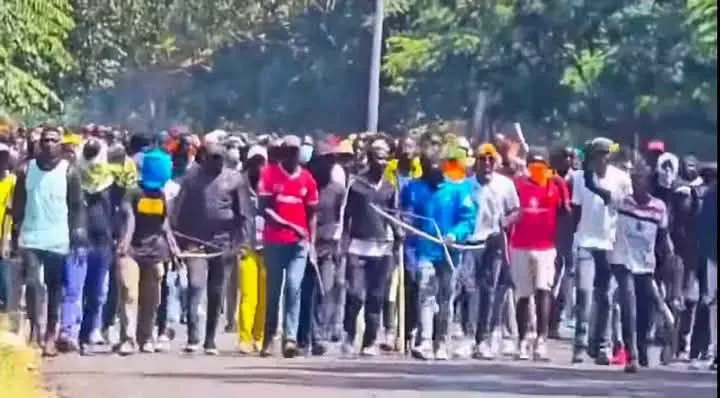
NAIROBI, Kenya, Jul 13 – The government is facing mounting pressure over what critics describe as a failure to decisively crack down on organized political violence, after armed groups disrupted political activities in Kisumu and Nyahururu over the weekend, deepening concerns that Kenya could be sliding toward a dangerous election-era culture of impunity.
The incidents, which saw young men openly carrying bows, arrows, clubs and other crude weapons, have reignited debate over the state’s ability, or willingness, to curb political goonism despite repeated assurances from security agencies that perpetrators will face the law.
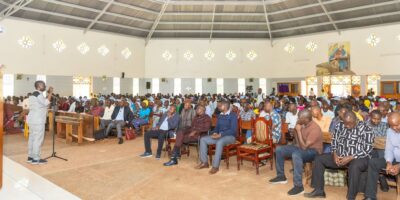
Amateur videos circulating online on Sunday showed armed youth marching through parts of Kisumu before violent confrontations erupted during a church service attended by Siaya Governor James Orengo and Nairobi Senator Edwin Sifuna.
The clashes left one person dead, several others injured, nine motorcycles torched and a police vehicle damaged, according to the National Police Service (NPS).
Witnesses said a group of armed youth attempted to force their way into the church compound before violence broke out.
Addressing journalists after the incident, Sifuna condemned the attack, saying the violence was intended to intimidate opposition leaders but had instead exposed the country’s deteriorating political climate.
“These attacks are not going to intimidate us,” Sifuna said.
He lamented what he described as the normalization of armed groups operating in broad daylight.
“Nobody looking at the pictures that have come out of Kisumu today and Nyahururu can be proud of such a country, where people are just brandishing weapons and walking and marching on the streets to go and attack a congregation in church. This is the lowest I think we have sunk,” he said.
Governor Orengo drew parallels with the insecurity that has plagued Haiti, suggesting the violence bore signs of political orchestration.
“If you want to go to Haiti, Haiti is here. The violence and the audacity with which it is being organized, perpetrated and carried out has the hand of the state in it,” Orengo said.
His remarks echoed accusations made a day earlier by former Deputy President Rigathi Gachagua, who claimed armed groups linked to the state had attacked a Democracy for Citizens Party (DCP) public address truck in Ol Kalou.
“As the Deputy Inspector General is making a litany of promises for high-level security in Ol Kalou, his Nairobi Sierra Killer Squad is wreaking havoc in Ol Kalou,” Gachagua claimed in a social media post on July 11.
“They have this afternoon attacked the DCP sound truck with guns and teargas. Goon Nation. New Haiti.”
The allegations have intensified an already heated political blame game, with both government and opposition camps accusing each other of sponsoring violent youth gangs.
Despite repeated statements by the government and the National Police Service condemning political violence, a growing number of opposition leaders and sections of the public argue that enforcement has been selective, with armed groups allegedly perceived to be aligned with the state operating with little consequence.
The perception, some leaders argue, risks eroding public confidence in security agencies at a time when political temperatures are steadily rising ahead of the next General Election.
In a statement issued Sunday, the National Police Service condemned what it termed “political intolerance, violence and goonism,” saying the incidents undermined public order, national cohesion and constitutional rights.
Police said preliminary investigations established that the Kisumu violence resulted from a confrontation between two opposing groups, leaving one person dead and several others injured.
Authorities said eight suspects had been arrested in Kisumu, while six others were arrested in Nyahururu after individuals allegedly attempted to disrupt a political rally by throwing stones.
Police also dismissed allegations that there had been a shooting incident in Nyahururu, saying investigations showed only stone-throwing that caused minor injuries.
“The National Police Service reiterates that no person, regardless of social status, political affiliation or public office is above the law,” NPS Spokesperson Muchiri Nyaga said.
“Anyone found engaging in violence, sponsoring criminal gangs, inciting supporters or disrupting lawful gatherings will be dealt with firmly and in accordance with the law.”
The Service appealed to members of the public to share information that could assist investigations, promising impartial and evidence-led inquiries aimed at bringing all perpetrators to justice.
However, the arrests have done little to calm growing political concern over the resurgence of organized gangs at public gatherings.
The latest incidents have revived memories of previous election cycles when politically sponsored militias were accused of intimidating opponents, disrupting rallies and fueling deadly clashes.
With campaigns expected to intensify in the coming months, pressure is mounting on the government to demonstrate that its condemnation of political violence will be matched by consistent enforcement, regardless of political affiliation.