NAIROBI, Kenya, Oct 15 — Africa must have a greater say in global decision-making and demand accountability from both international partners and its own governments if trust in multilateral institutions is to be restored, a senior United Nations official has said.
Ahunna Eziakonwa, the UN Under-Secretary-General and Special Adviser to the Secretary-General, said confidence in multilateralism was being eroded by unfulfilled international commitments, unequal representation in global institutions and African governments’ failure to deliver on promises to their citizens.
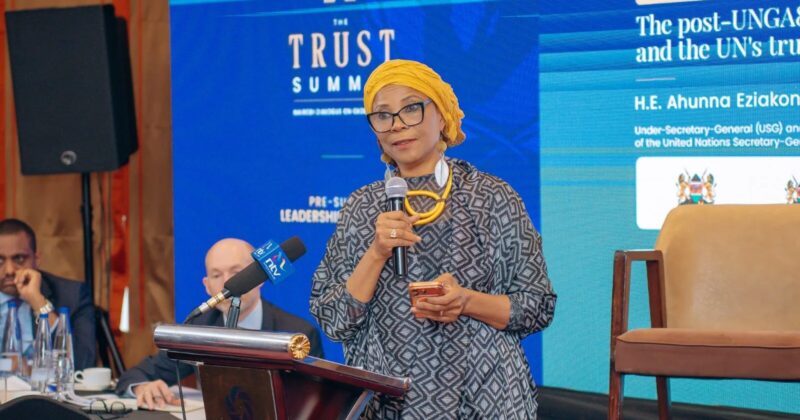
Speaking at a leadership meeting in Nairobi ahead of the Trust Summit scheduled for October 21–23, Eziakonwa urged African countries to move beyond being treated as recipients of global decisions and instead help shape the international system.
“Africa is not asking for a seat at someone else’s table anymore. Africa is a co-architect of a system that is renewed, and not only repaired,” she said on Thursday.
“The starting point for trust is to treat Africa as a shaper of our common future, and not as a recipient of global change.”
Eziakonwa said rebuilding trust would require more than declarations of intent, pointing to a widening gap between commitments made by governments and international institutions and what they ultimately deliver.
She cited promises of climate finance to countries least responsible for global warming but most exposed to its effects, as well as the long-standing commitment by wealthy nations to allocate 0.7 per cent of their national income to development assistance.
Only a handful of countries have consistently met the development assistance benchmark, she said, warning that unfulfilled commitments further undermine confidence in international cooperation.
“Every unkept promise, ladies and gentlemen, is a withdrawal from an account that was already widely owned,” she said.
Africa must also answer for its own commitments
The UN official challenged African governments to address their own record on public spending and service delivery, saying the continent’s demands for accountability from international partners would carry greater weight if its leaders honoured commitments made to their citizens.
Eziakonwa cited the 2003 Maputo Declaration, under which African leaders committed to allocating at least 10 per cent of national budgets to agriculture, and the 2014 Malabo Declaration, which renewed the commitment.
She also pointed to gaps in education financing, saying only about a quarter of African countries meet agreed investment benchmarks, while 15 countries spend more servicing debt than educating children.
Citizens, she said, judge governments by the services and opportunities they deliver rather than the promises they announce.
“Trust is not rebuilt by grand declarations. It’s rebuilt by commitment, one commitment after another, with a named owner, a timeline, and a date on which we report back,” Eziakonwa said.
She said the Nairobi Call to Action and its framework for action were designed to turn commitments into measurable obligations.
Eziakonwa urged governments to invest as much effort in fulfilling campaign promises as they do in mobilising voters during elections, arguing that trust depends on whether public institutions deliver tangible results.
Call for greater African influence
Eziakonwa said Africa’s limited influence in global decision-making was another barrier to rebuilding confidence in multilateral institutions.
The continent holds 54 of the 193 seats in the UN General Assembly but has no permanent seat on the Security Council, she noted, adding that African countries also have limited voting power in institutions that shape global financial rules.
While the African Union’s admission as a permanent member of the G20 in 2023 was an important step, she said greater representation must translate into meaningful influence.
“A system that asks for your confidence and not your voice should not be surprised when confidence is slow to come,” Eziakonwa told guests at the pre-summit breakfast meeting.
She also criticised narratives that portray Africa primarily as a continent of problems requiring external intervention, arguing that such perceptions obscure its resources, markets, young population and potential to shape global development.
Africa, she said, should approach international partnerships as an actor with agency and bargaining power rather than as a beneficiary dependent on assistance.
Reform financing, reduce dependence on aid
Eziakonwa called for changes to the international financial architecture, arguing that the cost of borrowing and the way African economies are assessed by credit rating agencies constrain the continent’s ability to finance development.
She cited figures showing that Africa’s external debt-service payments rose from USD61 billion in 2010 to USD163 billion in 2024.
Eziakonwa also referenced estimates presented in the debate over the proposed African Credit Rating Agency that put the additional cost of borrowing associated with perceived risk at about USD75 billion annually.
She said the continent needed fairer financing terms, stronger domestic resource mobilisation and greater use of its own savings and capital markets.
“A high cost of capital robs governments of the means to keep their promises on farms, schools, jobs, and power,” the UN official told the gathering.
Eziakonwa said the UN would continue advocating for international cooperation on global challenges such as pandemics and climate change, alongside reforms to financial systems that leave African countries reliant on development assistance.
“The continent wants trade, investment, and fair terms,” she said.
She added that stronger African financing capacity would not mean abandoning international partnerships, but would make the continent a more equal partner.
Trust Summit seeks commitments
Foreign Affairs Principal Secretary Korir Sing’Oei, said rebuilding trust would require established institutions to widen participation in decision-making, including by civil society and other non-state actors.
“If we are serious about rebuilding trust, states must open the door to greater engagement with society, and large institutions must make room for non-state actors,” Sing’Oei said.
Debora Nzomo, Secretary General of Kenya Model United Nations, said institutions needed to demonstrate that young people had a meaningful role in shaping decisions affecting their future.
“The future of multilateralism depends not only on whether young people believe in its institutions, but also on whether those institutions demonstrate that they believe in young people,” she said. “Trust must be mutual.”
The inaugural Trust Summit: Nairobi Dialogues on Global Trust will take place from October 21–23, bringing together political leaders, policymakers, businesses, academics, civil society groups, media and young people.
Organisers plan to produce a Nairobi Statement on Global Trust, a summit outcome report, a Trust Barometer dashboard, a joint task force to monitor implementation and an assessment of Africa’s trust landscape.
Eziakonwa urged participants to arrive with specific commitments, clear responsibility for implementation and dates for reporting progress.
She also challenged young people to remain engaged despite their frustrations with public institutions, describing hope as a choice to participate rather than simply a feeling of optimism.
“The world does not need people to be optimistic,” she said. “What the world needs is for us to be unavailable for despair.”
Whether the summit can rebuild confidence, she said, will depend on whether the commitments made are fulfilled and their implementation openly assessed.