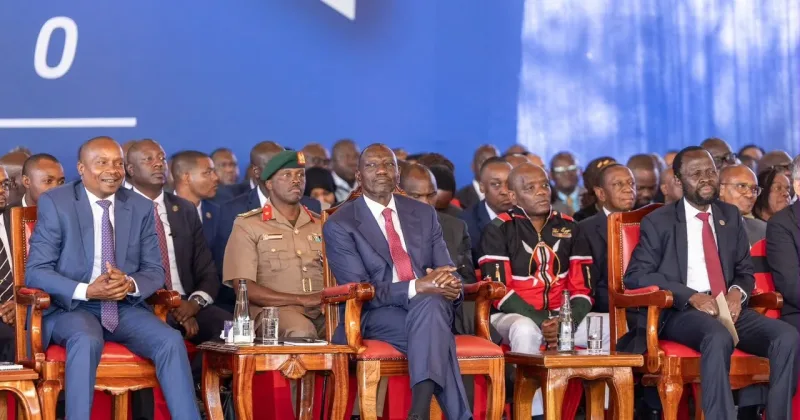
NAIROBI, Kenya, Aug 12 — President William Ruto has credited Kenya’s Vision 2030 development blueprint with providing a long-term roadmap that has helped drive progress in infrastructure, industrialisation, education, electricity connectivity and democratic governance.
Ruto said Vision 2030 had placed Kenya on a path towards becoming a middle-income economy while improving the quality of life for citizens.
The President made the remarks while highlighting the country’s development achievements under the long-term framework.
“Vision 2030 has provided Kenya with a long-term roadmap for development, setting the country on a path towards industrialisation, a middle-income economy and a higher quality of life,” Ruto said.
The President said Kenya had made notable progress under the political pillar of Vision 2030, particularly through constitutional and institutional reforms.
He cited the 2010 Constitution, which established a stronger framework for governance and expanded the protection of citizens’ rights through a comprehensive Bill of Rights.
According to Ruto, the country has also strengthened its democratic institutions as part of its political transformation.
The political pillar is one of the three key pillars of Vision 2030, alongside the economic and social pillars.
Ruto also highlighted improvements in Kenya’s road infrastructure, saying the country has made significant progress in expanding paved roads.
“Today, we have significantly done well in our region in terms of paved roads. We have 20,000 km of paved roads,” he said.
The President cited road upgrades and expansion as part of the infrastructure investments undertaken to improve connectivity and support economic activity.
He also pointed to the construction and expansion of dual carriageways as part of efforts to improve transport efficiency.
Ruto said Kenya now has a functioning Standard Gauge Railway (SGR) and an Expressway, describing both as significant infrastructure developments.
The SGR has transformed passenger and freight transport along the Nairobi-Mombasa corridor, while the Nairobi Expressway has provided an additional route for motorists travelling across the capital.
The President also noted that some major roads have been upgraded to dual carriageways, improving connectivity between key economic centres.
Ruto said Kenya has also made significant progress in expanding access to electricity.
According to the President, the number of households connected to electricity has reached about 10 million and is expected to rise to approximately 11 million.
“We’ve extended electricity. We now have 10 million households going to 11 million households connected to electricity,” he said.
Expanded electricity access is a key component of Kenya’s development agenda, with improved connectivity expected to support households, businesses, industries and public institutions.
Ruto also cited education as another area where Kenya has made significant progress.
“Our transition on education is significant. We have done fairly well,” the President said.
The government has been implementing reforms across the education sector, including the transition to the Competency-Based Curriculum (CBC) and Competency-Based Education and Training (CBET).
The reforms are intended to place greater emphasis on practical skills, competencies and preparing learners for the changing demands of the labour marketVision 2030 legacy debate
Ruto’s remarks come amid a growing national conversation on Kenya’s development trajectory beyond Vision 2030.
With the country approaching the end of the current long-term development framework, political and development leaders have been debating how Kenya should maintain continuity in planning while setting new targets beyond 2030.
The President’s assessment emphasises infrastructure, electricity, education and political reforms as key areas where the country has made progress under the Vision 2030 framework.
The next phase of Kenya’s development planning is expected to determine how these gains are consolidated while addressing remaining economic and social challenges.