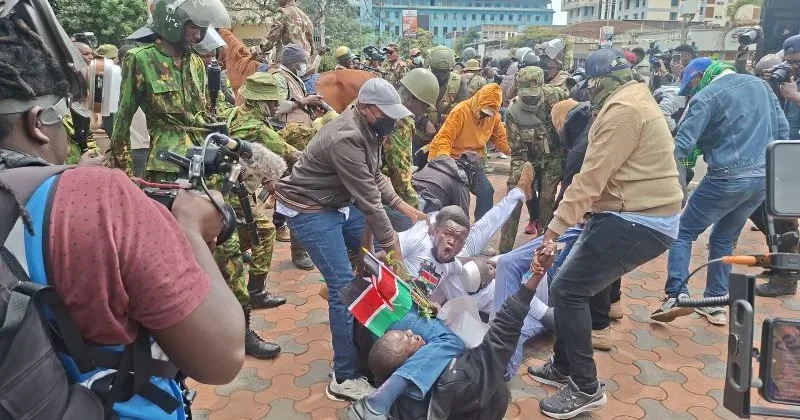
NAIROBI, Kenya, Aug 31 — Kenya’s human rights watchdog has warned that enforced disappearances remain a continuing human rights crisis, citing 46 cases it has documented in 2026 and calling on the government to establish the whereabouts of missing persons and prosecute those responsible.
The Kenya National Commission on Human Rights (KNCHR) said 35 cases of enforced disappearance were included in its National Reparations Framework and report presented to President William Ruto on June 15.
The Commission said it documented a further 11 cases during the June 25 protests involving protesters who were arrested, held incommunicado and later found to have been subjected to torture and ill-treatment.
The KNCHR made the disclosure on Monday to mark the International Day of the Victims of Enforced Disappearances, observed annually on August 30.
It called for an immediate end to abductions, secret detention and other forms of unacknowledged deprivation of liberty, warning that families of missing persons continue to suffer uncertainty over whether their relatives are alive, detained, injured or dead.
“For families of persons who have disappeared, the ordeal does not end when a loved one is taken. It becomes a daily and often unbearable search for answers,” the Commission said.
KNCHR said the government has a constitutional and international obligation to prevent enforced disappearances, promptly investigate allegations, establish the whereabouts of missing persons and hold perpetrators accountable.
The Commission also called on the Ministry of Interior and National Administration to publish accurate and verifiable information on people who have been arrested, detained, abducted or reported missing, and to establish mechanisms for tracing those unaccounted for.
It urged the Directorate of Criminal Investigations to independently investigate reported cases, preserve evidence and regularly update affected families, while calling on the Office of the Director of Public Prosecutions to prosecute suspects where sufficient evidence exists, regardless of their rank or institutional affiliation.
KNCHR also warned that compensation for victims must not replace accountability.
“Reparation cannot and must not be construed as a substitute for accountability,” the Commission said, stressing that victims must receive redress while the State pursues truth, justice and accountability.
The watchdog further called on the government to take steps towards ratifying the International Convention for the Protection of All Persons from Enforced Disappearance.
It also urged the government to comply with a court order in Petition E.488 of 2026 and ensure the 35 victims documented in its reparations report receive compensation.
The Commission said questions remain unresolved over the whereabouts and fate of some people reported missing and called for the State to publicly account for efforts to locate them.
KNCHR said enforced disappearance places victims outside the protection of the law and exposes them to heightened risks of torture and other serious violations.
“Such uncertainty is itself a form of continuing harm,” the Commission said.
It urged anyone with information about a missing, abducted or disappeared person to report through its email, SMS, WhatsApp or toll-free channels.