NAIROBI, Kenya, Oct 15 — The Motorists Association of Kenya (MAK) has demanded an independent audit of the latest fuel price review and the government-to-government (G-to-G) petroleum import arrangement, questioning the sharp increase in prices.
In a statement issued on October 14, MAK condemned the latest price adjustments, saying they would worsen the cost of living and pile pressure on motorists, transport operators and households.
“This is not a minor adjustment to an economic commodity. It is a direct assault on the productive capacity of the Kenyan economy,” the association said.
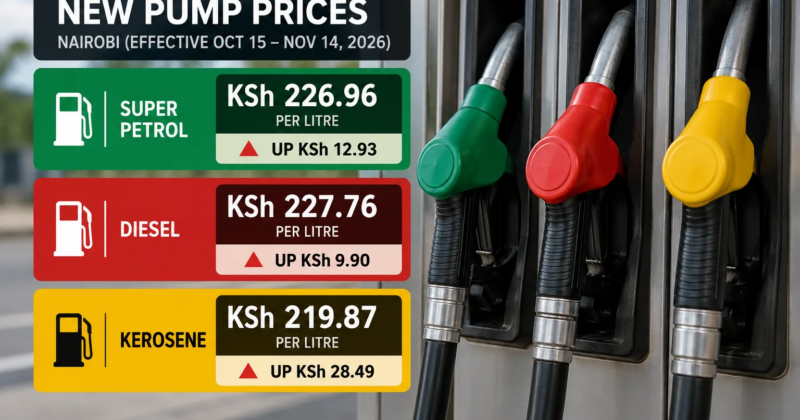
Under the new prices, effective October 15 to November 14, motorists in Nairobi will pay Sh226.96 per litre of petrol, Sh227.76 for diesel and Sh219.87 for kerosene.
The increases stand at Sh12.93 for petrol, Sh9.90 for diesel and Sh28.49 for kerosene.
MAK questions kerosene price increase
MAK questioned why kerosene recorded the steepest percentage increase at the pump despite having the lowest reported percentage increase in landed cost.
According to the association, landed costs rose by 11.81 per cent for petrol, 11.32 per cent for diesel and 9.41 per cent for kerosene. At the pump, prices increased by 6.04 per cent, 4.54 per cent and 14.89 per cent, respectively.
“How does the product recording the lowest percentage increase in landed costs suffer the highest percentage increase at the pump?” MAK asked.
The association acknowledged that the figures alone did not establish an arithmetic error, noting that pump prices also incorporate taxes, levies, margins, transport costs and possible stabilisation adjustments.
It nevertheless demanded that the Energy and Petroleum Regulatory Authority (EPRA) publish a full breakdown of the calculations behind the new prices.
MAK also challenged the reported explanation that the kerosene price adjustment was partly intended to narrow the price difference between kerosene and automotive fuels to discourage adulteration.
“This is an extraordinary admission of regulatory failure,” the association said.
It argued that authorities should strengthen surveillance, fuel quality testing and prosecution of dealers involved in adulteration rather than shift the burden to households relying on kerosene for cooking and lighting.
“Adulteration is an enforcement problem. It must not become an excuse for imposing punitive prices on the poorest citizens,” MAK said.
G-to-G deal faces scrutiny
The association also called for a comprehensive independent audit of the G-to-G petroleum import arrangement, demanding disclosure of its costs and measurable benefits compared with competitive procurement.
MAK questioned whether the arrangement had delivered the promised benefits to consumers, including improved market stability and reduced pressure on foreign exchange.
“Three years later, the ordinary motorist is entitled to ask: where are the promised benefits?” the association said.
It called for the publication of actual savings, if any, from the arrangement, alongside supplier premiums, financing costs, freight charges, foreign exchange exposure and their impact on pump prices.
“If G-to-G cannot demonstrate that Kenyans are purchasing petroleum more competitively than they otherwise would, it has no economic justification for continued protection from competition,” MAK said.
The association further urged the government to publish the Petroleum Development Levy Fund’s receipts, disbursements, stabilisation balances and product-specific allocations.
Demands transparency in fuel pricing
MAK wants EPRA to release complete product-by-product pricing worksheets showing international benchmarks, landed costs, exchange rates, freight, insurance, taxes, levies, margins and applicable adjustments.
It also called on Parliament, the Auditor-General and the Competition Authority of Kenya to scrutinise petroleum procurement and pricing arrangements.
The association argued that consumers should be able to distinguish the effects of international market movements from domestic policy decisions.
“An explanation is not scientific merely because it contains figures. It becomes scientific when its assumptions, methodology and calculations can be independently examined and reproduced,” it said.
MAK also renewed its call for a shift towards competitive, transparent and market-led petroleum procurement, while acknowledging that deregulation alone would not eliminate international price shocks or guarantee lower prices.
The association warned that the latest increases would strain transport operators working under previously agreed freight contracts, with higher fuel costs potentially feeding into fares and the prices of goods.
It said it would consult members and stakeholders on further lawful civic action, including peaceful demonstrations, if the concerns remained unanswered.
“Kenyans are not demanding free fuel. They are demanding fair prices, open competition, transparent calculations and an end to the political management of a commodity upon which the entire economy depends,” MAK said.