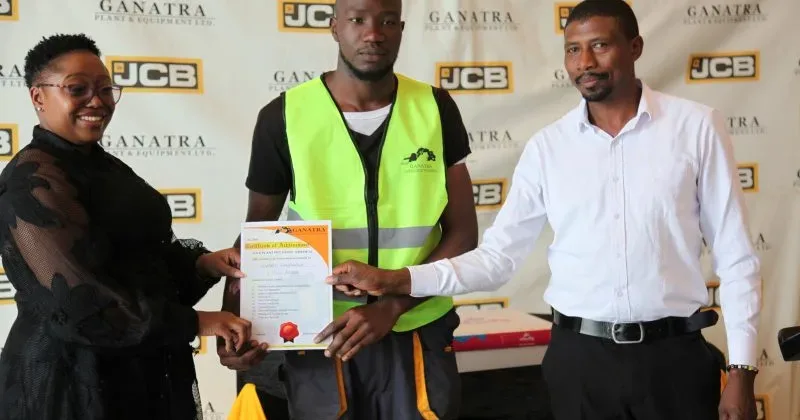
NAIROBI, Kenya, Jul 13 – Ganatra Plant and Equipment Training Institute Ltd on Monday announced a regional expansion strategy targeting 5,000 certified heavy plant operators across East Africa by 2029, as it marked ten years of operation and graduated a cohort drawn from Kenya, Uganda, the Democratic Republic of Congo and South Sudan.
GPTI has trained more than 1,500 operators, mechanics, and instructors as a regional training platform serving markets where equipment fleets are expanding faster than the accredited capacity to staff them.
At the centre of the model is a heavy plant simulator imported from Europe, the first and only installation of its kind in Africa.
The simulator supports wheeled and tracked excavators and wheel loaders, and is embedded in every operator programme rather than offered as an optional add-on.
“Every trainee’s first hours on a real machine are the most expensive and the most dangerous hours of the entire course,” said Suhhel Yakub, General Manager.
“The simulator lets a student make those mistakes in software instead of on twenty tonnes of hydraulics. They arrive at the machine past the fear, and that changes everything: for the operator, for the equipment, and for everyone else on that site,” he added.
Certified heavy plant operators remain among the most acutely under-supplied trades in Kenya’s construction labour market.
Developers report that the shortage constrains project delivery, drives up costs, and pushes contractors toward uncertified labour, with downstream consequences for safety standards, equipment life and project timelines.
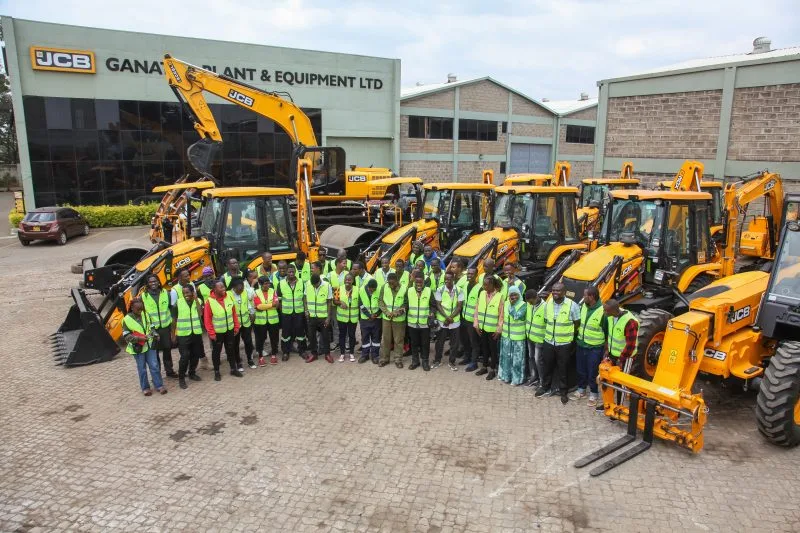
The scarcity persists because the training is capital-intensive. Unlike most technical trades, plant operation cannot be taught without a working fleet, fuel, a service workshop, and open ground for practical instruction.
Ganatra Training Institute operates as the training arm of Ganatra Plant and Equipment, the JCB dealership in Kenya, giving trainees access to machinery, workshops, and technical staff from day one.
The institute has restructured its offering into flexible modules to broaden access, allowing trainees to qualify on a single specialised machine or complete an accelerated crash course where time is constrained.
“A student who can only spare two weeks is still a student,” said Maggie Kamau, Administrator at GPTI who designed the modular structure. “We built the modules so that time stops being the thing that disqualifies you. We arrange the hours around the student.”
She said the order of instruction is fixed regardless of the route a student takes. “We do not start with the machine. We start with the classroom, then the simulator, then the workshop. By the time a student climbs into a live excavator, the expensive mistakes are already behind them.”
Mr Yakub said the curriculum deliberately extends past machine handling. “We work according to the student’s plan and hours. But there is more to this than operations. There is safety. That is why you learn the fundamentals of safety procedures, machine knowledge, and operating principles.”
Yakub also pointed to the sector’s changing composition, noting a sustained rise in the number of women entering a field historically regarded as male-dominated. “This proves that skills and dedication have no gender boundaries. Anyone with the passion, commitment, and the right training can succeed.”
The graduating class offered its own account of what the institute delivers. Shanice Amakhula, an alumna, told graduates the milestone was about outcomes rather than years. “It is about recognising the growth, the achievements, the challenges overcome, and the many lives that have been changed through the knowledge and skills gained here.”
Stephen Ndung’u, who joined in 2024 and progressed from trainee to operator and then mechanic, credited the workshop facilities, saying that not many schools offer them and that he could now call himself an engineer.
Mukasa Lawrence, a heavy mechanics student from Kampala, said the equipment made the difference: “Every concept in heavy mechanics, hydraulics, fluid mechanics, we now touch with our own hands.”
The institute offers a four-week Plant Operator Course anchored on excavator and backhoe loader, with supplementary instruction on wheel loader and compactor, with blended learning with classroom theory, simulator practice, workshop instruction, and supervised practical work, followed by placement on live construction sites; Plant Mechanics Course featuring diagnosis and repair of heavy-duty machinery and automobiles; Driving Course and Instructor Training Course for trainers.