
NAIROBI, Kenya, Jul 29 — For a growing number of Kenyans, the journey to securing capital no longer begins at a bank.
Faced with high collateral requirements, thin credit histories and rising borrowing costs, entrepreneurs, salaried workers and startups are increasingly turning to Savings and Credit Cooperative Societies (SACCOs), fintech lenders, venture capital firms and development finance institutions (DFIs) for financing tailored to their needs.
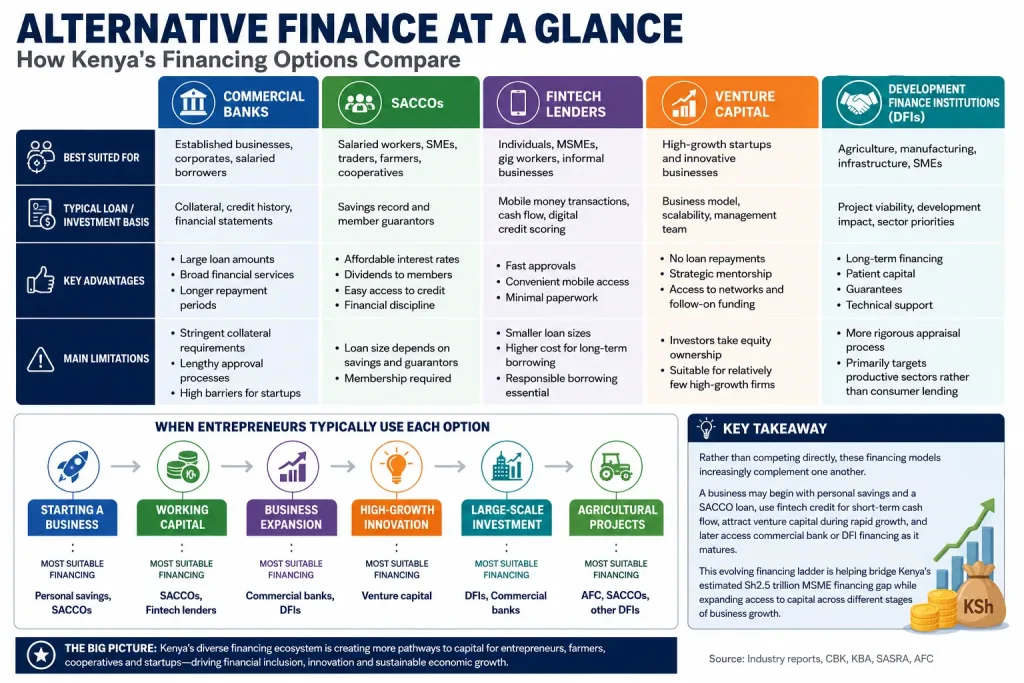
Together, these institutions are helping bridge Kenya’s estimated Sh2.5 trillion MSME financing gap, offering alternatives that prioritize savings history, cash flow, business potential and community guarantees over traditional collateral.
While commercial banks remain the backbone of Kenya’s financial system, millions of small businesses continue to struggle to access formal credit due to limited collateral, informal financial records and stringent lending requirements.
That gap has created fertile ground for alternative financiers whose products increasingly complement rather than compete with traditional banking.
SACCOs: Community Capital Driving Financial Inclusion
Among the country’s most established alternatives are SACCOs, whose member-owned model has become synonymous with affordable credit, disciplined saving and community-based financial inclusion.
Unlike commercial banks that often require land titles, vehicle logbooks or other physical collateral, SACCOs primarily rely on member savings and guarantor systems when extending loans.
For many grassroots investors, that distinction has transformed access to affordable credit.
Joyce Kigotho, an investor who joined Fanisi SACCO in 2013, says cooperative savings encourage financial discipline while opening doors to affordable loans.
“In a SACCO, it encourages saving because we mostly operate in groups. When you save through groups, those same members become your guarantors if you need a loan.”
She says members also earn annual dividends while qualifying for loans worth up to three times their savings.
“Unlike a bank where you can easily withdraw your money, a SACCO disciplines you to save. The more you save, the more opportunities you create for yourself.”
Jackson Musoya, who has belonged to Verona Huruma SACCO for five years, says the cooperative model has simplified borrowing.
“The procedures are not cumbersome like the bank. The interest rates are friendlier, and fellow members guarantee your loan instead of asking for land or other assets.”
Trader Grace Wanjiru says belonging to both Unaitas SACCO and Universal Traders SACCO has enabled her to combine borrowing capacity without surrendering title deeds or vehicle logbooks, giving her the flexibility to expand her business.
“Joining two SACCOs has allowed me to grow my business because I can access larger loans while continuing to save.”
While SACCOs rely on member savings and guarantors, technology has opened another pathway to finance through digital lending.
Fintech Lenders: Credit at the Tap of a Button
Digital lenders have emerged as another major pillar of Kenya’s alternative finance ecosystem, providing rapid credit to salaried workers, traders, gig economy workers and small businesses.
Unlike banks that often rely on lengthy financial histories and physical collateral, licensed digital lenders assess borrowers using transaction records, mobile money activity and alternative digital data.
For many entrepreneurs, that flexibility bridges a critical financing gap.
“Actually, as an SME, accessing finance is not an easy walk in the park,” says Eronja Linda, founder of Linkaya Cleaning Services.
“When you walk to the banks, they need a background which you don’t have. You have a story, but they need data and bank statements.”
Companies such as Tala, Branch, KCB M-PESA and M-KOPA Finance have pioneered alternative credit scoring models.
Tala Founder and CEO Shivani Siroya says innovation has been necessary because millions remain outside conventional banking.
“In sub-Saharan Africa, only 34 per cent of the adult population have a bank account. Organizations such as Tala have had to find new and creative ways of delivering financial services.”
According to the Central Bank of Kenya (CBK), licensed Digital Credit Providers had issued 7.5 million loans worth Sh133.5 billion by February 2026 following the licensing framework introduced in March 2022.
To strengthen consumer protection, CBK has licensed 227 Digital Credit Providers after reviewing more than 800 applications since digital lending regulation began in 2022.
For businesses seeking to scale rather than simply borrow, equity investors are becoming an increasingly important source of capital.
Venture Capital: Financing Businesses with Growth Potential
Unlike lenders, venture capital firms do not extend loans. Instead, they invest equity in promising startups in exchange for ownership stakes, enabling founders to scale businesses without immediate repayment obligations.
That model has positioned Kenya as one of Africa’s leading startup investment destinations.
According to the Africa Tech Startups Funding Report, Kenyan startups attracted approximately USD984 million in venture capital funding during 2025—a 52 per cent increase from the previous year.
Companies including M-KOPA, Sun King, d.light, Burn Manufacturing and PowerGen accounted for much of that investment, particularly within climate technology and clean energy.
The growth reflects increasing investor confidence in Kenya’s innovation ecosystem and the country’s expanding pipeline of scalable businesses.
Steve Beck, Co-founder and Managing Partner at Novastar Ventures, says East Africa’s entrepreneurial ecosystem continues to attract investors because it combines significant market opportunities with founders capable of solving real-world problems.
“What we had was more a reasonable belief that Africa’s consumers represented a neglected market opportunity that could be met by entrepreneurs with the character, capacity, and ambition to innovate business models and adapt technology to serve them.”
He says investors also prioritize businesses capable of executing disciplined growth strategies.
“We look for market potential, focused strategies—there is more than enough complexity in execution when growing a business in frontier markets.”
Kenya’s venture capital success is perhaps best illustrated by companies that have scaled through innovative financing models.
Off-grid solar energy provider Sun King combined venture capital backing with its pay-as-you-go (PAYGo) model to expand affordable clean energy without relying on conventional bank financing.
Known locally as lipa mdogo mdogo, the PAYGo model enables customers to acquire solar systems by paying a small deposit before clearing the balance through affordable installments made via M-Pesa.
Each payment activates the solar unit through embedded smart-metering technology until the customer fully owns the system.
Supported by venture capital, Sun King combined PAYGo technology, mobile money and a nationwide sales network of more than 13,000 agents to deliver off-grid solar systems to millions of households and businesses across Kenya.
Not every financing need can be met through short-term credit or equity investment. Large-scale investments often require patient, long-term capital.
Development Finance Institutions: Closing the Long-Term Investment Gap
Development Finance Institutions (DFIs) are increasingly filling another important segment of Kenya’s financing ecosystem.
Unlike commercial lenders focused on short-term returns, DFIs provide long-term financing, guarantees and risk-sharing facilities that support investment in agriculture, manufacturing, infrastructure and industrial development.
The Kenya Development Corporation (KDC) finances projects ranging between Sh10 million and Sh500 million, targeting sectors with significant economic impact.
The Agricultural Finance Corporation (AFC) complements this by tailoring agricultural lending to seasonal crop cycles, reducing financing risks faced by farmers.
International institutions are also playing an increasingly important role.
The International Finance Corporation (IFC) estimates Kenya’s MSME financing gap at roughly Sh2.2 trillion, supporting commercial banks through guarantees and blended finance structures designed to expand lending to underserved businesses.
AFC Managing Director George Kubai says the institution develops products that reflect the realities faced by farmers and agribusinesses.
“We are able to accommodate divergent needs of our various customers by making sure that we have products that address those needs.”

He says AFC’s wholesale lending model allows cooperatives, SACCOs, microfinance institutions and agricultural off-takers to channel financing to borrowers who would otherwise struggle to qualify for loans.
“These are now able to lend onwards to those other people who ordinarily would not be able to come and borrow from AFC.”
Kubai adds that government-backed credit guarantee schemes also enable AFC to lend to youth, women and other underserved borrowers who may lack conventional collateral.
Christopher Kiburu, AFC’s Chief Credit Officer, says aligning repayment schedules with production cycles is critical to sustainable lending.
“We ensure that we align our repayment with the harvest cycle, whether half-yearly or quarterly. Once they start laying eggs and selling eggs, then they are able to repay our facilities.”
One beneficiary is dairy farmer William Kirwa from Uasin Gishu County, who transformed a small zero-grazing venture into a commercial dairy enterprise after accessing financing and technical support from the Agricultural Finance Corporation (AFC).
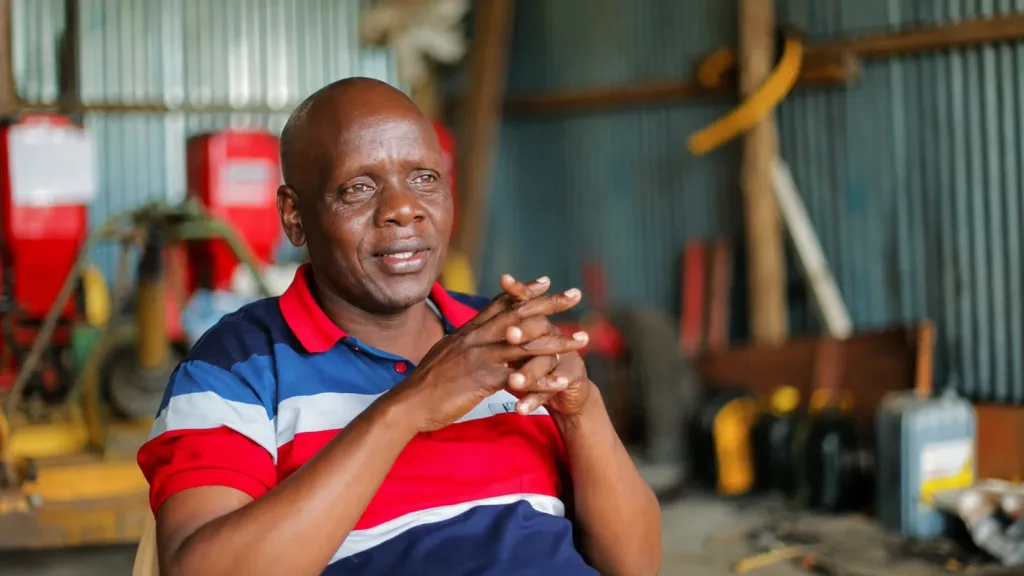
Kiburu says Kirwa’s success has made his farm a demonstration enterprise, where other dairy farmers visit to learn about modern commercial production.
Kirwa credits affordable, patient financing with enabling him to invest in modern dairy infrastructure, improved breeds and on-farm feed production—investments he says would have been difficult under conventional bank lending.
“When I started, I didn’t have the kind of collateral commercial banks usually require, but through agricultural financing I was able to build automated sheds, invest in quality breeds and formulate my own feeds,” Kirwa says.
“Access to affordable financing that matches a farmer’s production cycle makes the difference between remaining a small-scale farmer and building a sustainable commercial business.”
Why Alternative Finance Is Growing
Financial analysts say the expansion of alternative finance reflects changing borrower needs as much as technological innovation.
Gideon Gitonga, CEO and founder member of Karura Community SACCO and a financial analyst, argues that conventional lending models often fail to accommodate small businesses.
“For an entrepreneur facing an immediate cash-flow gap, quick money serves the exact need at the time.”
He says alternative financiers increasingly evaluate business activity rather than fixed assets.
“Traditional bank models demand heavy collateral and formal balance sheets, whereas alternative platforms evaluate real-time cash flow and operational execution.”
Recognizing the sector’s growing importance, the government is strengthening regulation while safeguarding consumers.
Under the Ministry of Co-operatives and MSME Development, proposed legislative reforms seek to modernize governance across the cooperative movement.
The reforms are intended to strengthen public confidence in SACCOs as they continue mobilizing household savings at record levels.
The SACCO Societies Regulatory Authority (SASRA) is spearheading the establishment of a Deposit Guarantee Fund (DGF), which will insure member deposits against institutional failures.
Responding to public concerns earlier this month, MSMEs Development Principal Secretary Patrick Kilemi reaffirmed that SACCO deposits remain private property and will not be used to finance government infrastructure projects.
According to SASRA’s Quarterly Statistical and Soundness Report released on June 6, Kenya’s deposit-taking SACCOs manage assets exceeding Sh1.21 trillion, supported by Sh870 billion in member deposits.
More than 91 percent of deposit accounts hold balances below Sh100,000, meaning the proposed Deposit Guarantee Fund would fully protect the overwhelming majority of members.
Financing Kenya’s Next Phase of Growth
Kenya’s financial landscape is steadily evolving beyond a one-size-fits-all model.
Commercial banks remain indispensable for large-scale corporate lending, but they no longer occupy the financing space alone.
SACCOs are mobilizing community savings, fintech firms are extending digital credit, venture capital investors are backing innovation, and development finance institutions are financing long-term productive investment.
As businesses move through different stages of growth, many are drawing on several of these financing models rather than relying on a single institution.
“A startup may begin with personal savings, graduate to a SACCO, use fintech for working capital, attract venture capital during expansion and later qualify for commercial bank financing,” Gitonga observes.
That increasingly interconnected financing ecosystem may prove essential if Kenya is to close its Sh2.5 trillion MSME financing gapand unlock the next generation of enterprise growth.