NAIROBI, Kenya, Aug 11 — The United Nations has warned that children and young people are increasingly exposed to online harms as artificial intelligence and digital platforms evolve faster than the laws designed to protect them.
In a new issue brief launched ahead of International Youth Day on August 12, the UN Department of Global Communications called for urgent action to place children’s rights, safety and participation at the centre of emerging artificial intelligence governance.
The brief, Strengthening Information Integrity: Issue Brief 3, applies the UN Global Principles for Information Integrity to children’s rights and youth engagement, urging governments, technology companies, advertisers, media organisations and researchers to act collectively.
The UN said more than 82 percent of young people aged 15 to 24 are online globally, exposing them to risks ranging from synthetic and misleading content to AI-facilitated exploitation.
It warned that these dangers cannot simply be attributed to individual choices or inadequate parental supervision, arguing that they are also linked to digital business models that monetize attention and personal data.
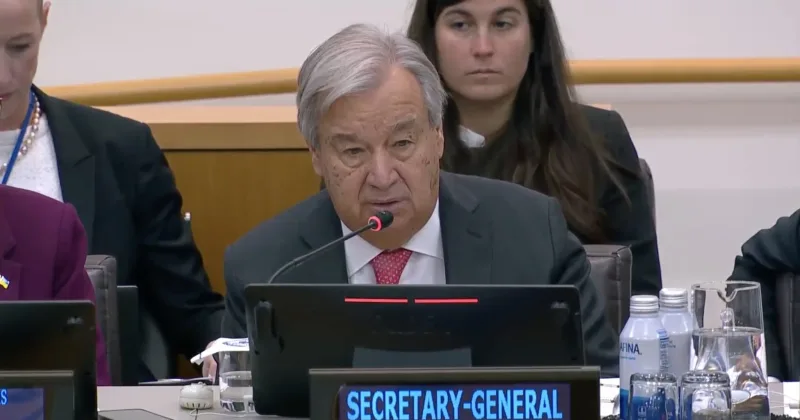
“No child should be a guinea pig for unregulated AI … When a child is harmed, the answer must never be ‘the algorithm did it,’” UN Secretary-General António Guterres told delegates in Geneva last month during the opening of the inaugural Global Dialogue on Artificial Intelligence Governance.
Guterres has called for an AI Child Safety Pledge covering every AI system accessible to children, as governments and UN entities work through the Coalition for Children’s Rights and Protection in the Age of Artificial Intelligence.
The UN said AI is advancing faster than regulatory frameworks that were largely designed before the technology became widely deployed, creating new and compounding risks for children and young people.
“The moment to write children’s rights into AI governance is while those laws are being developed – a window that will not stay open for long,” the brief said.
Beyond protection, the UN is also calling for greater participation by children and youth in decisions governing the information spaces they increasingly inhabit.
Although young people are among the most active users and creators of digital content, their perspectives remain underrepresented in policy forums and research that shape technology regulation.
The UN brief therefore calls for a dual approach that combines protection with participation, recognizing children and young people not only as potential victims of digital harms but also as creators, advocates and organizers.
It assigns responsibilities across the digital ecosystem.
Governments are urged to establish clear, rights-respecting regulations while empowering children, parents, guardians and educators to navigate digital environments safely.
Technology companies and AI developers are being urged to put child safety and rights at the centre of product design and business models.
Advertisers, the UN said, can also drive change by demanding stronger safeguards in digital advertising, while news organisations should invest in journalism that responds to children and youth as both audiences and content creators.
Researchers and civil society organisations have been urged to provide independent evidence, oversight and advocacy, particularly in areas where the impact of emerging technologies on young people remains poorly understood.
The UN also stressed that children and young people themselves must be recognized as active participants in shaping information environments.
The latest brief is the third in a series applying the UN Global Principles for Information Integrity, launched by Guterres in June 2024 as a framework for coordinated action by governments, technology companies, media, civil society and other stakeholders.