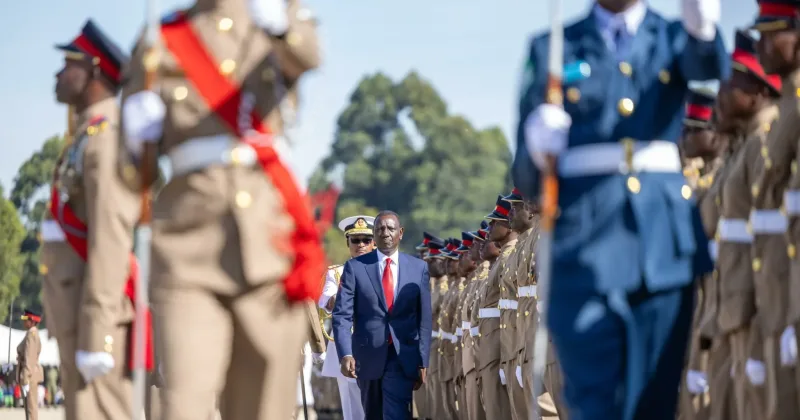
NAIROBI, Kenya, Aug 27 -President William Ruto is moving to give police a new look, but the planned change of uniform has raised a more uncomfortable question: why has the government been so quick to change what officers wear while dragging its feet on reforms meant to change how the police service operates?
Ruto is expected to unveil the new Kenya Police Service uniform at the passing-out parade for recruits at the National Police Training College in Kiganjo on Friday, with General Duty officers scheduled to begin wearing it from August 31.
Inspector-General of Police Douglas Kanja has defended the change as part of efforts to improve the morale of officers and align their clothing with recommendations arising from a 2023 public participation exercise.
But the timing has invited scrutiny.The President’s planned appearance at Kiganjo comes days after former Chief Justice David Maraga’s seven-day deadline for the release of a long-awaited police reforms report expired without the document being made public.
Maraga, who chaired the National Taskforce on Police Reforms, handed the report to President Ruto on November 16, 2023. On August 18, 2026, he demanded that the President publish the complete and unedited report within seven days, threatening to release it himself if the government failed to do so.
The contrast is striking: while a new uniform can be designed, procured and rolled out, the recommendations of a taskforce established specifically to examine the deeper problems afflicting Kenya’s security services remain the subject of a public standoff between the former Chief Justice and the President.
A new uniform, old problem
The Maraga taskforce was not established to discuss appearances. It was mandated to examine legal, policy, administrative, institutional and operational challenges affecting the National Police Service, Kenya Prisons Service and National Youth Service.
Its findings identified underfunding, corruption, leadership problems, weaknesses in human-resource management and structural challenges among the problems undermining the services.
The taskforce’s concerns were not merely about officers’ welfare. Its recommendations were aimed at improving accountability, strengthening institutions and addressing longstanding problems in the way the police service operates.
Maraga has now gone further, accusing the government of failing to implement recommendations necessary to restore the constitutional independence of the National Police Service and address systemic police brutality and impunity.
He cited what he described as organised political violence, goonism and partisan policing in several parts of the country as evidence of a worsening policing environment.
Third change in eight years
The latest switch will not be the first major redesign of the police uniform in recent years.
In 2018, President Uhuru Kenyatta unveiled the Persian-blue uniform as part of a broader police reform programme. The government said the new outfit was intended, among other things, to make officers more visible and improve their relationship with the public.
The 2018 reforms came at a time when the government was also changing police command structures, training and other aspects of the service.
The new Ruto-era uniform will now replace the deep navy-blue outfit that followed that reform programme.
Police officials say the current change is based on a 2023 exercise in which officers expressed dissatisfaction with the navy-blue attire and preferred another design. The new outfit is essentially a return to an earlier style, with General Duty officers expected to wear it progressively from next week.
General Duty police have gone through significant uniform changes in a relatively short period, raising questions about the durability and cost-effectiveness of repeatedly redesigning a national security service’s basic attire.
There is a legitimate operational argument for changing a police uniform. An effective uniform should be functional, durable, appropriate for the climate, easily identifiable, and suitable for the work officers perform.
Kanja says the new design is intended to meet operational needs and boost morale. More than 6,000 recruits graduating from Kiganjo are expected to be among the first officers to wear it.
There is also evidence that some officers have struggled to obtain adequate uniforms.
A 2026 report documented cases of officers buying uniforms from private tailors, while some junior officers were reportedly wearing faded and worn-out attire
The harder question is whether an entirely new national rollout is the most urgent police reform Kenya needs.
The procurement question
Uniforms are also public procurement. That matters in Kenya because previous police uniform changes have generated controversy over how contracts were awarded and who benefited.
When the Persian-blue uniforms were introduced in 2018, the National Youth Service was involved in their production, with the then Inspector-General Joseph Boinnet saying the arrangement helped reduce the cost of producing the required 60,000 uniforms.
The process was nevertheless politically contentious.
In December 2018, reports emerged of a dispute involving then Deputy President Ruto and Interior Cabinet Secretary Fred Matiang’i over the tender for the new police uniforms.
Repeated replacement of uniforms inevitably creates another procurement cycle, and taxpayers are entitled to know how much the latest exercise will cost and why the previous uniform is being phased out after only a few years.
The National Police Service has already been undertaking procurement related to officers’ clothing and equipment. For example, a 2024 NPS tender covered the supply and delivery of footwear to the Kenya Police Service, Administration Police Service and General Service Unit under a two-year framework agreement.
Maraga taskforce
Ruto’s administration has not ignored every recommendation associated with the Maraga taskforce.
The National Police Service Commission says it has made progress in implementing some recommendations, including salary reviews, promotions and proposed amendments to the NPSC Act.
Ruto’s government has also announced a wider police modernisation programme estimated at Sh28 billion over two years, covering equipment, digitisation, vehicles, ammunition and housing.
But the continued withholding of the complete Maraga report leaves a significant accountability gap.
The public cannot properly assess which recommendations have been accepted, rejected or implemented if the full document remains unavailable.
That is precisely why Maraga’s intervention has given the uniform unveiling an awkward political backdrop.
The former Chief Justice says the report was prepared using public resources and invokes Article 35 of the Constitution on access to information in demanding its publication.
That is the test facing Ruto as he unveils the new uniform: whether it will become another symbol of reform, or another highly visible change that leaves the deeper problems of Kenya’s police service untouched.