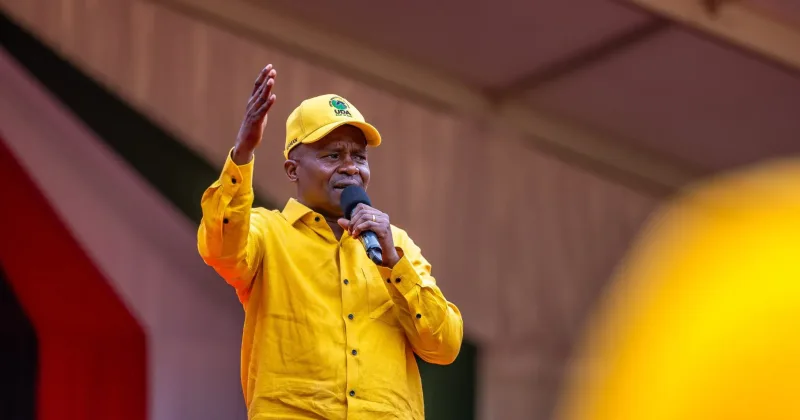
Sep 13 – Deputy President Kithure Kindiki has asked Kenyans to assess President William Ruto’s administration based on its development record and reject what he described as a “vengeful narrative” being pushed by the President’s opponents ahead of next year’s State House race.
Kindiki, while outlining the Kenya Kwanza administration’s performance over the last four years, said Ruto had exceeded the expectations of his critics in designing and implementing transformative development projects and programmes aimed at growing the grassroots economy and empowering millions of Kenyans to rise from poverty.
The Deputy President hit out at government critics, accusing them of inciting anger and hatred against the President instead of offering alternative policies and development programmes.
“When you ask them to table alternative policies and development programmes, they tell you Kasongo must go. When you ask them what plans they have to help millions of young people across the country looking for jobs, they say soprano and other useless things. How can such people be trusted with the leadership of our country? How can such clueless people be an alternative for President Ruto, who has a solid plan that envisages Kenya beyond 2030? Let us be fair to President Ruto,” Kindiki said.
According to Kindiki, opponents of the Ruto administration had given the government six months to collapse under the weight of public debt and economic pressure, but innovative policies and interventions had saved the economy from total shutdown.
“The United Democratic Alliance (UDA) made specific manifesto commitments in the 2022 elections on improving the economy, agriculture, health, education, roads, housing, sports and creating more opportunities for the youth. Stabilisation of the economy is on course, with the Kenyan shilling firmly exchanging at 129 to the dollar for three years now, compared to 165 in 2022. We are on course and there is no turning back,” Kindiki said.
Comparing the prices of basic food items and agricultural inputs from 2022 to date, Kindiki said the government’s decision to subsidise production rather than consumption had yielded the desired results.
“Fertiliser cost Sh7,000 a bag in 2022; today it is Sh2,000. Certified seed prices have been slashed by 50 per cent, while the price of sexed semen for artificial insemination has reduced from Sh8,000 to Sh1,400 a dose. Coffee prices have nearly tripled from Sh50 to Sh140 per kilogramme, while milk prices have risen from Sh35 to Sh52 per litre,” he said.
Kindiki said the changes had translated into increased production of food and cash crops as well as livestock products, resulting in higher incomes for farmers and lower prices for basic food items.
On education, Kindiki said the government had made progress in reforming the funding of higher education and tertiary institutions through a student-centred model aimed at developing a skilled workforce for local and international markets.
“The education budget has risen from Sh500 billion in 2022 to Sh784 billion this year. A record 100,000 teachers have been employed, 23,000 classrooms and 1,600 laboratories built, while policy reforms in tertiary institutions have resulted in enrolment rising from 297,000 students in 2022 to 718,000 currently,” he said.
“No Kenyan child should miss an opportunity to study and acquire skills that will help them play a role in building our nation,” the Deputy President added.
On healthcare, Kindiki criticised opposition leaders who have vowed to scrap the Social Health Authority (SHA), which replaced the defunct National Health Insurance Fund (NHIF).
“I hear them say they will scrap SHA if they get to power. They are criticising the health sector reforms for the sake of it. They are not telling us why a system that has 32 million people on board is bad and why NHIF, which had only eight million Kenyans enlisted, is better,” Kindiki said.
“Politicising health is dangerous. It is irresponsible, uncaring and unpatriotic,” he added.