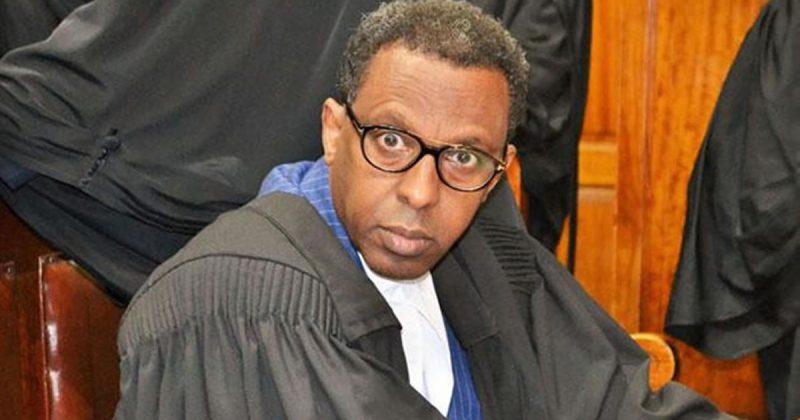
NAIROBI, Kenya, July 20 – Senior Counsel Ahmednasir Abdullahi has reignited debate over Kenya’s justice system by claiming High Court and Court of Appeal judges spend an average of just 54 days a year in court.
His remarks come barely two weeks after the Judiciary announced it had reduced its case backlog by 27 per cent and two days before lawyers stage a nationwide boycott over delays and alleged inefficiencies.
Ahmednasir, in a commentary on Monday, argued that judicial recesses, annual leave, official travel and other commitments significantly limit the number of days judges spend hearing cases.
“The average judge of the High Court and the Court of Appeal sit in court a mere 54 days a year,” he wrote.
He questioned the impact of increasing the number of judges without expanding court sitting days.
“With judges working just 54 days a year, do you now understand the second biggest challenge facing the courts after JurisPESA?” the Senior Counsel wrote, using a term he has coined to refer to alleged judicial corruption.
Ahmednasir also claimed Supreme Court judges sit between 25 and 28 days annually, while the Chief Justice sits in court for fewer than 15 days each year.
His remarks stand in sharp contrast to the Judiciary’s latest performance report released on July 3, in which Chief Justice Martha Koome announced that the institution had achieved a 104 per cent case clearance rate during the 2024/25 financial year, meaning it resolved more cases than were filed while reducing the national case backlog by 27 per cent.
Speaking during the launch of the Judiciary’s Performance Management and Measurement Understanding (PMMU) Evaluation Report, Koome said the results reflected the impact of ongoing reforms aimed at improving the administration of justice.
“In practical terms, the Judiciary resolved more cases than it received during the reporting period,” she said, adding that the reduction in backlog had translated into improved access to justice for Kenyans.
Koome also announced that beginning this month, the Judiciary would publish individual performance reports for judges and judicial officers as part of broader reforms to strengthen transparency, accountability and public confidence in the administration of justice.
Despite the gains, the report acknowledged growing pressure on the courts, noting that rising caseloads across superior and specialised courts had strained judicial and administrative capacity, affecting case clearance rates, timely delivery of judgments and compliance with case disposition timelines.
It also cited shortages of judges and operational constraints as persistent challenges.
The renewed scrutiny comes as the Law Society of Kenya (LSK) prepares to boycott court proceedings nationwide on Wednesday, July 22, in protest over what it describes as persistent failures in the administration of justice.
LSK President Charles Kanjama said advocates will refrain from participating in court hearings and applications, citing delays in the hearing and determination of cases, late delivery of rulings, inefficiencies in court registries, concerns over judicial accountability and the deteriorating working environment for advocates.
The boycott will not affect the filing of new cases, while mentions and applications involving interim orders will proceed solely to obtain fresh hearing dates or extend existing orders where necessary.
“In light of these concerns, the Council has resolved to undertake a nationwide boycott of court proceedings on Wednesday, July 22, 2026. The boycott is intended to underscore the seriousness of the issues raised by members and to call for meaningful institutional interventions that will restore confidence in the administration of justice,” Kanjama said.
The Judiciary has, however, rejected the planned boycott, insisting that all courts will remain open and continue hearing matters as scheduled on Wednesday.
In a statement issued on Monday, Judiciary Spokesperson Paul Ndemo said the institution did not consider a boycott an appropriate or proportionate response to the concerns raised, warning that such action would primarily prejudice litigants and other court users awaiting the hearing and determination of their cases.
While acknowledging that delays and adjournments remain legitimate concerns, the Judiciary argued that responsibility for case delays extends beyond the courts.
It cited its latest performance data showing that the leading causes of adjournments during the 2024/25 financial year were the absence or unpreparedness of witnesses, parties and advocates, alongside courts being engaged in other official duties.
The Judiciary also defended its recent performance, saying it had resolved 647,686 cases against 621,425 new filings during the financial year, achieving a 104 per cent case clearance rate despite rising caseloads.
It urged the Law Society to pursue its concerns through ongoing institutional dialogue, pointing to a consultative meeting bringing together the Judicial Service Commission, the LSK Council and representatives of the Senior Counsel Bar scheduled for July 31.
The institution further reaffirmed its commitment to judicial independence, cautioning that attempts to direct judges or judicial officers on how to hear or determine cases undermine constitutional guarantees and the rule of law.
Former LSK President Nelson Havi has meanwhile intensified pressure on the Judiciary, revealing that he had written to the Society’s leadership urging it to publish what he termed a “list of shame” identifying judges and magistrates whose courts should be boycotted.
“I confirm that I have written to the President of the LSK and Members of the Council and asked them to publish the list of shame for Judges and Magistrates whose illegal Courts should be boycotted. We look forward to the publication of the list today,” Havi said on Monday.
In a subsequent post, Havi released what he described as a preliminary list naming Chief Justice Martha Koome, Supreme Court Judge Isaac Lenaola, Employment and Labour Relations Court Judge Hellen Wasilwa, High Court Judge Dorah Chepkwony and Magistrate Josephine Mongare, while indicating more names would follow.
Havi did not provide evidence to support the allegations or explain why the judicial officers had been listed.
Although the Judiciary’s overall institutional performance score declined to 88.12 per cent from 95.29 per cent in the previous financial year, Koome said the lower rating should be viewed as an opportunity for continuous improvement rather than a setback, citing growing demand for judicial services and mounting operational pressures.
While critics argue that delays, accountability concerns and alleged judicial misconduct continue to undermine public confidence, the Judiciary maintains that its reforms are delivering measurable improvements in case resolution and has urged stakeholders to pursue dialogue rather than actions it says could ultimately deny litigants access to justice.