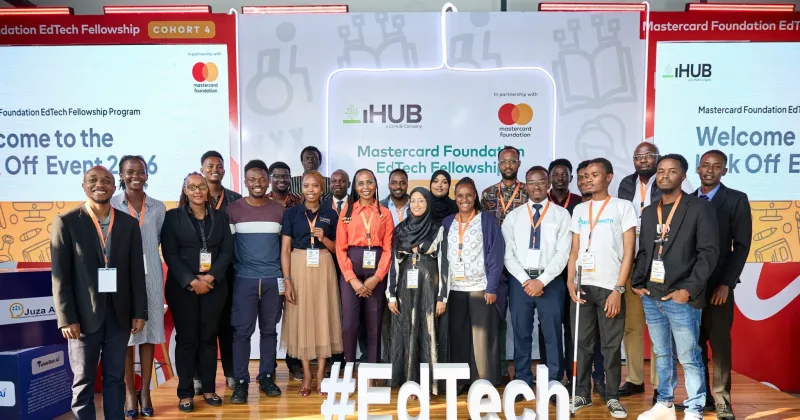
NAIROBI, Kenya, Jul 25 – Twelve early-stage Kenyan education technology (EdTech) startups will each receive up to USD 100,000 (Sh13 million) in equity-free funding under the fourth cohort of the Mastercard Foundation EdTech Fellowship, as efforts intensify to help young innovators scale inclusive learning solutions.
iHUB, which is implementing the Fellowship in partnership with the Mastercard Foundation, said the programme is designed to address the persistent funding, technical capacity and market access gaps that continue to constrain the growth of early-stage EdTech startups, preventing many promising innovations from scaling beyond the pilot stage.
The selected startups were drawn from four thematic areas that address barriers to equitable education for learners living with disabilities, refugees, displaced and underserved communities, and girls and young women.
Unlike previous cohorts that focused on growth-stage companies over an eight-month acceleration period, the latest cohort targets early-stage ventures through an 18-month programme aimed at helping founders build sustainable businesses.
Beyond funding, the startups will receive tailored technical assistance in product development, business strategy, communications and evidence generation through a dedicated pilot framework.
They will also gain access to iHUB’s network of ecosystem partners, media readiness support and stakeholder engagement opportunities to help refine, validate and scale their solutions through strategic partnerships and investment.
Since its launch in Kenya in 2023, the Mastercard Foundation EdTech Fellowship has supported 36 EdTech companies, which have collectively reached more than 700,000 learners, empowered over 11,000 educators, partnered with more than 2,100 schools nationwide and expanded access to learning for more than 6,000 learners with hearing and visual disabilities.
Wariko Waita, Director of the Centre for Innovative Teaching and Learning (CITL) at the Mastercard Foundation, said the Fellowship seeks to ensure educational technology creates opportunities for learners who have traditionally been excluded from technology-enabled education.
“At its best, EdTech does not just digitize education; it redistributes opportunity.”
“The Fellowship sits at the intersection of three powerful forces education system transformation, inclusive technology-enabled solutions and sustainability of Africa’s EdTech entrepreneurship.”
Among the selected startups is DeafHealth, which is developing digital solutions to bridge communication barriers between deaf patients and healthcare workers through online learning and community outreach.
Co-founders Mohamed Jamal and Nafisa Akil, said while access to financing remains one of the biggest hurdles facing startups, technical guidance is equally critical for long-term growth.
“Funding is a big part of why startups fail.”
“This program combines both the technical expertise and guidance that is needed to do it right, and also the funding backing to actually help you do it.”
They agreed that the fellowship provides founders with the structure, mentorship and resources required to transform promising ideas into scalable businesses capable of delivering lasting social impact.
Another startup, AssistiveMath, is developing affordable digital tools to make mathematics more accessible for learners who are blind.
Founder Ron Pile said the high cost of assistive devices continues to limit access to quality education for visually impaired learners.
“It is very expensive for blind students to access calculators.”
“Some cost up to Sh80,000, while drawing machines are also costly and cumbersome to carry from one classroom to another.”
The fourth cohort also includes startups developing multilingual, offline and AI-enabled learning platforms for refugee, displaced and underserved communities, as well as ventures equipping girls and young women with entrepreneurial, vocational and digital skills to strengthen pathways from education to employment.
As demand for inclusive education continues to grow, the Fellowship aims to bridge financing and ecosystem gaps that have historically constrained early-stage EdTech companies, enabling them to attract investment, forge strategic partnerships and expand access to quality learning for underserved communities across Kenya.