NAIROBI, Kenya, Feb 26 – Before 1994, one could have easily been convinced that parliamentary sessions in South Africa were an unlikely contest of whose suit was the darkest or whose hat had the widest brim.
But then came Mr. Mandela. He’d illustriously jaunt through the sacred National halls wearing what became renown, the world & over, as the Madiba shirt – a daring combination of yellow and black or white and red; sometimes of all the above. Full length. Untucked. And never snug.
Increasingly so, there are now a number of outlets specializing in these eponymous Madiba shirts, even though, the original was conceived & designed by Sonwabile Ndamase, the former president’s personal designer.
In essence, power has always had a form. An identifier of sorts.
When President William Ruto touched down in Beijing for his maiden trip to China on October 14th 2023, he was wearing Silk. When Mr. Mandela took to the stage at the United Nations General Assembly on 23rd October 1995, he was wearing silk. When Former President Uhuru Kenyatta met Prince William, The Duke of Cambridge, on 30th September 2018, he was wearing Silk.
So what effect does silk seem to have, especially for pinnacle figures? And why is it a go-to favorite, especially for platform occasions?
These scenarios, among myriad others, are by no means unique exceptions. These figures understand the esoteric game of power, and the role dress plays in expressing it in its unsullied form. From Sir. Winston Churchill’s “Siren Suit” to Kim-Jong Un’s dynastic Mao-Style attire, clothing has long served as a shorthand for authority.
In modern Kenya, however, a subtler language is emerging; one spoken not in medals or excesses, but in the silent undertones of refined textures, intentional cuts and above all, peerless fits.
Silk, once the preserve of emperors, has quietly glissaded into the public foreground, not as spectacle, but as statement. Understood & interpreted only by a discerning circle.
Classified among the most expensive fabrics on earth, to wear silk is to exercise appreciation on a totally uncustomary scale. Sea-silk (also Byssus or The “Diamond of Clothing”), exists as the rarest fabric on earth, fetching an astonishing $1,340 (Ksh. 174, 200) per gram. That costs more than its equivalent weight in Gold. Furthermore, Silk varieties occupy four of the top ten slots in the world’s most expensive fabrics, maintaining a lead in the exclusive club of “Fabric Heavy-Weights”. And in Kenya, an elite scion is silently relishing in this discovery.
Unlike cotton or wool, silk does not impose. It moves. It responds. It’s fluid. It embraces light differently, with acknowledgement and finesse. Depending on posture and poise, it meets you differently at every glance. To wear silk well is to understand restraint, because it emanates ease, confidence, and control—qualities that cannot be borrowed.
Silk’s association with power dates back centuries, when its rarity underpinned China’s dominance across what later became known as the Great Silk Road, a commercial corridor stretching more than 6,000 kilometers between Asia and the Western world.
That legacy of exclusivity endures. The fabric remains costly owing to its labor-intensive production process and restricted supply. Producing a single kilogram involves thousands of silkworms, carefully raised in monitored conditions whilst painstakingly fed mulberry leaves multiple times a day. Yields from Silk farms are dismal at best, justifying the notion that silk has never truly been for the ordinary.
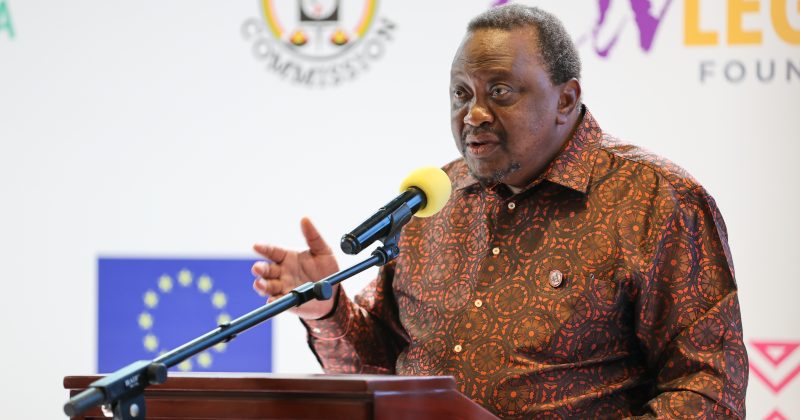
In recent years, Kenya’s top brass has progressively leaned into this visual language, using dress to underpin might rather than rely on brazen excesses. Former President Uhuru Kenyatta was notably emphatic about vibrant patterned shirts, emerging as a national style lexicon, pairing authority with cultural ease.
President William Ruto, who seems to have refined this particular aesthetic, has since recently been championing the silk philosophy. Seemingly intentional, his recent embarkation on the silk route as a go-to staple, especially in interactive settings, seems to have balanced out his renown fondness for the Kaunda, which he single-handedly iconized.
Analysts have it that this is part of his greater ability to match energy correctly, not just political energy but rather personal energy. His choice of shirts is slowly becoming eponymous with the man, especially during NYOTA Business Support disbursements, occasional church services and a myriad other public engagements, where presentation plays a deeper role than that which meets the eye.
His particular pick of Short-sleeved options rather than the commonly-perceived long-sleeved style, also doesn’t seem accidental. This is equally noticeable in his go-to picks for his signature Kaunda style.
This aesthetic is seemingly proving influential, with senior leaders, aides, and ministers – including Deputy President Kithure Kindiki – increasingly adopting similar silhouettes and textiles. This becomes less about vanity and more about alignment: a visual expression of discipline, self-awareness, and uncompromising command.
The renewed prominence of Classic African forms, particularly with the Kaunda suit and expressive Silk Shirts, marks a shift away from westernized/borrowed forms. Instead, they hint at intentional self-expression. When cut correctly, such garments do more than clothe the body—they frame the man. They announce presence and authority before a word is spoken.
In a previous interview about the significance of wielding power through statement dressing, Brian Kisimba, an expert couturier & MD at Barone, explained the concept of “Style as Power”, where the garment, especially in silk, is used as a “Personalized Instrument of Influence”.
Additionally, Niccolò Ricci, son and CEO of the infamous Italian Style Icon Stefano Ricci, in his Patrick-Bet-Davis interview, underscored that “Life is made of details”, while alluding to the Italian house’s hyper-focus on craft and detail as cornerstones of their brand’s success.
History reminds us that poor dressing can erode authority. Ill-fitting garments, careless styling, or visual inconsistencies have often turned opportune moments of leadership into devastating distractions, allowing optics to dilute substance and weaken public confidence.
In a noisy world, clarity remains the ultimate luxury. To dress well is not to chase fashion; it is to exercise agency.
And in silk – fluid, demanding yet uncompromising – power finds a most befitting metaphor.