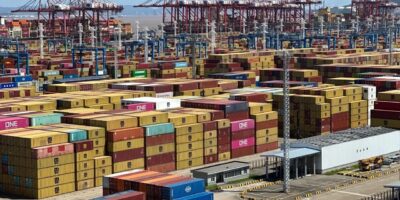
NAIROBI, Kenya, Aug 28 – A section of traders in Nairobi on Friday shut their businesses and took to the streets in protest over a revised Kenya Revenue Authority (KRA) customs benchmark that has raised the minimum yield for consolidated cargo from Sh2.5 million to Sh3.2 million.
Videos circulating online showed closed shops along major commercial streets including Moi Avenue, Kenyatta Avenue and Tom Mboya Street, while some traders demonstrated against the new benchmark.
The protests come after traders in Kamukunji, Gikomba and Nyamakima markets vowed to close their businesses nationwide in opposition to the 28 percent increase, which adds Sh700,000 to the previous benchmark.
Small-scale importers, many of whom consolidate shipments from China with other traders to share freight and clearance costs, argue that the higher benchmark will increase their operating costs and further squeeze already thin margins.
Earlier, a Kamukunji trader who has operated in the market for 15 years said the previous arrangement was already putting pressure on businesses.
“I have been a trader at Kamkunji for 15 years and we have been doing business well. This year we were told that to ship a container from China we will be paying Sh3.2 million,” he said.
Another trader said the additional amount could leave businesses with little room to make profits.
“If they add the Sh700,000 there is no profit we will make. We are asking the relevant government agencies to look into the matter,” the trader said.
KRA, however, has clarified that the Sh3.2 million figure is not a fixed tax or flat charge payable on every consolidated container.
The authority said the minimum yield is a risk-management benchmark used under a simplified customs clearance arrangement, while the actual tax liability is determined by the nature, value and classification of goods.
“It is important to emphasize that the minimum yield is not a representation of the actual tax liability for the goods contained in a container.”
“Rather, it is a risk-management reference used under the simplified clearance arrangement.”
KRA said the benchmark was reviewed following changes in exchange rates, freight costs and national and East African Community tax laws. It also cited concerns over undervaluation, under-declaration and misclassification of imports.
The revised benchmark took effect on August 21, following a grace period granted to traders.
The dispute now centres on how the benchmark will affect small importers who rely on consolidated cargo, with traders demanding government intervention while KRA maintains that taxes should continue to be based on the actual goods imported and their customs value.