NAIROBI, Kenya,Aug 8- The reported appearance of Pakistani-made armoured vehicles in Sudan’s capital Khartoum has raised fresh concerns over the growing involvement of foreign defence industries in Africa’s conflicts, with analysts and rights groups warning that new weapons supplies could further complicate Sudan’s devastating war.
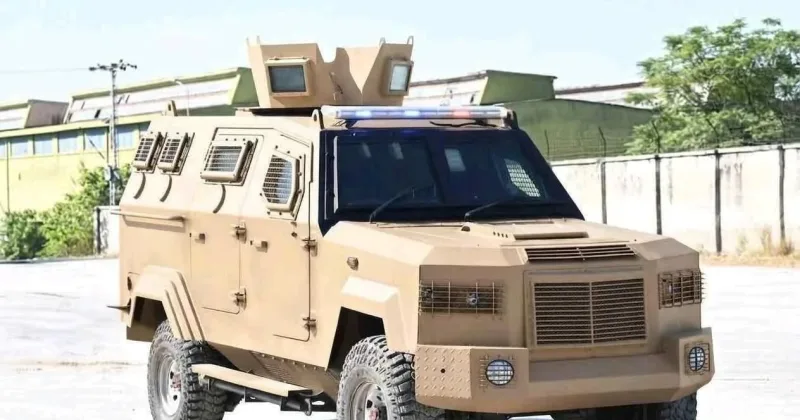
The first reported sighting of Pakistani Mohafiz-V armoured vehicles in Khartoum has placed a spotlight on an alleged defence arrangement between Islamabad and the Sudanese Armed Forces (SAF), reportedly worth about $1.5 billion.
The claims were reported by Indian media outlet News18 on August 6, citing Indian intelligence sources.
The report said the vehicles were seen during a military parade in Khartoum, providing what it described as the first visual evidence of Pakistani military equipment reaching the Sudanese army.
The reported development comes as Sudan remains engulfed in a brutal conflict between the SAF, led by General Abdel Fattah al-Burhan, and the paramilitary Rapid Support Forces (RSF), with the fighting triggering mass displacement and a severe humanitarian crisis.
Pakistan-Sudan defence ties under scrutiny
According to News18, the reported Pakistani package extends beyond armoured vehicles and could include Shahpar-2 armed drones, Yaya-3 loitering munitions, K-8 Karakorum training and light-attack aircraft and air-defence systems.
The report described the arrangement as one of Pakistan’s most ambitious efforts to expand its defence exports through its state-owned military-industrial complex.
However, the reported agreement has faced financing challenges and delays, with News18 citing reports that Saudi Arabia had reconsidered the extent of its financial backing.
Sudanese army chief Burhan has reportedly made diplomatic efforts, including visits to Riyadh, aimed at securing financing and keeping the proposed military supplies moving.
The reported developments highlight how Sudan’s war has increasingly become entangled with wider regional and international interests, as competing actors seek influence in a country located at the crossroads of the Horn of Africa, North Africa, the Middle East and the Red Sea.
Why the weapons matter for Africa
The reported deployment of Pakistani military equipment comes at a particularly sensitive moment for Sudan.
The country’s conflict has produced one of the world’s largest displacement crises, while fighting has devastated communities, disrupted food supplies and severely damaged health and other essential services.
The introduction of additional drones, armoured vehicles and air-defence systems could therefore have consequences beyond the battlefield.
There are also concerns over the possibility of weapons and military technologies being diverted in the chaos of war.
News18, citing Indian intelligence sources, warned that the transfer of advanced surveillance equipment, loitering munitions and armoured vehicles to an active conflict zone could create risks of diversion or technology leakage, including the possibility of equipment reaching armed groups or proxy networks.
Such concerns are particularly significant in a region where conflicts and armed groups frequently operate across porous borders.
The reported Pakistani involvement in Sudan is also being viewed through a wider Indian strategic lens.
According to News18, Indian intelligence officials are concerned that Pakistani military equipment, including systems incorporating Chinese technology, could give Islamabad a greater strategic presence along the Red Sea and closer to important maritime routes linking the Indian Ocean with the Middle East and Europe.
The concern extends beyond Sudan’s battlefield.
The Red Sea is a critical international trade corridor, connecting the Mediterranean through the Suez Canal with the Indian Ocean.
Instability along the route has already raised shipping and security concerns, particularly amid conflicts and attacks elsewhere in the region.
Indian officials reportedly fear that the operational deployment of Pakistani drones and other systems in Sudan could provide Islamabad with valuable battlefield experience that could later inform the development and improvement of its military platforms.
Baloch groups raise another concern
The reported deal has also triggered opposition from Baloch groups in Pakistan.
News18 quoted the Baloch People’s Congress (BPC) and allied organisations as expressing concern over the supply of additional weapons to the Sudanese military while Sudan remains in the grip of war.
The groups argue that increasing the flow of arms into Sudan could worsen the humanitarian situation and intensify violence against civilians.
They have also connected the reported deal to Pakistan’s internal security operations, alleging that revenues generated from defence exports could ultimately strengthen Pakistan’s military capacity.
The Baloch groups specifically raised fears that proceeds from a deal estimated at around $1.5 billion could contribute to Pakistan’s security operations in Balochistan and other regions.
Those claims, however, remain allegations attributed to the Baloch organisations and have not been independently verified.
For Sudan and the wider African region, the most immediate concern is less about the rivalry between Pakistan and India and more about the growing internationalisation of African conflicts.
Sudan’s war has already attracted competing interests from regional and global powers, with weapons, financing and political support becoming central to the conflict’s wider dynamics.
The reported Pakistani equipment adds another layer to that increasingly complex picture.
If confirmed, the deployment would demonstrate how defence exporters outside Africa can become directly connected to conflicts on the continent, while countries caught in war become testing grounds for increasingly sophisticated military technologies.
It could also reinforce concerns among African policymakers and humanitarian organisations that continued external military assistance risks prolonging conflicts rather than creating conditions for negotiations.
At the same time, the allegations surrounding the reported Pakistani-Sudanese arrangement remain subject to verification.
There has been no official confirmation from Islamabad or Khartoum of the reported $1.5 billion package or its full contents.