Two of the latest buzzwords in Kenya — Singapore and Vision 2060 — have quickly become political shorthand. Kenyans from all walks of life are accustomed to catchphrases and buzzwords, except that such phrases have often tended to polarise rather than unite.
Today, the Wantam brigade is shouting that Vision 2060 is yet another political campaign buzzword taking us nowhere, while the Tutam brigade is trying to articulate both the journey to Singapore and Vision 2060 as a common citizen agenda, divorced from the political rhetoric that polarises rather than helps Kenyans exercise their minds.
Many Kenyans probably know Singapore, or at least know about Singapore, and can identify with the idea of a country deliberately undertaking a journey from one level of development to another. But knowing Singapore is not the same as understanding what it means to embark on a journey towards Singapore. That is where the current conversation appears to be falling short.
The critical question, therefore, is not whether Kenya is going to Singapore, whether through Canaan or otherwise. The question is: what does Singapore mean to Kenyans? What does the phrase evoke in the ordinary Kenyan? Does it inspire hope, aspiration and possibility, or is it seen as yet another political slogan leading nowhere?
That interrogation of what Singapore and Vision 2060 mean matters because political language can lose its power when it is repeated without being translated into everyday realities. A vision must make sense to the citizen who wakes up worried about school fees, food prices, rent, employment, healthcare and the prospects of his or her children. It needs to answer a basic question: What does this destination mean for me?
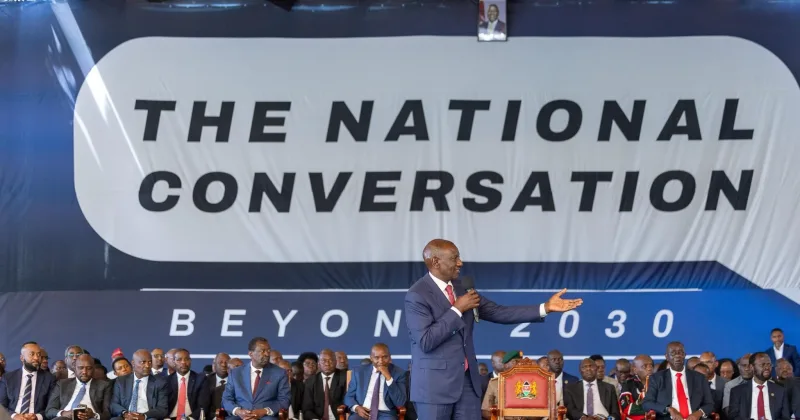
And this is where Vision 2060 requires a national conversation that goes beyond the political class.
As Vision 2030 approaches its end, perhaps thought leaders across different professions need to weigh in and save Kenyans from the bastardisation by politicians of what should be a noble national endeavour. We need to take stock of how far we have travelled towards the goals of Vision 2030 while, at the same time, defining a new vision for the country.
This is not peculiar to governments. Organisations, families and individuals set goals and establish frameworks for achieving them. There is no way to take a journey to a destination you have not clearly defined. Defining the destination gives everyone an opportunity to understand where they are going, what needs to be done, who needs to do it and when progress should be measured. Otherwise, it is like winking at a girl in the dark.
One of the most indignifying realities in Kenya today is the biting poverty experienced by millions of Kenyans who cannot afford decent meals, decent housing or a secure livelihood. Many Kenyans simply do not have enough money in their pockets. With Kenya’s income per person vastly below that of countries such as Singapore, the development gap is not an abstract economic statistic. It is lived every day in households across the country.
That macroeconomic reality — Kenya’s average GDP per capita of about KSh305,000 per person per year, compared with Singapore’s KSh12.75 million — is precisely why Vision 2060 ought to be unpacked in a way that allows ordinary Kenyans to understand its rationale and, more importantly, see themselves in it.
Simply put, if the destination is a significantly higher standard of living and substantially higher income per person by 2060, then the President’s role is fairly straightforward: articulate the destination, define the national ambition and set the journey in motion.
But a president cannot deliver that destination alone. This is where Vision 2060 can become much more than a presidential slogan. It can become the national performance framework against which every sector, government agency and economic actor defines its contribution.
If the President’s ultimate Key Performance Indicator (KPI) is to move Kenya towards a high-income economy by 2060, then every ministry, department, county government and major economic sector should be able to answer a simple question: What are we going to do to get Kenya there?
And this should be translated into language that tells Kenyans that the journey to Singapore and Vision 2060 ultimately means more money in their pockets, better opportunities and a dignified life free from debilitating poverty.
The ministry responsible for agriculture, for example, should have measurable targets for increasing agricultural productivity, reducing post-harvest losses, expanding value addition and raising farmers’ incomes.
Manufacturing should have clear targets for export growth, productivity, local value chains and job creation. The technology sector should have targets around innovation, digital exports, artificial intelligence, digital infrastructure and high-value employment.
The education sector should be asking whether the skills it produces correspond with the economy Kenya needs in 2030, 2040 and 2050. Our lawmakers should be busy exercising their minds on the legislative framework needed to underpin Vision 2060.
Business regulation should be assessed against whether it makes it easier or harder to invest, innovate and create jobs. Infrastructure should not simply be measured by the kilometres of roads constructed, but by how those roads reduce the cost of moving goods, connect producers to markets and unlock previously marginalised regions.
A national vision only becomes meaningful when it cascades downwards. If Kenya wants to become a high-income economy, each county should be able to identify its comparative advantage and define its contribution.
One county may become a food-production hub; another a manufacturing centre; another a technology or services hub; another a logistics gateway. The question should not simply be what the national government will do for counties, but what each county can contribute to the national destination.
This is what makes a long-term vision useful. It creates alignment. And it is only prudent that all and sundry — opposition or ruling, Broad-Based Government, Tutam or Wantam — engage in constructive dialogue on how we, as Kenyans, can contribute to lifting our people out of poverty.
President Ruto’s Vision 2060 therefore becomes the top-level national KPI. Government ministries derive sectoral KPIs from it. Counties derive their development priorities from the national ambition while responding to their unique circumstances. Private-sector actors identify investment opportunities. Universities align research and skills development. Civil society interrogates progress and holds institutions accountable.
And citizens begin to understand how different interventions fit into a larger national project, what role each institution and sector plays, and how to use their power to hold those responsible for delivery accountable.
That is how a vision becomes a journey.