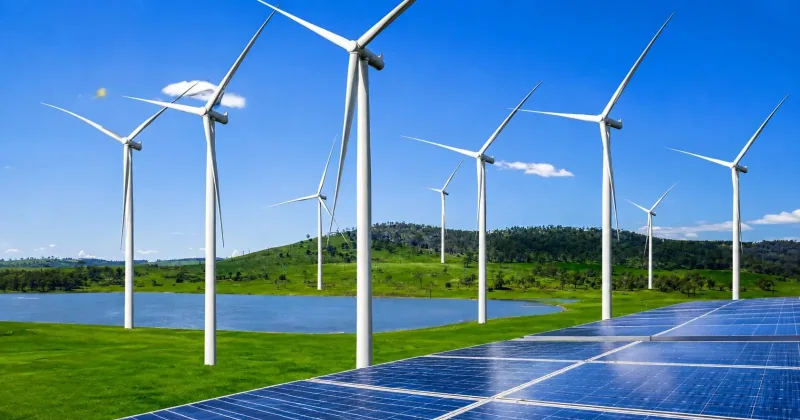
China’s newly unveiled Renewable Energy Development Plan for the 15th Five-Year Plan (2026–2030) is arguably the most consequential clean energy blueprint in the world today. Jointly issued by the National Development and Reform Commission and the National Energy Administration, the plan commits China to increasing renewable energy consumption to around 1.8 billion tonnes of standard coal equivalent by 2030, expanding installed renewable power capacity to 3.5 billion kilowatts (kW), and raising combined wind and solar capacity to more than 2.8 billion kW. It also prioritises large-scale energy storage, modern electricity grids and offshore wind development to ensure renewable power can reliably meet growing demand.
These targets matter because China is already the world’s largest producer and consumer of renewable energy technologies. According to the International Energy Agency (IEA), China is expected to account for nearly 60 percent of global renewable electricity capacity additions through the end of this decade. No other country is deploying clean energy on a comparable scale.
Decisions made in Beijing therefore extend far beyond China’s borders. They will shape not only the country’s pathway towards carbon neutrality by 2060, but also the affordability, availability and pace of the global energy transition. At a time when climate action, energy security and economic competitiveness have become inseparable, China’s latest five-year plan is poised to influence global clean-energy markets for years to come.
The scale of China’s progress over the past decade has been extraordinary. Renewable energy has evolved from a costly alternative to conventional power into one of the world’s most competitive energy sources. China now leads global manufacturing of solar panels, wind turbines and battery technologies. By 2024, it had installed more than 1,400 gigawatts of combined wind and solar capacity, surpassing earlier national targets well ahead of schedule. According to the International Renewable Energy Agency (IRENA), global renewable power capacity has more than doubled since 2015, with China contributing the largest share of new installations.
Perhaps China’s greatest global contribution has been its ability to reduce the cost of clean-energy technologies. Mass manufacturing and economies of scale have driven down prices for solar panels, batteries and wind equipment, making renewable energy increasingly accessible worldwide. IRENA estimates that the cost of utility-scale solar photovoltaic electricity has fallen by more than 80 percent over the past decade, transforming solar power into the cheapest source of new electricity in many countries.
These cost reductions have opened new opportunities for developing economies to expand electricity access without following the carbon-intensive industrialisation path taken by many advanced nations.
The implications are particularly significant for Africa, where energy poverty remains one of the continent’s greatest development challenges. The World Bank estimates that around 600 million people in sub-Saharan Africa still lack access to electricity. Affordable solar systems, battery storage and modern grid technologies offer an opportunity to close that gap while stimulating industrialisation, job creation and improved living standards.
China’s continued expansion of renewable energy manufacturing therefore carries implications not only for global climate ambitions but also for economic development across emerging markets.
Importantly, China’s latest plan recognises that renewable energy is only as effective as the infrastructure that supports it. Expanding solar and wind generation must be matched by investments in ultra-high-voltage transmission networks, smart grids, large-scale battery storage and other technologies capable of integrating intermittent renewable power into national electricity systems.
By prioritising this supporting infrastructure alongside generation capacity, China is building a more flexible, reliable and resilient electricity system capable of sustaining economic growth while reducing dependence on fossil fuels.
The plan also places renewed emphasis on sustainability itself. As renewable energy deployment accelerates, China has an opportunity to demonstrate that economic growth, technological innovation and environmental stewardship can reinforce rather than undermine one another. Continued investment in cleaner manufacturing, responsible mineral sourcing, biodiversity conservation and community engagement will strengthen the long-term credibility of the clean-energy transition.
China’s renewable energy strategy should therefore be viewed not merely as a national development programme, but as a milestone with global economic and environmental significance. Its investments are accelerating technological innovation, reducing clean-energy costs and demonstrating that renewable power can become a foundation for long-term economic growth. At the same time, maximising these benefits will require sustained international cooperation, resilient supply chains and continued investment in modern energy infrastructure across both developed and developing economies.
The world urgently needs faster progress towards climate goals while strengthening energy security and expanding access to affordable electricity. China’s latest renewable energy plan represents one of the most significant contributions to that global effort. Its success will ultimately be measured not simply by the number of solar panels installed or wind turbines erected, but by whether it delivers cleaner air, stronger energy security and broader economic opportunity.
If the momentum continues, the benefits will extend far beyond China’s borders. Renewable energy is no longer merely an environmental imperative; it has become one of the defining pillars of twenty-first-century economic development. China’s latest plan reinforces that reality and may well accelerate the global transition towards a cleaner, more secure and more prosperous energy future.