If the opposition is serious about unseating President William Ruto, it cannot afford to be at its wits’ end, displaying the kind of disunity and disorganisation now on show. The momentum may be waning, and the same old story that characterised opposition disunity in 1992 and 1997 appears to be playing out once again.
When politicians begin talking about bullying, intimidation and threats by fellow principals, at a time when their unity should be the first—not the ultimate—step towards unseating President Ruto, questions inevitably arise about whether some are already positioning themselves to leave the opposition or simply staking their claim in the political pecking order.
That struggle may actually be useful at this stage. Better for these tensions to emerge now, while there is still time to confront them, than to explode when a presidential ticket needs to be settled.
Bringing several parties under one tent and persuading them to rally behind a single candidate is a painstaking political struggle. Once a party leader emerges as the coalition’s presidential candidate, his lieutenants gain more than a place in the pecking order. They gain leverage in the corridors of power and an advantage in the scramble for elective positions.
That is why getting into the tent becomes a bruising jostle involving not just principals, but their lieutenants and political allies, each negotiating for position, influence and the promise of power.
And there are always a few looking beyond the tent. They are calculating where they would stand in President Ruto’s team and whether bolting could put them higher in the pecking order—or provide a financial soft landing.
This jostling, coupled with the enduring power of incumbency, is perhaps the biggest vulnerability in opposition coalition-building. Some players already see themselves at the bottom of the hierarchy. Their incentive may therefore be not to strengthen the opposition tent, but to rock it.
If the right opportunity comes along, they could trade their opposition credentials for a place in the broad-based government, injecting fresh energy into an otherwise lethargic coalition.
In Kenyan politics, coalitions are rarely held together by ideology. They are held together by the arithmetic of power—and by what each player believes their place in that arithmetic will be when the music stops.
Just look at Speaker Moses Wetang’ula and Prime Cabinet Secretary Musalia Mudavadi, whose departure from Azimio ahead of the 2022 election tilted the political arithmetic in President Ruto’s favour. There are undoubtedly opposition luminaries who will be calculating whether the same strategy could work for them in 2027.
Riggy G appears to be flaunting a mammoth support base, which he uses to intimidate other principals rather than inspire confidence among Kenyans rooting for opposition unity.
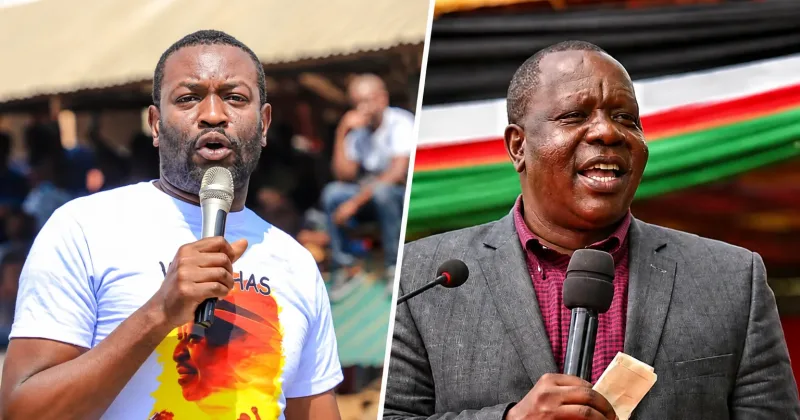
When party leaders in Mt Kenya publicly condemn his perceived overbearing posture, and Linda Mwananchi luminary Anthony Kibagendi calls him out from Migori County, it suggests deeper tensions are simmering beneath the surface.
This is the time to nip those tensions in the bud. Sometimes, moments such as Kibagendi’s bold intervention can prove pivotal in the wider political realignment.
The larger political blocs may still believe Kenya is operating within the familiar arithmetic of ethnic balkanisation. But smaller blocs, such as the Abagusii and Kurias in Migori, may simply be looking for a candidate they believe can represent their interests while appealing to a broader national constituency.
Perhaps in Fred Matiang’i they see a candidate who appeals to Kenyans on the basis of performance rather than the narrower politics of belonging.
Ground sentiments also suggest that any ticket featuring Senator Edwin Sifuna, in whichever configuration, could be a clincher. Yet while most opposition principals say they will support a single candidate against President Ruto, Kenyans have not missed the caveat repeatedly attached to those declarations: that the process must be fair and acceptable.
That is a red flag worth examining closely.
There are also strong sentiments about what a ticket featuring Riggy G would mean. Some believe it would weaken rather than strengthen the opposition’s chances, while others fear his influence could extend beyond the formal structures of a coalition. His rhetoric sometimes appears to suggest that, even if the opposition wins with his support, he would remain a powerful force behind the scenes.
That prospect does not appear to sit comfortably with many voters.
So, what would work for the opposition?
People often look for solutions to problems from the areas they understand best. As a researcher, I tend to look for empirical evidence.
Last week, a picture of a Kalonzo Musyoka-Sifuna ticket, with Kalonzo as President and Sifuna as Deputy President, was doing the rounds. I decided to subject the idea to my own semi-scientific test.
While Kalonzo remains a significant figure in opposition politics, many younger voters—particularly Gen Zs and millennials—appear uncomfortable with the prospect of a legacy politician overshadowing what they perceive as the new political energy represented by Sifuna.
Sentiments around Matiang’i were more accommodating. Interestingly, although his name and picture did not appear on the poster, several respondents in my informal poll suggested that Kalonzo should be replaced by Matiang’i.
But ultimately, is it for Kenyans to decide who the opposition flag bearers will be?
Maybe. Maybe not.
The more important question is whether the principals can emerge from the tent with a combination capable of winning—and, more importantly, whether they can remain united once they have done so.
Because opposition unity is not an end in itself. It is a means to electoral victory.
And if the opposition cannot resolve its internal arithmetic before facing the arithmetic of the ballot, President Ruto may not need to defeat it. It may defeat itself.