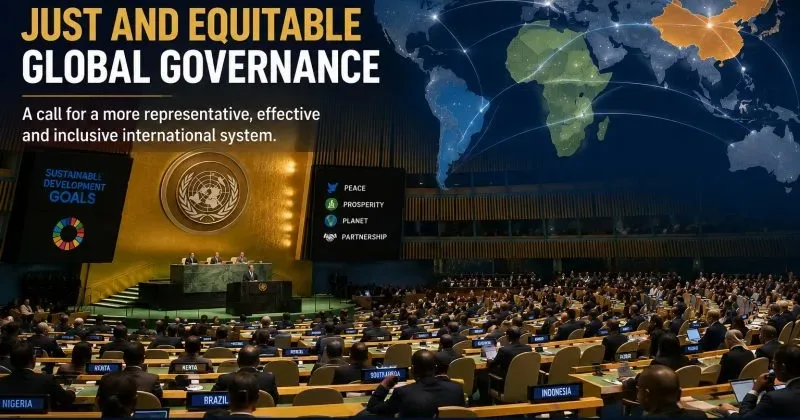
The publication of China’s white paper, More Just and Equitable Global Governance: China’s Principles, Proposals and Actions, comes at a pivotal moment in international affairs. The world is grappling with geopolitical tensions, economic uncertainty, climate challenges, and widening inequalities between developed and developing nations. Against this backdrop, the document contributes to an increasingly important global conversation: how can international governance be made more representative, more effective, and more responsive to the needs of all countries rather than a privileged few?
For much of the post-World War II period, global institutions have played a significant role in maintaining stability and promoting economic development. However, the international landscape has changed dramatically. Emerging economies now account for a growing share of global output, trade, investment, and innovation. Countries across Africa, Asia, Latin America, and the Middle East are no longer passive participants in global affairs; they are active contributors to economic growth and international development. Yet many of these nations continue to feel underrepresented in institutions where major global decisions are made.
This is where China’s call for a more just and equitable system of global governance resonates with many countries in the Global South. The argument is not simply about redistributing power. It is about ensuring that international institutions reflect contemporary realities rather than historical arrangements established in a vastly different era. As the world becomes increasingly multipolar, governance structures must evolve accordingly.
One of the most significant themes highlighted in the white paper is the importance of multilateralism. In an interconnected world, no country can effectively address global challenges on its own. Climate change, food insecurity, pandemics, financial instability, and technological disruption all transcend national borders. Effective solutions require cooperation, dialogue, and collective action. Multilateralism remains the most practical framework for managing these challenges, but it must be genuinely inclusive if it is to retain legitimacy and effectiveness.
For developing countries, multilateralism is not merely a diplomatic ideal. It is a necessity. International cooperation provides access to development financing, technological innovation, trade opportunities, and climate support. When developing nations are excluded from decision-making processes, the resulting policies often fail to address their unique circumstances and priorities. A stronger and more representative multilateral system would help ensure that global solutions are shaped by a broader range of perspectives.
The white paper also raises important questions about economic governance and international trade. Open markets have contributed significantly to global prosperity over the past several decades. However, many developing economies continue to struggle with unequal access to markets, technology, and capital. While free trade remains essential for economic growth, there is a growing recognition that trade must also support industrialization, value addition, and sustainable development.
Countries across the Global South increasingly seek economic partnerships that create jobs, build infrastructure, transfer technology, and strengthen domestic industries. They want participation in global trade to contribute to long-term economic transformation rather than reinforcing patterns of dependency. A more balanced international economic system would benefit not only developing countries but also the global economy as a whole by creating new markets and expanding opportunities for shared prosperity.
Another important dimension of the discussion is South-South cooperation. Over recent decades, cooperation among developing countries has become an increasingly powerful driver of growth and development. Through partnerships in infrastructure, renewable energy, agriculture, healthcare, education, and digital technology, countries of the Global South are demonstrating that development knowledge and innovation can emerge from multiple sources.
China has played a prominent role in advancing many of these partnerships, particularly through investment, infrastructure development, and economic cooperation initiatives across Africa, Asia, and Latin America. While opinions may differ regarding specific projects and approaches, there is little doubt that South-South cooperation has expanded the range of development options available to many countries.
The issue of climate change further underscores the need for more equitable governance. Developing countries often bear the greatest consequences of environmental degradation despite contributing the least to historical emissions. A fair global climate framework should therefore ensure adequate financing, technology transfer, and support for adaptation efforts. Without meaningful participation from developing nations, climate governance risks becoming disconnected from the realities faced by billions of people.
Ultimately, the significance of China’s white paper extends beyond any single country’s perspective. It reflects a broader demand for reforms that make international institutions more representative, more democratic, and more responsive to the needs of a changing world. Whether one agrees with every proposal or not, the central message deserves attention: global challenges require global solutions, and global solutions must involve all stakeholders.
As power and influence become more widely distributed, the future of international governance will depend on inclusivity rather than exclusivity. A world characterized by genuine multilateralism, fair trade, South-South cooperation, and shared development opportunities is not merely an aspiration of the Global South. It is increasingly becoming a practical requirement for global stability, peace, and sustainable progress in the twenty-first century.
The writer is a Journalist and Communication Consultant