NAIROBI, Kenya, July 3 – As preparations gather momentum for Saturday’s 4th Kaptagat Cycling Challenge, the Kenya Forest Service (KFS) has hailed the event as a powerful example of how sport can advance forest conservation, community development and economic empowerment.
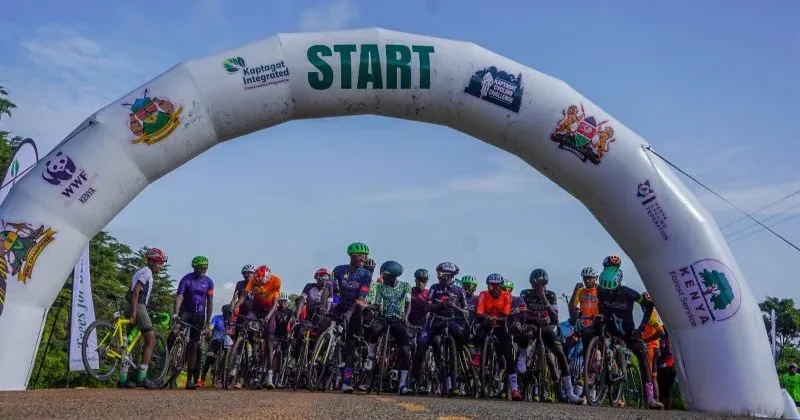
The 80-kilometre race will flag off and finish at Kaptagat Farm Resort, bringing together elite, para-cycling, junior, veteran and team riders from across Kenya and neighbouring countries.
Winners will take home KSh200,000, but organisers say the event’s greatest prize lies in its contribution to restoring the Kaptagat Forest ecosystem, one of Kenya’s most important water towers.
Chief Conservator of Forests Alex Lemarkoko said the annual challenge has evolved into much more than a sporting competition.
“The Kaptagat Cycling Challenge is much more than a sporting event. It is a win for nature, for people and the sports economy. Cyclists compete for attractive prize money while their registration fees directly support the restoration of Kaptagat Forest. They also leave behind a lasting legacy by planting trees, making every ride an investment in Kenya’s 15 Billion Trees Campaign,” he said.
The race forms part of the Kaptagat Integrated Conservation Programme (Kaptagat-ICP), a community-led initiative that has spent the last decade restoring the Kaptagat Forest ecosystem while improving livelihoods for communities living around the forest.
Lemarkoko said the programme has become a national benchmark for conservation by addressing the root causes of forest degradation through community participation.
“Beyond the race, the challenge showcases the Kaptagat Forest restoration model, which has become a national benchmark for community-led conservation. We realised that lasting conservation is only possible when the people living around the forest benefit from protecting it. By working with the community to understand the drivers of forest degradation, we developed sustainable livelihood programmes, including dairy farming, biogas systems and nature-based enterprises, that reduce pressure on the forest while improving household incomes,” he said.
He added that the initiative demonstrates that environmental protection and economic development can advance together.
“The result is a model where everyone wins. Cyclists experience one of Kenya’s premier high-altitude cycling routes, communities earn sustainable livelihoods from conservation, and the forest continues to recover. That is the future of conservation, where protecting nature and creating economic opportunity go hand in hand,” Lemarkoko added.
The Kaptagat Forest ecosystem, part of the Cherangani Hills Water Tower, covers more than 120,000 hectares of protected forest and is surrounded by a 240,000-hectare buffer zone that supports biodiversity, water security and climate resilience.
As the conservation programme marks its 10th anniversary, Kaptagat-ICP Patron and National Treasury Principal Secretary Dr. Chris Kiptoo said this year’s event also signals the launch of the programme’s ambitious “10 to 20” vision.
“As we mark the 10th edition of the Kaptagat Integrated Conservation Programme, we are launching our ’10 to 20′ vision, a commitment to double our impact over the next decade. Our model uniquely integrates sports, conservation and sustainable livelihoods, proving that environmental protection and economic empowerment can advance together,” said Dr. Kiptoo.
The programme, founded in 2017, is anchored on four pillars, Pesa Mfukoni, Kawi Safi Nyumbani, Maji Nyumbani and Mazingira Safi, which seek to make conservation economically rewarding for forest-edge communities.
The challenge continues to support Kenya’s national 15-billion-tree growing campaign, demonstrating how sport can become a powerful catalyst for environmental restoration while securing livelihoods and protecting one of the country’s most critical forest ecosystems.