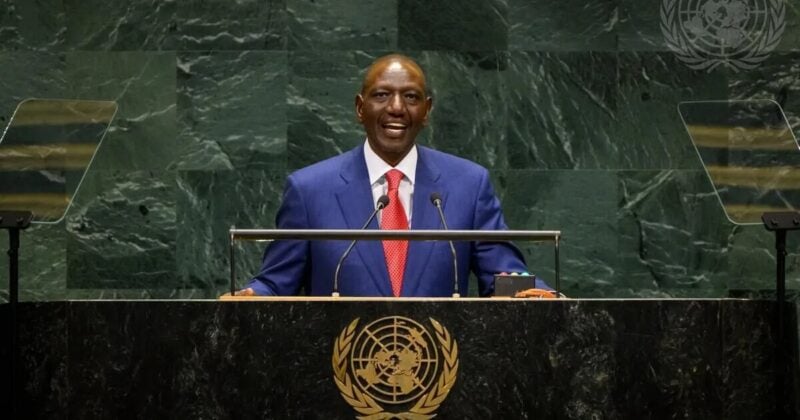
NAIROBI, Kenya, Sep 26— Kenya is seeking to turn its diplomatic engagements at the 81st United Nations General Assembly into concrete investment and industrialisation opportunities, with about $750 million in investment opportunities linked to a new UNIDO programme and talks on an East African refinery among the key outcomes.
President William Ruto’s engagements during the UNGA High-Level Week also focused on attracting development finance, strengthening Nairobi’s position as a regional financial hub and moving Kenya away from raw-material exports towards manufacturing and value addition.
According to a statement issued by the Office of the Prime Cabinet Secretary and Ministry of Foreign and Diaspora Affairs on Friday, Kenya and the United Nations Industrial Development Organization (UNIDO) signed a Country Partnership Programme for 2026–2030, with approximately $750 million in associated investment opportunities.
The programme covers industrial investment, technology transfer, manufacturing, enterprise development and jobs.
“Kenya’s participation was anchored on advancing national interests while strengthening its contribution to global peace and security, sustainable development, climate action, multilateral reform, economic transformation, technology, investment and international partnerships,” Prime Cabinet Secretary Musalia Mudavadi said.
“The President’s General Debate address placed Kenya in the global conversation on reform of multilateral institutions, international law, equitable African representation, affordable development finance and value addition to Africa’s resources.”
Ruto also held discussions with businessman Aliko Dangote and African Finance Corporation (AFC) President Samaila Zubairu on a proposed East African refinery in Kenya and the establishment of an AFC regional office in Nairobi.
The government said the AFC discussions support its ambition to strengthen Nairobi’s role as a regional financial, investment, development-finance and diplomatic hub.
The engagements formed part of Kenya’s broader economic diplomacy at the UNGA, where the government sought to link foreign policy with investment, industrialisation, technology, climate action and employment.
Kenya also used the General Assembly to push for reforms to the global financial architecture, including access to long-term, affordable and local-currency financing for developing countries.
The government said the cost of capital remains a major challenge for developing countries seeking to finance productive investment in infrastructure, education, health, energy and industrialisation.
AI and technology partnerships
Kenya also advanced international cooperation in artificial intelligence, digital transformation and data governance.
The government said it signed two instruments with the Emerging Markets Working Group at the Hoover Institution, Stanford University, covering economic transformation, governance, technology and public policy, as well as ICT cooperation.
It also advanced responsible AI cooperation through a Joint Declaration on Responsible AI, Research and Innovation with Anthropic PBC.
“Priority areas include AI and digital transformation, data governance, policy research, digital tools for policy analysis, fiscal transparency, investment efficiency, institutional capacity and knowledge exchange,” Mudavadi said.
The government said the partnerships are intended to help Kenya attract technology investment, expertise and knowledge while positioning the country as an African centre for responsible digital transformation.
Nairobi seeks bigger regional role
Kenya also signed a Host Country Agreement for the establishment of the United Cities and Local Governments of Africa East African Regional Office in Nairobi.
The government said the move, together with the growing presence of international and regional institutions, would strengthen Nairobi’s role as a diplomatic, multilateral, financial and development hub.
Kenya also established diplomatic relations with the Solomon Islands and signed political consultation instruments with the Maldives, North Macedonia, Croatia and Trinidad and Tobago.
The delegation further advanced the candidatures of Judge Njoki Ndung’u for the International Criminal Court for the 2027–2036 term and Judge Phoebe Okowa for re-election to the International Court of Justice for the same period.
Ruto also met US Secretary of State Marco Rubio for discussions that included trade and the future of the African Growth and Opportunity Act (AGOA).
Climate and diaspora agenda
Climate diplomacy was another component of Kenya’s UNGA engagements, with the country advancing Africa’s clean-cooking agenda ahead of the Clean Cooking Summit scheduled for Nairobi in January 2027.
As coordinator of the Committee of African Heads of State and Government on Climate Change, Kenya also pushed Africa’s common position ahead of COP31 in Antalya, Türkiye.
Kenya further convened a high-level event on building climate resilience among the urban poor, linking climate change, housing, poverty reduction and resilient infrastructure.
During the President’s engagement with Kenyans in the United States, the government also unveiled the Kenya Diaspora Investment Platform (KDIP), described as a proposed government-led digital platform for diaspora engagement.
The platform is intended to provide a single digital entry point through eCitizen for Kenyans abroad seeking to fund verified county projects, invest in Kenya, support enterprises, volunteer skills or establish businesses.
The government said KDIP is designed to help channel part of the more than $4 billion in annual remittances towards community development while using regulated escrow arrangements tied to verified project milestones.
The government said a total of 11 major instruments and agreements were signed or advanced during the UNGA period.
Mudavadi said the next challenge would be turning the commitments made during the diplomatic engagements into measurable outcomes.
“The next priority is implementation—translating commitments into investment, jobs, technology transfer, stronger institutions and tangible benefits for the Kenyan people.”
The government described the UNGA engagements as evidence of a shift towards using foreign policy as an instrument for domestic economic transformation.
“Foreign policy is an instrument for national transformation,” the statement said, pointing to the investment opportunities, partnerships, diplomatic relationships and international institutions being attracted to Kenya.