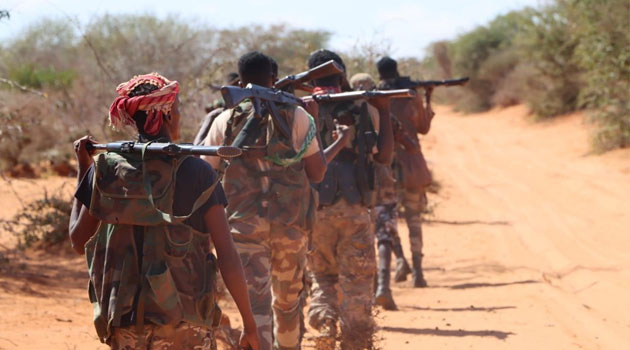
NAIROBI, Kenya, Sep 14— The detention of hundreds of Somali soldiers in Ethiopia has raised fresh questions over the scale and purpose of a Saudi-backed military training programme in Somalia, including unverified claims that some graduates could eventually be deployed to Sudan’s war.
The soldiers were detained in Jigjiga, in Ethiopia’s Somali Region, after crossing into the country from Somalia.
Estimates of the number detained vary widely, from about 180 to as many as 900, with the soldiers reportedly linked to a larger group of recruits who underwent training at the Hanano camp in Galmudug.
Somalia’s National Security Adviser has said the soldiers were on authorised leave and used the Ethiopian route to return to their families because roads inside Somalia were controlled by al-Shabaab.
That explanation accounts for why the soldiers crossed into Ethiopia, but it leaves unanswered broader questions about the training programme from which they emerged, its financing and what happens to recruits after completing their training.
Reports attributed to the Horn of Africa-focused account Voice of Horn say Saudi Arabia is funding a military training programme involving more than 5,000 Somali recruits.
The reports further claim that instructors or military contractors from Romania, Ukraine, South Africa and Colombia have been involved in the training.
More significantly, the account has alleged that some of the recruits could later be deployed to Sudan to fight alongside the Sudanese Armed Forces.
Those claims have not been independently established, and there is no evidence in the available information showing that the soldiers detained in Jigjiga were themselves travelling to Sudan.
But the incident has brought the reported Saudi-backed programme into sharper focus, raising a question that neither the detention nor Somalia’s explanation has answered: what is the intended role of the force once its recruits complete training?
A separate report by BML Daily has also pointed to Saudi financial support for military training programmes in Somalia and raised the possibility of some trainees eventually being deployed to Sudan.
The reported scale of the programme is significant.
The Hanano camp group alone is said to have included roughly 3,000 recruits who spent more than a year undergoing training.
If the broader figure of more than 5,000 recruits is accurate, the programme would represent a substantial expansion of Somalia’s pool of trained personnel at a time when Mogadishu is rebuilding its security forces and confronting the continuing threat posed by al-Shabaab.
The Jigjiga episode has therefore shifted attention from the immediate border incident to the larger question of where newly trained Somali forces are ultimately being deployed.
Sudan’s recruitment networks
The allegations also come as Sudan’s war increasingly draws fighters and recruitment networks from across the wider Horn of Africa.
Addis Standard has reported Prime Minister Abiy Ahmed as saying that networks are targeting young people in Tigray, including minors, and smuggling them towards Sudan to participate in the conflict.
There is, however, no evidence presented linking those networks to the Saudi-funded Somali training programme.
Other reports have separately alleged that Islamist-linked networks, including the Al-Bara ibn Malik Battalion, have strengthened their presence within Sudan’s military establishment.
Those claims have likewise not been independently established in the information available and have not been substantiated by the parties concerned.
What the overlapping reports demonstrate is the increasingly regional character of Sudan’s conflict, with concerns extending beyond Sudan’s borders to the recruitment and movement of fighters from neighbouring countries.
For Somalia, the issue carries an additional sensitivity.
Mogadishu has been working to build a capable national security force while reducing dependence on foreign security arrangements.
Any deployment of newly trained Somali personnel outside the country would therefore raise questions about who authorised such deployments, who finances them and under what command structure the troops would operate.
Neither Addis Ababa nor Somalia’s embassy in Ethiopia has, according to the information available, provided an independent detailed account of the Jigjiga detention.
Nor has there been independent confirmation that Saudi Arabia intends to send Somali trainees to Sudan.
The detention consequently offers no proof of a Saudi-Somali military pipeline into Sudan.
Instead, it has exposed a potentially much larger unanswered question of the destination and mandate of thousands of Somali recruits whose training is reportedly being financed from abroad.
Until Somalia, Saudi Arabia or other parties provide greater clarity on the programme’s funding, command arrangements and post-training deployments, the fate of the recruits will remain an important unanswered question in a region where military recruitment is increasingly crossing national borders.