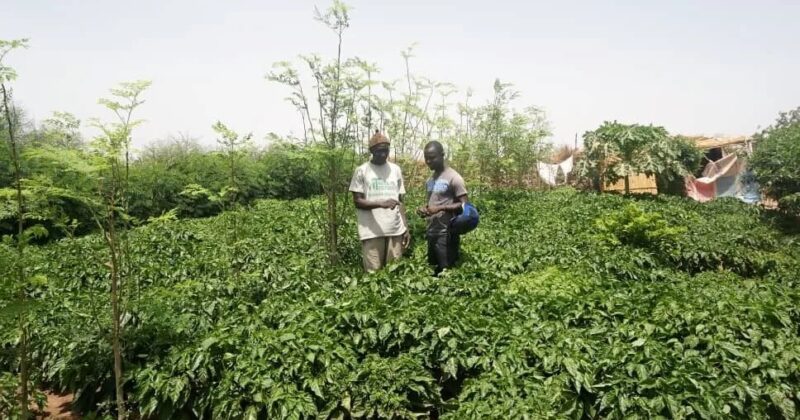
NAIROBI, Kenya, Oct 7— A new regional investment programme, backed by US$78 million in Global Environment Facility funding, will restore 270,000 hectares of degraded land and improve livelihoods for five million people across nine Great Green Wall countries.
The initiative, with total resources exceeding US$500 million including co-financing, seeks to accelerate land restoration across some of Africa’s most climate-vulnerable areas while strengthening the agricultural, pastoral and ecological systems on which millions of people depend.
The programme brings together Burkina Faso, Chad, Ethiopia, The Gambia, Mali, Mauritania, Niger, Nigeria and Senegal under a common regional framework designed to coordinate restoration efforts, improve monitoring and enable countries to share knowledge and successful approaches.
The Sahel is warming at about 1.5 times the global average, while roughly two-thirds of its productive land is degraded, increasing pressure on food systems, water resources and rural livelihoods.
Environmental degradation, food insecurity and conflict have also contributed to the displacement of more than four million people across the region.
UNEP will implement eight of the programme’s 10 projects and coordinate regional delivery, while the West African Development Bank (BOAD) will implement the remaining two.
“This programme provides the finance to act on that work across nine countries, and a common framework so that they can plan, measure, and learn from the results together,” said Susan Gardner, Director of UNEP’s Ecosystems Division.
She said the initiative would contribute to the countries’ commitment to bring 30 per cent of degraded land under restoration by 2030.
The US$78 million GEF grant will be supplemented by financing from the Green Climate Fund, the International Fund for Agricultural Development, the Food and Agriculture Organization of the United Nations and bilateral partners, taking total programme resources above US$500 million.
The largest restoration target will be in Mali, where 150,000 hectares will be regenerated across the Kayes, Nioro and Ségou regions. Niger will restore a further 55,000 hectares of farmland, woodland and grazing land.
In Ethiopia, the programme will restore 22,000 hectares of degraded land and place another 40,000 hectares of natural forest under improved management.
In The Gambia, wetland and forest corridor restoration is expected to benefit nearly 800,000 people, most of them women, while women-led enterprises will form part of projects in Nigeria’s Kebbi State and Mauritania.
Chad and Burkina Faso will focus on drought-resilient land management for communities facing the effects of desertification.
“The strength of the Great Green Wall lies in the leadership of its countries,” said Almoustapha Garba, Executive Secretary of the Pan-African Agency of the Great Green Wall.
“By connecting national priorities through a shared regional framework, this programme will help countries accelerate restoration, exchange knowledge, and scale up solutions that respond to their own landscapes and communities,” he said.
Launched in 2007 under the auspices of the African Union, the Great Green Wall is an African-led effort to combat desertification, land degradation and drought across the Sahel.
The new programme builds on more than a decade of restoration work by participating countries and earlier GEF-supported efforts to map degraded land and identify areas with potential for successful restoration.
Its regional approach is intended to move restoration efforts beyond individual projects towards coordinated investment, allowing countries to track results collectively and scale up approaches suited to local landscapes and communities.