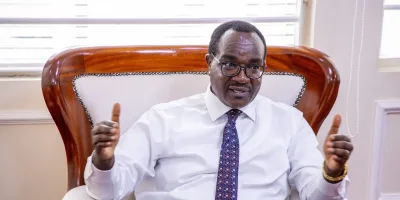
NAIROBI, Kenya, Sept 1 — Former Deputy President Rigathi Gachagua has escalated his criticism of the Independent Electoral and Boundaries Commission over its proposed election technology procurement, accusing the commission’s leadership of victimising officials who allegedly refused to support a tender he claims was designed to favour South Korean firm Miru Systems.
Gachagua claimed that senior officials in the commission’s Supply Chain Management and Electoral Management departments had declined to give what he described as false testimony in proceedings before the Public Procurement Administrative Review Board (PPARB).
The Democracy for Citizens Party leader alleged that the officials were subsequently transferred to counties outside Nairobi, while new officers were brought in to take over their positions.
“The Chairman and his Vice Chair have victimised officials in the two departments and transferred all of them, except the compromised head of department, to far-flung counties and replaced them with cronies,”he said.
The claims come amid a procurement dispute over IEBC’s proposed Integrated Elections Management System (IEMS), which has already been challenged before the procurement review board.
The commission advertised the tender on August 11 for the supply, delivery, installation, testing, commissioning, support and maintenance of the IEMS, hardware and accessories. The tender was initially scheduled to close on September 1.
The procurement has been temporarily halted following a challenge before the PPARB by a prospective bidder.
Gachagua has repeatedly alleged that the tender specifications were tailored to suit Miru Systems and that the procurement process was designed to produce a predetermined winner.
IEBC chairman Erastus Ethekon has rejected the allegations, saying no company, including Miru Systems, had been awarded the tender.
Ethekon said the technical specifications were generic and performance-based and had been developed from Supreme Court directives, lessons learnt from previous elections and feedback from IEBC field officers.
He also urged parties with concerns about the procurement to use the legal mechanisms provided under Kenyan law.
Staff changes questioned
In his latest statement, Gachagua sought to connect the procurement controversy with a series of staff changes announced by IEBC in August.
A memo dated August 12 and signed by the Acting Commission Secretary/CEO lists transfers and re-designations affecting officials in several departments, including Supply Chain Management and Voter Registration and Electoral Operations.
The memo says the changes had been communicated to affected officers through individual letters dated August 10 and directed them to report to their new stations by August 17.
Among those moved from the commission’s headquarters were several officials in the Supply Chain Management directorate.
Bildad Ochieng Owiyo was transferred from the headquarters to the Siaya County office, while Caroline Nkatha Mwongera was moved to the Kilifi County office.
Christine Nduku Makau was transferred to the Kiambu County office and Edward Keem Ekalale to Kajiado.
Other changes affected officials in electoral operations, including Abdidahir Maalim Abdi, Jacqueline Sabiri Osiemo, Martin Wachira Nyaga and Nelie Ilongo, who were moved between county offices and headquarters.
The memo, however, does not give reasons for the individual transfers.
Gachagua alleged that the changes were linked to the Miru procurement, claiming that commission officials had resisted efforts to make them defend disputed tender specifications.
He said he had been approached by what he described as patriotic IEBC employees who were concerned about intimidation and the direction of the procurement.
IEBC denies predetermined tender
The accusations come days after IEBC publicly dismissed claims that the Miru Systems tender had already been awarded.
Ethekon said the procurement process remained open and that the commission was not aware of the identities of companies that would ultimately compete for the contract.
He also rejected claims that the tender specifications had been tailor-made for the South Korean company.
The dispute has nevertheless raised questions over the timing of the planned transition to a new election management system, less than a year before the August 2027 General Election.
Gachagua argues that changing the system at this stage could create risks for the election, particularly if the migration involves the voter register and other critical electoral databases.
He has called on IEBC to abandon the tender and instead upgrade the existing system to address identified weaknesses.
He further warned that any changes to the electoral technology must protect the integrity of the voters’ register and guarantee that all eligible voters can participate in the election.
“Do not throw Kenya into chaos and anarchy. Do not subvert the will of the people of Kenya. Leave Kenyans to make their decision at the ballot,”Gachagua warned.
Procurement challenge
The controversy is now before the PPARB, which is expected to determine the challenge to the procurement.
A prospective bidder has questioned aspects of the tender, prompting the board to temporarily halt the process. The dispute has placed the Sh6.5 billion procurement under increased scrutiny.
IEBC has also acknowledged an error in the tender documents relating to performance security, saying it had mistakenly required bidders to provide security equivalent to 20 per cent of the contract price, despite the statutory ceiling being 10 per cent. The commission said it was preparing an addendum to correct the error.
The procurement dispute has consequently become part of a wider political debate over preparations for the 2027 election, with opposition figures questioning whether the electoral commission can introduce and operationalise a new system in time.
Gachagua has now called on the commission’s leadership to stop what he described as harassment of staff and allow officials to perform their duties professionally.
He also urged the electoral agency to ensure that decisions on election technology do not undermine public confidence in the 2027 polls.
The former Deputy President’s latest claims come as political leaders increasingly turn their attention to the systems that will underpin the next election, with the integrity of the voter register, biometric identification and electronic transmission of results expected to remain major issues in the preparations for the 2027 contest.