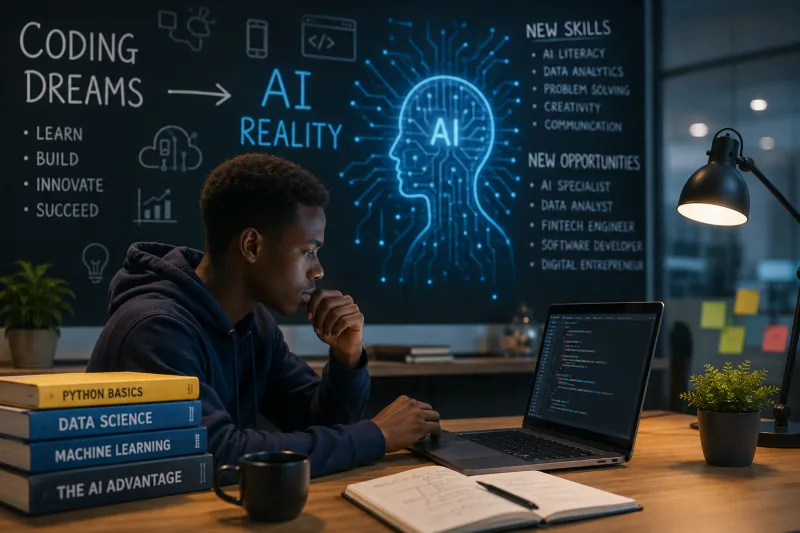
NAIROBI, Kenya, June 29 – For years, coding was marketed as one of the surest pathways to employment in the digital economy.
Governments invested heavily in digital literacy programmes, universities expanded computer science courses, and thousands of young Africans enrolled in coding bootcamps convinced that software development would unlock economic opportunity.
Then artificial intelligence arrived.
Rather than eliminating digital careers, AI is fundamentally reshaping them.
According to the World Economic Forum’s Future of Jobs Report 2025, “Technological change is expected to create 170 million new jobs globally by 2030 while displacing 92 million others, resulting in a net increase of 78 million jobs.”
The report also identifies “AI specialists, Big Data specialists, FinTech engineers and software and application developers” among the world’s fastest-growing occupations.
Those projections suggest the future of work is not disappearing; it is evolving.
Yet for thousands of young people investing their time and money in coding, data science and digital marketing, a pressing question remains: Will digital skills still deliver jobs, or has AI simply raised the bar?
From Coding Skills to Problem-Solving
The debate comes at a time when generative AI tools can write software code, design websites, analyze data and produce marketing content within seconds tasks that once required junior developers, designers and digital marketers.
As businesses increasingly adopt AI, employers are placing less emphasis on technical skills alone and more value on workers who can combine technology with creativity, critical thinking and business understanding.
The International Labour Organization (ILO) argues that fears of mass job losses may be overstated.
In a 2025 analysis, the agency noted that “When confronted with the current debate on the impact of Generative AI (GenAI), we should be speaking more about jobs being affected by AI rather than replaced by it.”
It adds that while one in four jobs worldwide is exposed to generative AI, most occupations are likely to be transformed rather than fully automated.
For Ian Muthomi, founder and chief executive of Kenyan AI company Pinnlab, that transformation presents more opportunity than threat.
“I see AI creating more opportunities for young people than taking them away.”
“Young people should focus on understanding the gaps and inefficiencies that exist within organizations and use AI to develop solutions that address those challenges.”
Muthomi says many Kenyan companies recognize AI’s disruptive potential but are still struggling to identify practical business applications that deliver measurable returns. That gap, he argues, creates an opening for young innovators.
“AI has significantly lowered the barriers to building and scaling software,” he says, adding that developers who understand real business problems will be better positioned to create products that reduce costs, improve efficiency and generate revenue.
His outlook reflects a broader shift across the technology industry. Increasingly, employers are not simply looking for programmers they are looking for problem solvers.
The New Rules of the Job Market
That means the value of learning to code has changed.
“I think ‘evolved’ is a better word than ‘changed,”Muthomi says of today’s labour market.
“Learning coding, data science and other technical skills is still a valuable investment, but those skills alone no longer guarantee employment.”
“The most successful professionals will be those who combine strong technical skills with strong interpersonal and business skills.”
Research supports that assessment. The World Economic Forum lists analytical thinking, resilience, flexibility, leadership and AI literacy among the fastest-growing workplace skills, reflecting employers’ growing demand for workers who can collaborate with intelligent systems rather than compete against them.
AI as a Co-Worker, Not a Competitor
Caleb Korir, Chief Executive Officer of youth-led public relations and marketing agency GrowthSasa, says AI has become an essential productivity tool within the communications industry, but it has not replaced human creativity.
“AI has made our team faster and more efficient, but it has not replaced creativity, strategic thinking or human understanding.”
“Young people who learn how to work with AI instead of competing against it will be far better prepared for the future of work.”
Korir says communications professionals now spend less time producing routine content and more time interpreting data, developing campaigns and building relationships with client’s areas where human judgement remains essential.
Beyond Coding: The Mentorship Gap
Still, the road into the technology industry remains far from equal.
While access to online learning platforms has improved, many young innovators continue to struggle with mentorship, financing and finding their first commercial opportunities.
For Muthomi, mentorship proved to be the biggest hurdle.
“It is difficult to find mentors who are willing to invest in you over the long term, trust you with their network and genuinely commit to helping you succeed.”
He says some experienced professionals dismissed him because of his age, while others were reluctant to share opportunities or industry connections.
Those experiences have reinforced his belief that Africa’s digital economy needs stronger innovation ecosystems rather than more coding certificates.
Rethinking Digital Skills for Kenya
If he were redesigning Kenya’s digital skills curriculum, Muthomi says he would begin by teaching AI from day one rather than treating it as an advanced topic.
“The first thing I would change is where we start,” he says.
Instead of replicating Silicon Valley’s curriculum, he believes students should learn to build solutions around Kenya’s own digital economy.
“We are in Kenya. The M-Pesa ecosystem is one of the most sophisticated platforms in the world and most of our developers cannot build on it properly.”
He argues that training should prioritize technologies such as M-Pesa integrations, USSD applications, mobile-first development, AgriTech, county government systems and community health solutions.
Equally important, he says, is preparing young people to earn a living as freelancers and entrepreneurs.
“Getting your first contract is a skill. Building something sustainable is a completely different one.”
“Those are not soft skills. Those are survival skills.”
His comments echo growing calls for universities to align digital education with industry needs rather than focusing largely on theoretical instruction.
Can Africa Keep Pace?
Despite the uncertainty surrounding AI,Muthomi remains optimistic.
His company, Pinnlab, is developing AI tools that transform educational content, policy documents and standard operating procedures into explainer videos.
The startup is also incubated by NVIDIA, giving it access to advanced AI infrastructure and technical expertise.
Yet he worries Africa risks falling behind if governments fail to invest in local computing infrastructure and research ecosystems capable of supporting home-grown AI innovation.
He wants governments to encourage investment in AI infrastructure, universities to become more responsive to startups, and private companies to provide funding, mentorship and opportunities for young innovators to test their ideas.
The Bottom Line
The future of digital work, experts suggest, will not belong to those who simply know how to write code.
Instead, it will favour those who can identify problems worth solving, understand business needs and use AI as a tool to create value.
For young people pursuing careers in technology, the coding dream is still alive.
But in the age of artificial intelligence, coding alone is no longer enough.
The real competitive advantage lies in combining technical expertise with creativity, communication, entrepreneurship and the ability to work alongside intelligent machines.
That may ultimately be AI’s biggest lesson not that humans are becoming obsolete, but that the skills that make them uniquely human have never mattered more.