Beyond the public rallies, political contests and the weight of his political stature was a man who appreciated the ordinary rhythms of life. I had the privilege of witnessing this side of Baba during 25 years of close interaction with him.
These experiences shaped my understanding of Baba as a man who could command the attention of a nation yet find time for ordinary people, conversations and pleasures.
Baba was a gifted storyteller. In the quiet moments we shared, he would recount stories from his childhood and school days, including visits to village bars with childhood friends to enjoy whatever drinks were available. He did not always have special preferences or expect to be treated differently because of who he was. He partook of what was available and enjoyed the company.
Some of my most vivid memories of Baba’s ordinariness are from our time having drinks at the Bunge canteen, in the company of the late Joab Omino, Joshua Ojode and Otieno Kajwang. It was fascinating to witness how his childhood friends could challenge him, tease him and engage him without ceremony.
In those moments, Baba seemed comfortable returning to familiar spaces where his name and position counted for little, and friendship counted for much.
Of course, there was one thing Baba and I never quite had in common: his unwavering affection for Arsenal Football Club.
Whenever Arsenal was playing, Baba would summon some of his close friends, including Mweha Kamau, popularly known as Kamau wa Raira, and CS Wycliffe Oparanya, to watch the match with him. On one occasion, I needed to share some information with him, and he asked me to join him at AXA Sports Bar and Grill, the popular open-air establishment off Bogani East Road in Karen.
I quickly learnt that approaching Baba during an Arsenal match required an appreciation of football etiquette. When the game was on, his attention was fixed firmly on the screen. His mind was entirely on the match, leaving little room for competing conversations. At half-time, however, the atmosphere changed. He would analyse the game with his guests before sparing a few minutes for other discussions.
That was Baba: intensely focused on whatever had captured his attention, but willing to make room for other matters when the moment was right.
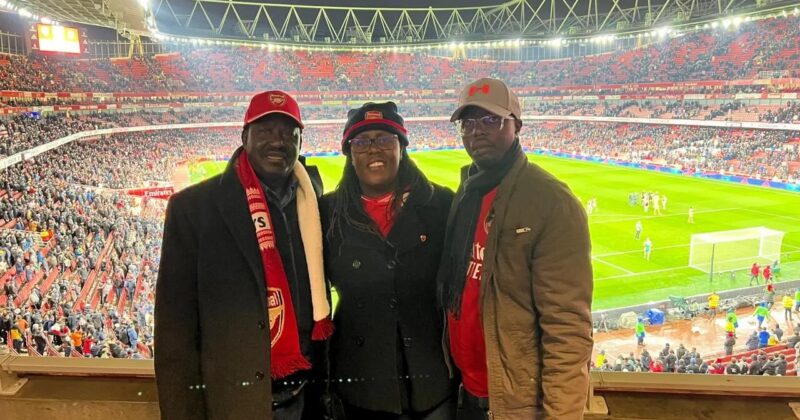
I also remember an official trip to London that he asked me to organise, with one important condition: it had to coincide with a week when Arsenal were playing. On one such occasion, former Member of Parliament Peter Kenneth, who was part of the entourage, arranged box seating for us at the Emirates Stadium.
It was a memorable experience that captured a lighter, more personal side of Baba: his love for football and the simple pleasures that brought him joy.
Among those present were Siaya Governor James Orengo, Hassan Joho, Junet Mohamed, COTU Secretary-General Francis Atwoli, and Baba’s children, Raila Junior and Winnie Odinga.
We were there to watch Arsenal take on Liverpool. Throughout the match, Baba’s attention was exactly where one would expect it to be: on the football.
Perhaps no anecdote captures Baba’s connection with ordinary people better than an incident following a campaign rally somewhere in Dagoretti.
A Member of Parliament from Nairobi informed him that lunch had been organised at the Kempinski Hotel. Baba would have none of it.
“We must go where the people are. Juma, let’s go to Njuguna’s,” he instructed his driver.
And so, instead of proceeding to Kempinski, we left Dagoretti and headed to Njuguna’s.
It was a simple decision, but one that spoke volumes about the man I knew. He did not always need the formality, exclusivity or elaborate arrangements that might ordinarily accompany someone of his stature. He could choose a familiar, accessible establishment and be perfectly content.
To me, this reflected his ease in ordinary spaces and his willingness to be among people without the trappings of high office.
For all his public stature and political preoccupations, one of the most revealing experiences of my interaction with Baba was deeply personal.
It occurred during preparations for the first Azimio Presidential Secretariat retreat at Elementaita. At the time, I was the acting Chief Executive Officer of the Secretariat. However, when arrangements were made for the retreat, my name was missing from the list of invitees.
I only learnt of the meeting after seeing a Capital FM 411 News alert announcing the appointment of Mrs Elizabeth Meyo as CEO. My understanding at the time was that my exclusion from the retreat arrangements stemmed from the actions of an officer in Baba’s office, whose name I have chosen to withhold, who believed I occupied a strategically important position.
That evening, following the announcement, Baba and his daughter Winnie separately called me and asked why I had not attended the retreat. I explained that I had not been invited.
Baba then instructed me to report to his residence in Karen the following morning at 6.00 am. I arrived at 5.45 am and was ushered into one of the lounges. By 7.00 am, Baba was dressed and ready for the day.
I recounted the previous day’s events and explained why I had not attended the retreat. He listened. Then, rather than allowing the conversation to be consumed by what had happened, he told me that the matter was in the past. He wanted to know what I would like to do at the Secretariat.
My response was in Dholuo: “Baba, gimi miya ema kawo” — whatever you assign to me, I will take.
He then told me that he wanted me to handle his interactions with the international community and the diaspora, as well as monitor activities around the Independent Electoral and Boundaries Commission (IEBC).
I accepted the assignment with aplomb.
What stayed with me was not merely the responsibility he entrusted to me. It was the fact that he had taken the time to establish why I had been excluded, listen to my explanation and discuss my future role directly with me.
For a man carrying the weight of a national political movement, there were undoubtedly countless other matters competing for his attention. Yet he made time for my concerns.
It was a reminder that leadership is not only about making consequential national decisions. It is also about noticing when someone has been left out, hearing their side of the story and ensuring that they are not defined by an experience of exclusion.
These memories have stayed with me because they reveal a side of Baba that formal political accounts can easily overlook. Beyond the rallies, the political calculations and the demands of public life was a man who valued friendship, enjoyed football, cherished familiar places and could make time to listen.
These are the memories I carry with me: of a man whose public stature was immense, but whose humanity was often most evident in the simplest moments.
Rest in peace, Baba
(The author is a Former Director, International and Diaspora Engagement, Raila Odinga Presidential Campaign Secretariat)
Disclaimer: The views expressed are solely those of the author and do not necessarily reflect those of Capital FM.