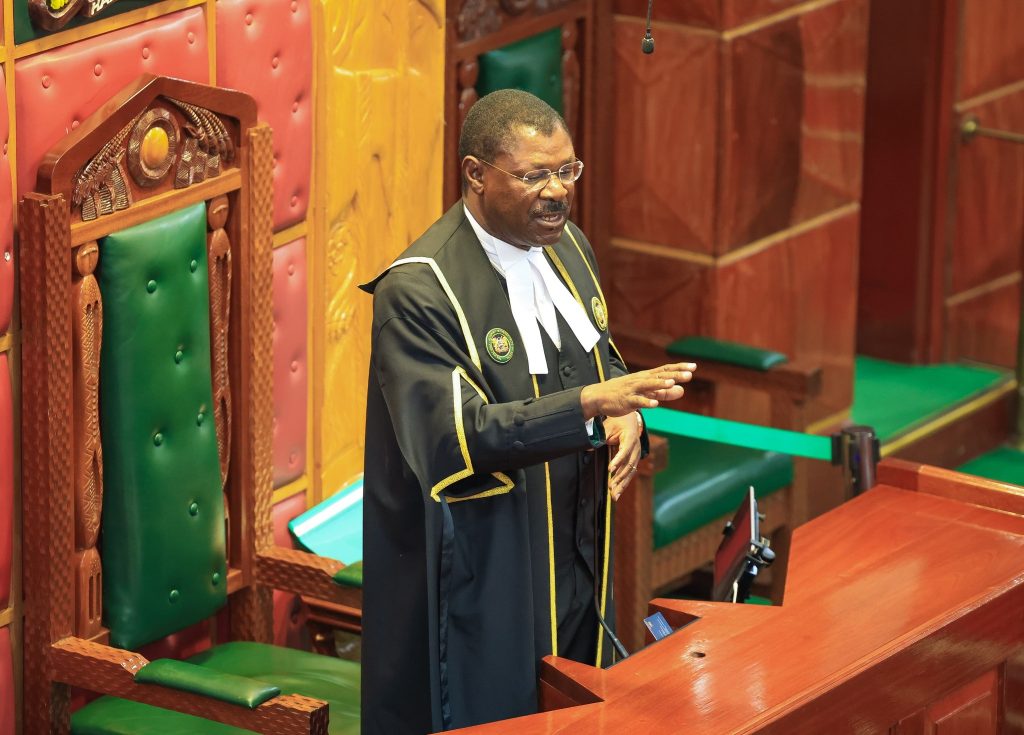
NAIROBI, Kenya, Jun 18 – The opposition suffered a setback in the National Assembly on Thursday after Speaker Moses Wetangula rejected a series of amendments to the Finance Bill 2026 proposed by opposition Members of Parliament, citing constitutional and public finance management requirements.
Wetangula ruled that the contested proposals would not be considered during the Committee of the Whole House stage, stating that they failed to comply with Article 114(2) of the Constitution and provisions of the Public Finance Management Act governing money Bills.
Before the House proceeded to debate the Finance Bill and the Appropriations Bill, the Speaker issued a detailed procedural ruling effectively striking out amendments submitted by several opposition legislators, including Deputy Minority Leader Robert Mbui, Embakasi West MP Mark Mwenje, and Yatta MP Robert Basil.
“In the absence of evidence that the amendments were processed in the manner contemplated in Article 114 of the Constitution, the Speaker is left with no choice but to direct that the Committee of the Whole House shall not consider the amendments, or parts of the amendments, that have been published in the Order Paper with a disclaimer,” Wetangula ruled.
He emphasized that any legislative proposal affecting public finances must strictly adhere to constitutional procedures for money Bills.
“As you are aware, when considering any matter that has a financial implication on public funds, the House is bound by the provisions of Article 114(2) of the Constitution,” he said, adding that such proposals require consultation with the National Treasury through the relevant parliamentary committee.
The Speaker further noted that the Finance Bill falls within the definition of a money Bill, as it deals with taxation, charges on public funds, appropriation and other fiscal measures.
He explained that under Article 114, Parliament can only proceed on such matters following recommendations from the relevant committee after considering input from the Cabinet Secretary for the National Treasury.
Wetangula also cited Section 39(a) of the Public Finance Management Act, which operationalises the constitutional framework governing fiscal legislation.
He said his review of the amendments revealed that several proposals directly affected taxation and public expenditure, thereby triggering constitutional safeguards requiring prior consultation.
“In this regard, I have analysed the amendments proposed to the Bill and noted that some contain proposals touching on matters listed in the definition of a money Bill,” he said.
The Speaker specifically pointed to amendments by Mbui affecting Clauses 3, 18, 19, 22 and proposed Clause 21A; Mwenje’s proposals affecting Clauses 7, 17, 22 and 36A; and Basil’s amendment to Clause 31A(9), noting that all required prior engagement with the Treasury.
He ruled that in the absence of evidence of such consultation, the amendments could not proceed to debate.
“In this regard, the proposed amendments… will only be proceeded with if there has been consultation with the National Treasury through the Departmental Committee on Finance and National Planning,” he said.
The ruling means the Finance Bill 2026 will proceed to the Committee of the Whole House stage without consideration of the contested opposition amendments, which the Speaker effectively declared inadmissible.