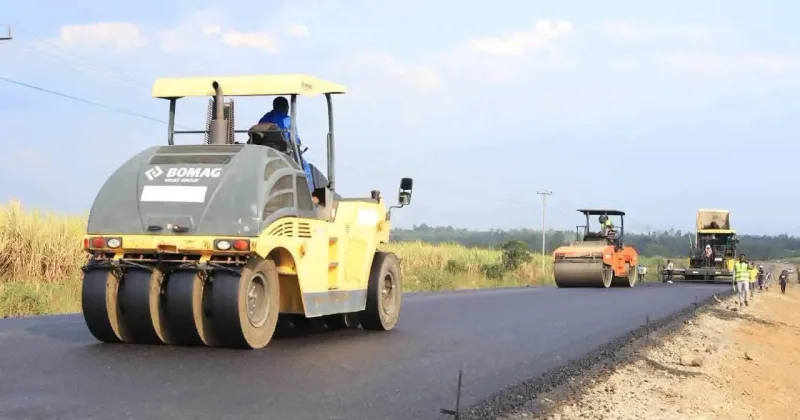
KISUMU, Kenya Sep 9 — More than Sh14 billion worth of road projects are either under construction or at the contracting stage in Kisumu County, in a major infrastructure push aimed at improving connectivity and strengthening economic activity across the region.
The projects, whose progress has been outlined by Principal Secretary for Interior and National Administration Raymond Omollo, cover key transport corridors linking Kisumu with Muhoroni, Chemelil, Miwani, Kipsitet and surrounding centres.
The government says the investments are expected to improve connectivity, reduce travel times and facilitate the movement of people and goods across the county and the wider western Kenya region.
Among the projects under construction is the 30.5-kilometre Maseno-Kombewa-Kalandini road and Maseno Town roads, valued at Sh1.73 billion.
The project has reached 67.7 per cent completion, according to the latest progress update.
The government has described road infrastructure as critical to opening up communities and supporting economic activity.
The road is expected to improve access to markets, public services and other economic centres along the corridor once completed.
One of the projects closest to completion is the dualling of the Kisumu Boys Roundabout-Mamboleo Junction section of the A1 road.
The 4.7-kilometre project, valued at Sh1.31 billion, is now 98 per cent complete.
The upgraded section is expected to improve traffic flow along one of Kisumu’s busiest corridors while enhancing connectivity between Kisumu city and neighbouring areas.
Its near-completion is also expected to ease congestion and improve the movement of vehicles along the important transport corridor.
The government is also undertaking major reconstruction works along the Mamboleo-Miwani-Chemelil-Muhoroni-Kipsitet corridor through three lots.
Lot One, covering 12.9 kilometres between Mamboleo Junction and Miwani, has a contract value of Sh5.19 billion and is 20.2 per cent complete.
Lot Two, covering the Miwani-Chemelil section, is valued at Sh4.96 billion and has reached 34 per cent completion.
Lot Three, covering the Chemelil-Muhoroni-Kipsitet section, is valued at Sh5.72 billion and stands at 28 per cent completion.
The projects are expected to strengthen the road connection between Kisumu and the wider western Kenya transport network.
The corridor is strategically important for the movement of agricultural produce, goods and passengers between Kisumu and surrounding economic centres.
Other major projects include the completion of the Ahero and Kericho interchanges at junctions A1/B1 and B1/C23 respectively.
The two projects have a combined value of Sh1.39 billion and are both above 95 per cent complete.
The Ahero interchange has reached 95.3 per cent, while the Kericho interchange stands at 95.2 per cent.
The near-completion of the interchanges is expected to improve traffic management and road safety while facilitating smoother movement along the strategic routes.
The projects are also significant for businesses and motorists who rely on the corridors connecting Kisumu with other parts of western Kenya and the Rift Valley.
Further road works are planned in Koru, where the 11-kilometre Koru Town-Junction C35 and access to Koru Bible College road project is valued at Sh892.6 million.
The project is currently listed as pending, with 11.47 per cent progress recorded.
Two other projects — Holo-Lela and Chiga-Rabuor roads — have reached the contract award stage.
The 12-kilometre Holo-Lela road has a contract value of Sh920 million, while the Chiga-Rabuor road is valued at Sh1.1 billion.
The contracting of additional roads signals an expansion of the government’s road programme beyond major urban corridors, with more communities expected to benefit from improved access.
The ongoing projects form part of a broader infrastructure programme aimed at improving road connectivity within Kisumu and strengthening links with neighbouring counties.
Once completed, the roads are expected to reduce travel times, improve access to markets and public services, and lower transport costs for businesses and residents.
The upgraded network could also support agricultural trade by improving the movement of farm produce from rural areas to Kisumu and other major markets.
With several projects already above 90 per cent completion and others progressing at different stages, the road programme represents a significant infrastructure investment in Kisumu County.
The government is expected to continue monitoring the projects as construction advances, with motorists and residents awaiting completion of the key corridors.