In an era when public leadership is increasingly measured by motorcades, mansions, imported watches, and unexplained fortunes, it is worth revisiting the lives of leaders who understood that political power was never meant to be a vehicle for personal enrichment. Their greatest wealth lay not in what they owned, but in what they gave to their people.
History has a way of separating those who merely occupied office from those who truly served it. Long after the titles have faded and the motorcades have gone quiet, it is character, not possessions, that decides how a leader is remembered.
Mwalimu Julius Nyerere, Tanzania’s founding president, remains one of Africa’s most respected statesmen, not because he amassed wealth or surrounded himself with extravagance, but because he embodied simplicity, discipline, and service. His philosophy of Ujamaa sought a society built on equality, communal responsibility, and self-reliance. Scholars still debate the economic outcomes of that project. Almost no one debates his personal integrity. He lived modestly, avoided conspicuous displays of wealth, and left office with a reputation largely untouched by allegations of personal corruption.
Thousands of miles away, another leader proved that power could be exercised with humility. Former US President Jimmy Carter rejected the well-worn path of monetising the presidency. He returned to his small hometown, continued living modestly, taught Sunday school, and spent decades building homes and mediating conflicts through the Carter Center and Habitat for Humanity. His post-presidential life was not a retreat from public service; it was a continuation of it.
Nyerere and Carter came from different continents, systems, and eras, yet shared one conviction: leadership is stewardship. Public office is a trust extended by citizens, not a licence for self-enrichment.
That ideal feels increasingly distant today. Across many democracies, citizens watch officials transform almost overnight once they assume office. Convoys grow longer. Homes grow grander. Fortunes balloon at a pace no salary can explain. Meanwhile, hospitals run short of medicine, schools run short of teachers, graduates run short of jobs, and the cost of living keeps climbing.
This is not simply a fiscal problem. It is a trust problem, and trust is the most valuable currency any government holds. When citizens conclude that public office exists mainly to manufacture millionaires rather than opportunity, faith in democratic institutions does not decline gently. It erodes, year after year, until cynicism becomes the default posture toward government itself.
It is worth saying plainly: corruption is not merely the theft of money. It is the theft of opportunity. Every diverted shilling is a classroom left unbuilt, a hospital left unequipped, a farmer denied irrigation, a graduate denied a job, a family denied hope. The victims of corruption rarely show up as line items in an audit report. They show up as ordinary people whose ordinary aspirations were quietly sacrificed for someone else’s private gain.
Strong nations are rarely built by charismatic personalities alone. They are built on values that outlast any one leader. Accountability ensures that whoever is entrusted with public resources must answer for how those resources are used. Transparency gives citizens the means to scrutinise how public money is raised and spent. Responsibility reminds leaders that they are temporary custodians of institutions meant to outlive them by generations.
None of this is revolutionary. The countries that consistently rank among the world’s most prosperous and stable are not necessarily the most naturally gifted. They are the ones that invested, deliberately and over decades, in institutions that reward integrity and punish the abuse of office. They accepted, early, that development and unchecked corruption cannot coexist indefinitely.
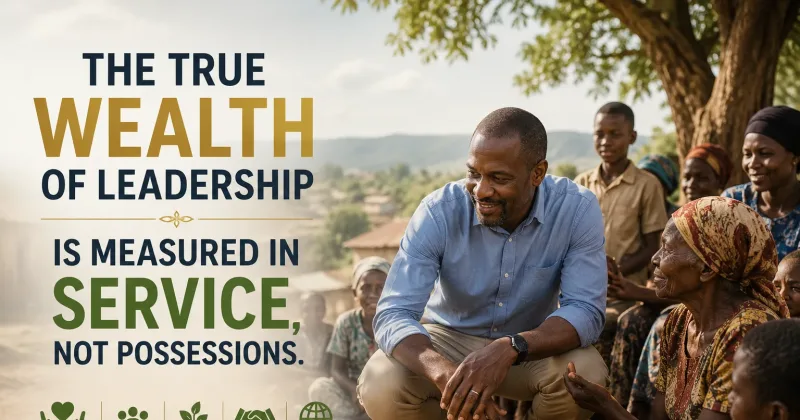
Africa has its own tradition to draw on here. Nyerere is proof that simplicity is not political weakness but moral strength. Leadership is not measured by the number of vehicles in a convoy or the size of a private residence. It is measured by whether children get a real education, whether hospitals actually save lives, whether small businesses can survive, and whether ordinary citizens believe tomorrow will be better than today.
The task facing today’s leaders, then, is not only to promise economic transformation. It is to restore the moral authority of public office itself. Citizens deserve leaders whose personal conduct reflects the sacrifices they ask everyone else to make. They deserve to be told, and shown, that public resources are sacred, not personal entitlements.
Perhaps the truest tribute to leaders like Nyerere and Carter is not to admire their simplicity from a distance, but to demand it as a baseline. Humility, accountability, transparency, and service should never be treated as exceptional virtues worth praising when they appear. They should be the minimum qualification for holding public power at all.
In the end, the finest leaders leave behind neither palaces nor hidden fortunes. They leave behind stronger institutions, more capable citizens, and a country a little more just than the one they inherited. That is the wealth history actually remembers. It is also the legacy the next generation deserves to inherit.
Alex Owiti is the Founder and CEO of Alexander PR and Communication Network