When the World Cup came to Africa in 2010, there was an interesting argument advanced by scholars who saw football as a mirror of society. The development of football in many countries often reflects their political and socioeconomic realities.
Countries plagued by corruption frequently have football systems riddled with match-fixing, poor governance and weak institutions. In such environments, results are sometimes known before kick-off. Conversely, countries that build strong institutions tend to build strong football systems. Those that reward merit, invest in youth development and embrace accountability often produce teams capable of competing on the global stage.
It is therefore no surprise that Morocco continues to excel. Its success is not accidental. It reflects years of planning, investment and institution-building.
But football offers another lesson that our politics increasingly ignores: the importance of succession, mentorship and leaders who understand that institutions are bigger than individuals.
Across Africa, former football stars continue to mentor younger generations. Retired players remain involved in the game, offering guidance without feeling threatened by emerging talent. They understand that the future of the sport depends on nurturing those who come after them.
The contrast with Kenya’s politics could not be starker.
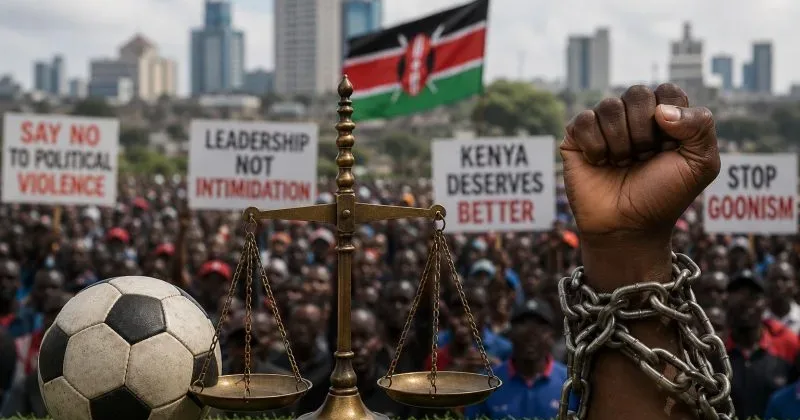
Instead of nurturing future leaders, many politicians appear determined to destroy the very environment within which leadership can emerge. Instead of mentoring, they intimidate. Instead of creating opportunities, they manufacture dependency and cultivate a culture of goonism that increasingly threatens public order and democratic participation.
Recently, church leaders condemned what they described as a growing culture of political goonism. While well-intentioned, their criticism missed the central issue.
The question is not where the goons come from. The question is who creates them.
There are no naturally occurring goons sitting somewhere waiting to be recruited. Goonism is not a spontaneous social phenomenon. It is a political creation.
The real goons are not the young men and women mobilised to disrupt rallies, attack opponents or intimidate citizens. The real goons are the politicians who recruit, finance and deploy them.
They are the architects of the system.
For years, many politicians have presided over corruption, unemployment and hopelessness. They have failed to create opportunities through effective legislation, oversight and representation. They then exploit the desperation they helped create by recruiting vulnerable youth into political violence.
The young men who throw stones, disrupt meetings and attack rivals are often symptoms of a deeper disease.
The disease itself is a political culture that rewards impunity and weaponises poverty.
That is why it is misleading to accuse politicians of merely hiring goons. They do far more than that. They create, sustain and benefit from goonism.
Political violence has become an investment designed to protect political monopolies, intimidate opponents and discourage competition. It creates fear and allows mediocre politicians to survive without having to compete on ideas.
If there were no politicians willing to finance violence, organised goonism would quickly disappear. If there were no politicians willing to reward disruption, there would be no market for it.
The supply exists because powerful individuals continue to create demand.
Yet the greatest danger is not the violence itself. The greatest danger is what it is doing to our democracy.
Democracy depends on the free contestation of ideas. Citizens must be allowed to hear competing visions, evaluate leaders and make informed choices. But when politicians deploy resources to mobilise vulnerable youth to disrupt meetings and attack opponents, they deny citizens that opportunity.
The objective is not simply to create chaos. The objective is to silence alternatives.
The result is that Kenyans increasingly find themselves trapped in a political system dominated by a small clique of waheshimiwa, while the rest of society watches from the sidelines. The marketplace of ideas shrinks. Fear replaces debate. Intimidation replaces persuasion.
Even talented and visionary leaders begin to think twice before offering themselves for public office. Why risk exposing yourself, your family and your supporters to organised violence simply because you hold a different opinion?
This is how democracies decline—not necessarily through coups or constitutional amendments, but through the gradual normalisation of fear.
Growing up, politics felt different. As children, many of us attended political rallies and public gatherings without fear. We listened to leaders debate ideas, challenge one another and seek support from voters. Political competition was often fierce, but public participation remained largely safe.
Today, attending a rally, a public meeting or even a national function can expose citizens to violence. People increasingly calculate security risks before participating in public life. That should concern all of us.
The tragedy is that politicians rarely consider the long-term consequences of the monsters they create. The networks they build for political violence often outlive election cycles. Once campaign money dries up, those same structures can evolve into criminal enterprises that terrorise communities long after elections are over.
What begins as political violence eventually becomes a societal problem.
Kenya therefore faces a choice. We can continue pretending that goonism is merely the work of misguided youth, or we can confront the uncomfortable truth that the real perpetrators often sit in parliament, county offices and political boardrooms.
If football teaches us anything, it is that institutions thrive when competition is fair, talent is nurtured and succession is respected.
Politics is no different.
A democracy cannot flourish where ideas are met with violence, dissent is met with intimidation and vulnerable young people are transformed into instruments of political warfare.
The battle before us is not against the young men recruited to cause chaos. It is against the political culture that creates them, funds them and protects them.
Until we identify and isolate the architects of goonism, Kenya will continue treating the symptoms while ignoring the disease.