China’s economic transformation may be entering a new phase one in which artificial intelligence, humanoid robots, semiconductors, aerospace and other frontier technologies increasingly become engines of growth.
The latest figures from China’s State Administration for Market Regulation (SAMR) offer a striking glimpse of that transition.
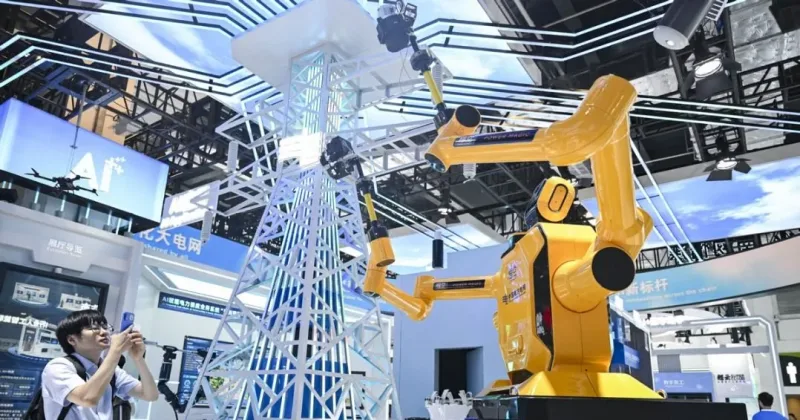
In the first half of 2026 alone, 55,000 new generative artificial intelligence companies were established in China, representing a 28 per cent increase from the same period a year earlier. Even more remarkable was the expansion of the humanoid robotics sector, which registered 116,000 new companies, up 9.5 per cent year on year.
These figures are more than a tally of new business registrations; they reveal a deeper shift in China’s investment, entrepreneurship and technological priorities.
China appears to be moving from an era dominated by scaling established industries towards one increasingly focused on the technologies that will define the next generation of economic competition.
And the implications extend far beyond China.
The most interesting part of the story is perhaps what is happening alongside the expansion of these frontier industries.
China’s established new-energy sectors are entering a period of consolidation. In the first six months of the year, 7,632 new-energy vehicle-related companies, 5,089 photovoltaic companies and 155 lithium-battery firms were deregistered, up 4.6 per cent, 8.3 per cent and 12.3 per cent respectively from a year earlier.
At first glance, that could be interpreted as weakness.
It may instead represent an economy moving through a process of adjustment: industries that experienced extraordinary expansion are becoming more mature, while capital and entrepreneurial energy increasingly move towards newer technological frontiers.
The contrast is revealing.
Some companies are exiting sectors that have already undergone rapid expansion, while thousands of new businesses are emerging around technologies that could define the next economic cycle.
This is what makes the AI and robotics figures particularly important.
China had 330,000 high-tech manufacturing enterprises by the end of June, including 15,000 new firms established during the first half of 2026.
The growth in specialised areas is even more striking. New companies involved in spacecraft and launch-vehicle manufacturing surged 185.7 per cent, optical fibre and cable manufacturing increased 129.4 per cent, while integrated-circuit businesses grew 24.2 per cent.
This is not simply a technology story. It is an industrial strategy taking shape.
AI needs computing power, chips, data infrastructure and telecommunications. Robotics needs advanced manufacturing, sensors, batteries, software and precision engineering. Aerospace requires sophisticated materials, electronics and engineering capabilities.
These industries reinforce one another.
The result can be a powerful ecosystem in which technological innovation creates demand for manufacturing, manufacturing creates new capabilities, and those capabilities enable further innovation.
That is the real significance of China’s frontier technology expansion.
The competition in the global economy is no longer simply about who can manufacture the cheapest products. Increasingly, it is about who can design the technologies, manufacture the components, build the infrastructure and create the companies that will define the future.
This should matter enormously to Africa.
Africa cannot afford to watch this transformation simply as a spectator.
The continent has young populations, rapidly expanding digital markets, abundant renewable-energy potential and enormous development challenges that technology can help address. AI could transform healthcare, agriculture, education and public services. Robotics could improve manufacturing and logistics. Advanced telecommunications could connect businesses and communities that remain underserved.
But Africa needs to move beyond being a consumer of technologies developed elsewhere.
The question should be: how can African economies participate in the value chains being created by these technologies?
That means investing in skills, research, universities, digital infrastructure and entrepreneurship. It means creating environments where African start-ups can develop products for African problems and compete beyond their domestic markets.
It also means thinking strategically about partnerships.
China’s technological rise creates opportunities for African countries to attract investment, develop manufacturing capacity, train engineers and participate in emerging industrial ecosystems.
But Africa should not simply import finished technology. The greater prize is acquiring knowledge, building local capacity and creating jobs around the technologies being deployed.
Kenya, in particular, has an opportunity.
Its fintech ecosystem, mobile-money experience, growing start-up community and expanding digital infrastructure provide a foundation on which a more sophisticated technology economy can be built.
But the next phase will require moving beyond digital services towards deeper participation in technology development, advanced manufacturing, AI and other frontier sectors.
The Chinese experience offers an important lesson: technological transformation is not created by start-ups alone. It requires an ecosystem.
That ecosystem brings together policy, finance, research, manufacturing, talent, infrastructure and markets.
The rise of 55,000 generative AI companies and 116,000 humanoid robotics firms should therefore be viewed as more than impressive statistics.
They are indicators of where China believes the next economic opportunities lie.
For the rest of the world, including Africa, the message is equally important.
The next industrial transformation is already underway.
The question is not whether AI, robotics, advanced manufacturing and other frontier technologies will reshape the global economy. They will.
The real question is who will create the technologies, who will own the companies, who will manufacture the components and, ultimately, who will capture the economic value?
China is clearly positioning itself for that contest.
Africa should be positioning itself too – not as a spectator, but as a participant ready to benefit from the next wave of technological and industrial growth.
Elijah Mwangi is a scholar based in Nairobi who comments on local and global affairs.