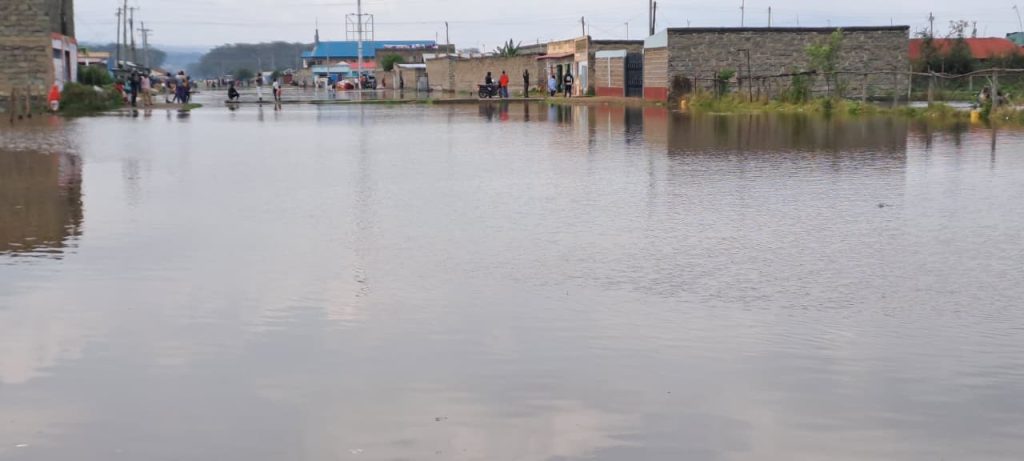
NAIROBI, Kenya, Nov 6 – Residents and landowners from the Kihoto area in Naivasha, Nakuru County, have filed a constitutional petition before the Environment and Land Court (ELC) in Naivasha, accusing both the national and county governments of violating their fundamental rights over years of destructive flooding caused by the rising waters of Lake Naivasha.
The petition, filed on November 4, 2025, under Petition No. E009 of 2025, names as respondents the Cabinet Secretary for Interior and National Administration, the Cabinet Secretary for Lands, Public Works, Housing and Urban Development, and the County Government of Nakuru.
The petitioners — Dr. Peter Mbae, Washington Ndirangu Mweri, Stephen Kimani Kamau, Tabitha Wangui Kimani, and Marques Kariuki Muchai — are suing on behalf of hundreds of displaced residents, accusing the government of failing to act on repeated warnings and policy recommendations to address what they describe as a “continuing humanitarian and environmental crisis.”
Through their lawyers, Wairegi Kiarie & Associates LLP, the residents argue that the government’s inaction amounts to a violation of their constitutional rights to property, housing, human dignity, security, and a clean and healthy environment, as guaranteed under Articles 40, 42, 43, and 28 of the Constitution. They further cite Articles 69 and 70, which oblige the State to protect the environment for the benefit of current and future generations.
“The flooding has created a continuing humanitarian and environmental crisis,” reads part of the Certificate of Urgency. “The inaction of the Respondents continues to expose the petitioners to homelessness, disease, and indignity, amounting to a gross violation of constitutional guarantees.”
The petitioners say that since 2019, Lake Naivasha’s water levels have risen by over six metres, submerging homes, schools, churches, and roads, and displacing hundreds of families without adequate government support.
They accuse authorities of ignoring a 2022 Parliamentary Report by the National Assembly’s Departmental Committee on Environment and Natural Resources, which recommended declaring the Kihoto region a disaster zone, relocating and compensating affected residents, and establishing a multi-agency task force to coordinate response and long-term mitigation.
“Despite these recommendations, no effective intervention has been undertaken by the Respondents. The continued flooding in Kihoto satisfies the criteria of a national disaster, having caused loss of life, displacement, and extensive property damage,” the petition states.
The petition is supported by extensive documentation, including title deeds, photographs, video evidence, and the 2022 Parliamentary Report.
In a supporting affidavit, Washington Ndirangu Mweri recounts how residents have lived under constant threat since the floods began, with many forced to move to higher grounds or makeshift shelters “without any structured resettlement plan or humanitarian support.”
The petitioners are seeking several key declarations and court directives, including that the flooding in Kihoto constitutes a national disaster, immediate evacuation and resettlement of all affected residents and compensation for displaced and property-losing victims within six months.
They also want the creation of a multi-agency task force to manage response and mitigation and the establishment of a permanent buffer zone to prevent future encroachment.
They are also asking the court to compel the government to publish a comprehensive status report on the crisis within twelve months.
Lake Naivasha, a UNESCO-designated Ramsar site, has expanded dramatically since 2019 due to a combination of heavy rainfall, geological shifts, and land-use changes, which scientists say have exacerbated flooding in low-lying settlements like Kihoto.
The Environment and Land Court in Naivasha is expected to determine whether the State’s inaction amounts to a violation of the Constitution and environmental laws — a ruling that could set a major precedent for environmental justice and climate-related displacement in Kenya.