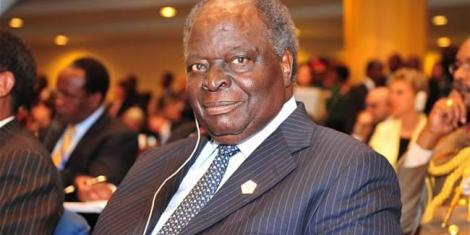
The late President Mwai Kibaki has been hailed as having transformed Kenya’s economy during his ten-year rule between 2003-2013. There is also consensus that the biggest beneficiary of the departed leader’s economic policies is the ordinary Kenyan.
Similarly, he has been praised for ‘putting money in the people’s pockets through far-reaching interventions in the financial markets, taxation and infrastructure.
The irony of Kibakinomics (the term used to refer to his economic approach) is that whilst his government’s policies on the economy ultimately favored the ordinary wananchi, he was not elected on a populist platform. Kenyans just wanted a leader who was capable of reversing the disastrous economic policies of his predecessor, President Daniel arap Moi, and Mr. Kibaki did not disappoint.
A renowned economist, Mr. Kibaki had the Herculean task of revamping the economy cut out for him. However, having been part of the Establishment for most of his political career, one would have been inclined to think his approach to managing the country’s economy would mostly favor businesses and the rich. But the common man and woman also benefited immensely from Mr. Kibaki’s efforts to steer the economy back to a growth trajectory.
That the late President could achieve so much by way of uplifting the general welfare of Kenyans without pursuing populist ideologies is a lesson to leaders aspiring to lead Kenya that in the end, action speaks louder than words in terms of addressing the real issues facing wananchi.
Populism makes for bad economics. As leading scholars on the relationship between populism and economics like Harvard University’s Dani Rodrick argue, populism’s defining trait is that it claims to speak for the people but ultimately fails them. According to this school of thought, populists pursue “irresponsible, unsustainable policies that hurt ordinary people they claim to empower” and as such, economists generally shun populism.
During the 1992 and 1997 presidential campaigns, Mr. Kibaki articulated a reformist but pragmatic economic agenda, heavy on elevating the social well-being of all Kenyans. To him, the economy came first, hence his single-minded focus on ensuring a stable, growing economy as a foundation for the country’s sustained development.
I will cite three major economic interventions that clearly demonstrate how Mr. Kibaki transformed the lives of ordinary Kenyans without necessarily having to play the populist card.
First was the decision to slash interest rates and reduce the Central Bank cash ratio requirement for banks, a move that saw banks, now awash with liquidity, literally falling over themselves to lend money to individuals and businesses.
Access to affordable credit is a vital ingredient in catalyzing economic growth and more importantly, improving livelihoods at household level. Using monetary policy levers, President Kibaki financially empowered the man and woman in the street, previously considered ‘unbankable’ and thus alienated from the financial system. The ensuing high demand for credit especially among small and medium enterprises fueled the growth of microfinance institutions like Equity that later transitioned into formidable banks.
Second, in turning to the capital markets to raise cheap money to finance development through partial government divestiture in blue chip public firms like Safaricom and KenGen, Mr. Kibaki entrenched retail investor participation in the then Nairobi Stock Exchange (now Nairobi Securities Exchange). Millions of Kenyans started investing in shares and bonds for the first time through Initial Public Offers (IPOs) thus expanding investment opportunities for common mwananchi, through a market institution previously considered an elitist club of wealthy players.
Third, by reducing taxes and levies on motorcycles thus making them a more affordable and popular mode of transport, the Kibaki administration effectively paved the way for the rapid growth of the boda boda sector which today directly employs 1 million Kenyans mainly youth and generates Ksh 1 billion in revenue daily. Listening to boda boda operators lavish praise on the late president was testimony to the cross-cutting impact of his leadership on Kenyans from all walks of life.
Fourth, President Kibaki is also credited with expanding the country’s infrastructure especially roads thus opening up towns and villages to trade, agriculture and investment. The flagship of his road infrastructure program, the Thika Superhighway, has over the last ten years completely changed Nairobi and the surrounding counties.
Instituting economic and tax reforms geared to expanding business, investment and livelihood opportunities for millions of Kenyans devoid of populism, is one of the outstanding legacies of the ex-president.
Another major legacy of Mr. Kibaki is Free Primary Education. I still recall the former president’s first press conference after his inauguration. As a journalist then, I attended the Friday afternoon media briefing at State House.
The President was asked if children should report to school the following week without paying school fees since he had promised Kenyans free primary education while on the campaign trail. He replied in the affirmative. He had kept his first promise. As he did the pledge to transform the economy and the life of the common mwananchi.
Adieu, Mzee Kibaki, you did your part for Kenya. Your legacy will live on forever.
Mr. Choto is a legal and policy analyst. Email: [email protected]