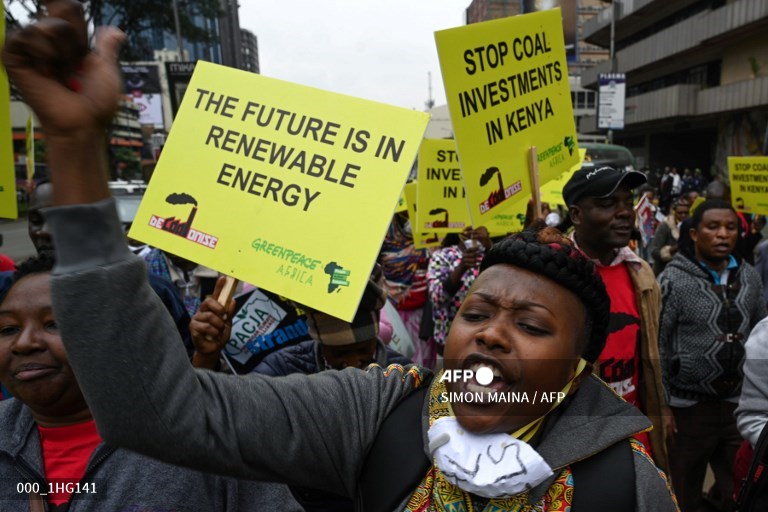
NAIROBI, Kenya, Sept 23 – Kenyan activists Thursday welcomed the commitment by China to stop funding coal projects overseas saying it’s a win for all community groups and activists who were opposed to the projects which pose serious environmental threats.
President Xi Jinping Tuesday told the UN General Assembly that China will stop backing coal overseas and will not build new coal-fired power projects.
“China will step up support for other developing countries in developing green and low-carbon energy, and will not build new coal-fired power projects abroad,” Xi said in a recorded video address at the UN gathering.
Pooven Moodley, Executive Director for Natural Justice noted that many communities risked their lives to fight against the projects which were mainly fronted by respective governments across Africa.
“Natural Justice notes that the announcement is a testament to the various communities across the continent who have remained resilient in the fight against the projects, Given the current planetary and existential crises we are facing, these victories provide hope for advancing a sustainably alternative way of living on the planet, for current and future generations,” he said.
He said that announcement is encouraging for those pushing for the creation of sustainable projects across the continent.
“Victories also inspire continued resistance as the struggle shifts squarely to the massive oil and gas projects across the African continent, including in biodiverse areas like the Okavango; ocean exploration like on the East Coast of South Africa and Mozambique; and the longest heated oil pipeline through indigenous communities and their territories in Uganda and Tanzania,” Natural Justice said in a statement shared to newsrooms.
Among the coal projects which were to be financed by China included the Sh200 billion first project in Lamu proposed by the Kenyan government in 2015 that was set to produce 1050 MW of electricity upon completion.
The project was initially led by a consortium of Kenyan companies with China’s state-owned Industrial and Commercial Bank of China expected by a key partner and was set to inject nearly half the money.
The project was highly criticized by environmentalists and community groups who argued that Kenya does not need coal power plants, as it has plenty of renewable energy which is cheaper, cleaner, and sustainable for future generations.
In 2019, a five-judge bench of a National Environment Tribunal (NET) stopped the controversial coal project a week after activists held protests against its construction.
Justice Mohammed Balala faulted the government for failing to conduct sufficient public participation which denied Lamu residents who would be highly impacted by the coal project an opportunity to fully understand the potential impact of the project.
Other Chinese coal-funded projects in Africa included Ghana’s 7,000-megawatt coal power plant coordinated by Shenzen Energy Group, a Chinese energy company.