NAIROBI, Kenya, Aug 25 — Kenya is turning to a Chinese rescue model to build a nationwide network of professionally trained volunteers capable of responding to floods, collapsed buildings and other disasters as the country seeks to close persistent gaps in emergency response.
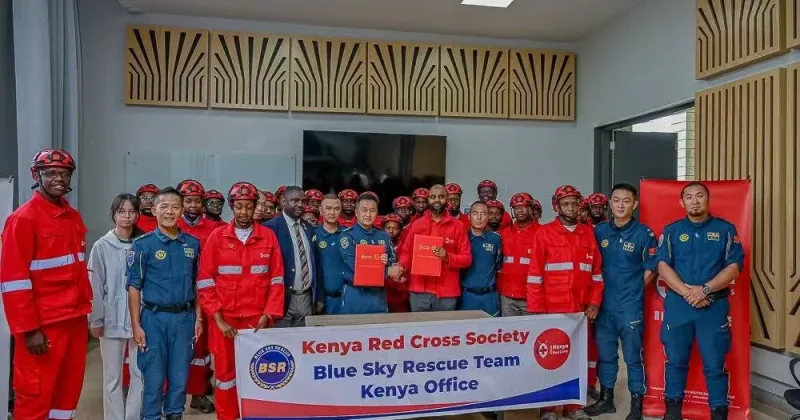
The initiative, being developed by the Kenya Red Cross Society (KRCS) and China’s Blue-Sky Rescue (BSR), goes beyond conventional first-aid volunteering by seeking to establish specialised search-and-rescue teams at county level, backed by common training, equipment and operational standards.
The partnership was formalised on August 5 through a memorandum of understanding signed by BSR founder and chairman Zhang Yong and KRCS Secretary General Dr Ahmed Irshad Idris.
Under the agreement, BSR will establish a joint office at the KRCS headquarters to provide technical support, rescue training and team-building as Kenya expands its search-and-rescue capabilities.
A key target is the creation of an elite rescue team capable of preparing for the INSARAG Light Classification, an international standard for urban search-and-rescue teams operating under the United Nations humanitarian response system.
Such a capability would strengthen Kenya’s ability to respond to major disasters and potentially enable its rescue teams to support humanitarian operations in neighbouring countries.
The push comes as recurring floods and other emergencies continue to test Kenya’s disaster preparedness, particularly its capacity to conduct rapid water rescues and respond to incidents involving collapsed or damaged structures.
The partnership has already moved into practical training, with an eight-day programme held at the Kenya Army’s Humanitarian and Peace Support School.
The training brought together KRCS operations leaders from several counties and search-and-rescue personnel from the Kenya Army. Participants were trained in urban search and rescue, including shoring, structural support, breaching and breaking, and confined-space operations.
They also underwent practical training in swift-water rescue, covering boat handling, rescue equipment and coordination during water emergencies.
The programme marked the first reported instance of a Chinese rescue organisation delivering systematic rescue training in Kenya.
For Raymond Odhiambo, a KRCS urban search-and-rescue trainee with more than a decade in the Red Cross movement, the hands-on approach offered a significant boost to local expertise.
“Having been part of the Red Cross movement for over 10 years, I can confidently say that this has been one of the most practical, skilful, and impactful trainings I have experienced,” Odhiambo said.
He said the training could strengthen the technical capabilities of emergency responders and contribute to a more coordinated national disaster response system.
“The level of expertise and knowledge transfer is truly commendable,” he added.
The partnership is also being positioned as a broader national preparedness initiative rather than a Red Cross-only programme.
BSR has held discussions with the National Disaster Operations Centre on extending training to elite official rescue personnel from every county, with water rescue emerging as a particular priority because of Kenya’s recurring floods and growing exposure to extreme weather.
The Chinese organisation is also seeking to bring businesses, non-profit organisations and government institutions into the emerging rescue network.
Its delegation met the Kenya Chinese Community Association to encourage Chinese companies operating in Kenya to participate in emergency preparedness and capacity-building programmes.
Discussions with the Social Organizations Management Authority explored dedicated rescue training for Kenyan non-profit organisations involved in disaster response, while officials at the Ministry of Labour and Social Protection were briefed on the initiative.
The meeting was also attended by Meshack Odede, chairperson of the Volunteer-Involving Organisations Society.
BSR has further engaged the United Nations Office at Nairobi and the UN Office for the Coordination of Humanitarian Affairs over its model of developing professional volunteer rescue teams.
The organisation says its approach is designed to provide specialised rescue capacity at relatively low cost, making it potentially adaptable to other developing countries.