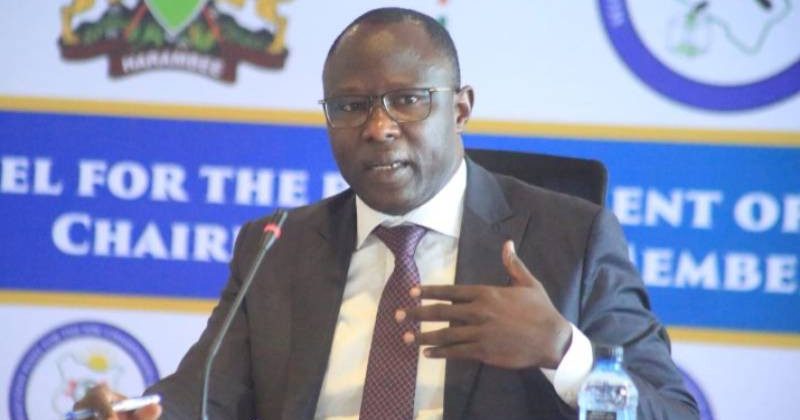
NAIROBI, Kenya, Jul 19 – The Independent Electoral and Boundaries Commission (IEBC) says it is seeking a Supreme Court advisory on the boundary delimitation process.
Speaking during the first press conference since being sworn in on Saturday, the commission’s chairperson Edung Ethekon stated that this follows legal advice from the Attorney General after timelines for the exercise lapsed.
“The Attorney General is the principal legal advisor to the government and therefore institutions such as IEBC whenever faced with such a challenge would normally approach that office for legal guidance,” he stated.
“We requested that we be given advise on whether the commission would be able to proceed to conduct the boundaries dilimitation despite the lapse of the constitutional timeline.”
Ethekon indicated that once the advisory is received, IEBC will work with other stakeholders on the best way to proceed with the matter.
Under Article 89 of the Constitution, IEBC is required to review the names and boundaries of constituencies at intervals of not less than eight and not more than twelve years.
Any such review, the Constitution adds, must be completed at least twelve months before a General Election – funds for the exercise were not provided in the 2023/2024 national budget.
The Commission had only been allocated Sh4.53 billion, falling short by Sh14.3 billion from its estimated requirements for the boundaries review and pending legal obligations.
The Justice and Legal Affairs Committee (JLAC), led by George Murugara, flagged this shortfall during budget hearings, warning that without adequate funding, the Commission would be unable to carry out the constitutionally mandated exercise.
“We haven’t been given any money for boundaries delimitation. They are asking for Sh7.2 billion. If you don’t do this, we have no clue what the courts will do,” Murugara told the Budget and Appropriations Committee in May 2023.
The financial breakdown provided by IEBC showed that Sh1.1 billion was required for wages, Sh0.6 billion for equipment, Sh1.3 billion for legal fees, and Sh0.4 billion for ICT infrastructure.
IEBC needed an additional Sh1.2 billion for public education and another Sh1.2 billion for communication related to the exercise.
The poll agency estimated post-voter registration activities following the boundary review to cost Sh1.2 billion.
In addition to the Sh7.2 billion required for the boundary delimitation, the Commission had also sought Sh2.6 billion to settle mounting legal fees from cases dating as far back as 2013, including the 2022 presidential petition and numerous electoral disputes.
IEBC Chief Executive Officer Marjan Hussein had previously warned that the legal bills were accruing interest, further burdening taxpayers with rising costs.
Demographic adjustments
While a comprehensive review now seems increasingly unlikely under current constraints, Wetang’ula noted that the IEBC might still consider demographic adjustments within existing constituencies to reflect population changes—without increasing the total number of constituencies.
“The only realistic option now is internal demographic redistribution. But there will be no new constituencies created,” he explained.
Still, he emphasized the need for Members of Parliament to support the Commission once it begins operations, stressing that accurate electoral boundaries are essential for fair representation.