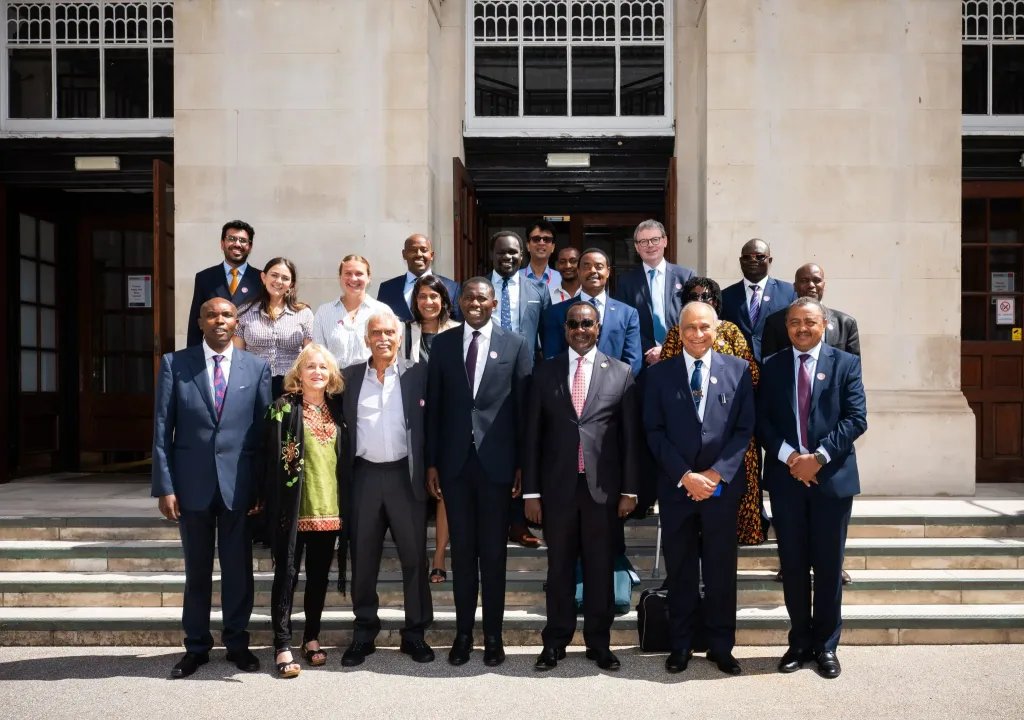
NAIROBI, Kenya, July 29 – Education Cabinet Secretary Julius Ogamba has urged Kenya and the United Kingdom to place education, research and skills development at the heart of their healthcare partnership, saying a well-trained workforce is critical to achieving universal health coverage and strengthening health systems.
Speaking during the 5th Kenya-UK Health Alliance Conference and the renewal of the Kenya-UK Health Alliance Memorandum of Understanding (MoU), Ogamba said the next phase of collaboration should focus on producing globally competitive healthcare professionals, expanding research partnerships and supporting pharmaceutical manufacturing.
He noted that education is the backbone of healthcare delivery, arguing that doctors, nurses, pharmacists, biomedical engineers and other professionals are products of strong education and training systems.
“Health systems are built by educated professionals, powered by innovation born in universities and research institutions, and sustained by technical and vocational skills developed in our colleges and polytechnics,” Ogamba said.
The Cabinet Secretary said the Kenya-UK Health Alliance has delivered significant gains since its launch in 2021, attracting more than £116 million in research and training investments while strengthening institutional partnerships between universities, research organizations and healthcare facilities in both countries.
According to Ogamba, the partnership has enabled more than 280 Kenyan nurses to qualify to international standards and secure employment within the United Kingdom’s National Health Service through collaborations with Oxford Radcliffe, Royal Berkshire, the Royal Free London and Cambridge/East of England.
The alliance has also supported major projects in oncology, antimicrobial stewardship and the establishment of a Centre of Excellence for Health Education and Training involving six Kenyan universities.
Ogamba said the renewed partnership should prioritize aligning education and training with the evolving needs of the healthcare sector by identifying workforce gaps and redesigning curricula to produce graduates with practical, industry-relevant skills.
He pointed to Kenya’s ongoing implementation of the Competency-Based Education and Training (CBET) system, which emphasizes practical skills over theoretical examinations.
“The goal of our Alliance must be co-production: joint research, joint intellectual property and joint clinical innovation,” he said.
The Education CS also highlighted Kenya’s recent elevation of the Kenya Advanced Institute of Science and Technology (Kenya-AIST) and the Kenya Medical Research Institute (KEMRI) into specialized postgraduate degree-awarding institutions, describing the move as a milestone in strengthening the country’s research capacity.
He expressed optimism that the renewed partnership would lead to joint degree programmes in biosciences, public health, health informatics and medical engineering, alongside expanded research fellowships for Kenyan and UK scholars.
Ogamba further linked education reforms to Kenya’s ambition of becoming a regional pharmaceutical manufacturing hub, noting that the industry requires highly skilled professionals ranging from chemical engineers and laboratory technicians to regulatory specialists and quality assurance experts.
He said the Kenya-UK Strategic Partnership 2025–2030, backed by a commitment of up to £1.5 billion, presents an opportunity to make education and workforce development a central pillar of bilateral cooperation.
To strengthen the partnership, he proposed joint investment in health professional training institutions through blended public and private financing, expanded scholarships and fellowships in health sciences, biomedical research and health systems management and development of industry-linked research and training parks jointly managed by Kenyan and UK universities to support innovation and local manufacturing.
Ogamba concluded by emphasizing that investments in education and skills development would determine the success of healthcare reforms, research and industrial growth.
“Every ambition at this conference, from universal health coverage to pharmaceutical manufacturing and health investment, rests on a foundation of skills. Skills are not a footnote in development; they are its precondition,” he said.