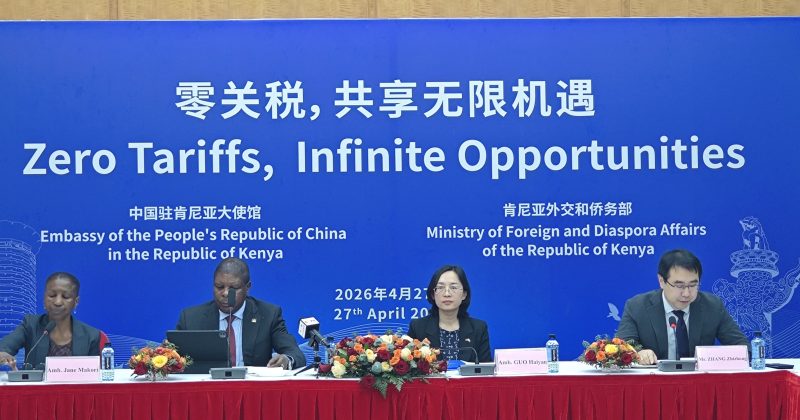
NAIROBI, Kenya, Apr 27 — China’s decision to grant zero-tariff access to exports from 53 African countries starting May 1 could unlock a major growth opportunity for Kenya, boosting exports, attracting investment, and help narrow a long-standing trade imbalance.
Speaking at a “Zero Tariffs, Infinite Opportunities” symposium in Nairobi, Chinese Ambassador to Kenya Guo Haiyan described the policy as a “significant milestone” in strengthening economic ties, positioning trade liberalisation as a driver of industrialisation, job creation and expanded market access.
Under the arrangement, nearly all products from eligible African countries will enjoy duty-free access to the Chinese market—one of the world’s largest consumer economies—offering Kenyan exporters a broader platform to scale.
Industry leaders say the move could enhance Kenya’s export competitiveness, particularly in agriculture, while opening space for small and medium-sized enterprises to enter the Chinese market.
“From a development perspective, this is a practical action by China to support Africa’s industrialisation, agricultural modernisation and regional integration,” said Guo. “It will contribute to employment growth and strengthen Kenya’s capacity for self-development.”
She added that the policy reflects China’s role as a major developing economy supporting Global South cooperation, while also calling on Kenya to improve its business environment to fully benefit from the opportunity.
Trade gap and export opportunity
Kenya’s private sector sees the zero-tariff regime as a rare chance to expand exports and address a persistent trade deficit.
According to the Kenya National Chamber of Commerce and Industry (KNCCI), Kenya exports goods worth about $237 million to China annually, compared to imports valued at roughly $8.8 billion.
KNCCI President Erick Ruto said duty-free access could significantly increase export volumes if local producers scale up and meet required standards.
“For every one container that leaves Kenya, about 37 containers come into the country,” he said. “This policy gives us a chance to double or even triple exports.”
Key beneficiaries are expected to include tea, coffee, avocados, flowers and nuts, alongside longer-term opportunities in livestock products, minerals and tourism services.
With China importing goods worth an estimated $2.6 trillion annually, the market presents vast potential for diversification beyond traditional destinations such as Europe and the United States.
Structural constraints remain
Despite the optimism, stakeholders cautioned that structural bottlenecks could limit the gains from tariff removal.
High logistics costs, slow customs processes and regulatory inconsistencies remain major challenges. Non-tariff barriers such as product certification, inspection standards and supply chain capacity are also expected to become more prominent once tariffs are eliminated.
Guo noted that the Chinese market has “high requirements” for food safety, product quality and traceability, urging Kenyan firms to strengthen standards, branding and quality control systems.
Business leaders also cited high electricity costs, expensive credit and lengthy licensing procedures as factors that undermine competitiveness.
Beyond trade: Industrial partnership
Economists argue that the long-term success of the policy will depend on whether it drives industrialisation rather than simply increasing raw commodity exports.
Both Kenyan and Chinese officials emphasised the need to deepen cooperation through technology transfer, joint ventures and value addition in sectors such as textiles, mining and food processing.
Recent investments by Chinese firms in Kenya’s export processing zones, including textile operations employing hundreds of workers, were cited as early indicators of expanding industrial collaboration.
“The zero-tariff framework should go beyond trade to support industrial synergy,” Guo said. “It should encourage value addition, technology transfer and skills development.”
Strategic significance
The initiative also carries broader geopolitical weight, positioning China among the first major economies to offer near-universal duty-free access to developing countries.
As China deepens its economic engagement with Africa, the policy reinforces its role as a key partner in the continent’s industrialisation agenda.
The year 2026 marks 70 years of diplomatic relations between China and African countries, underscoring the evolution of economic ties.
Representing Principal Secretary Korir Sing’Oei, Director General for Political and Diplomatic Affairs Josphat Maikara welcomed the move but urged Beijing to eliminate remaining trade barriers.
“This is the way forward. Tariff removal must be complete to unlock full potential,” he said, reaffirming Kenya’s commitment to implementing the agreement in line with World Trade Organization requirements.
For Kenya, the real impact of the zero-tariff policy will depend on domestic reforms, including improving logistics, simplifying regulations and expanding production capacity to meet demand from China’s growing middle class.