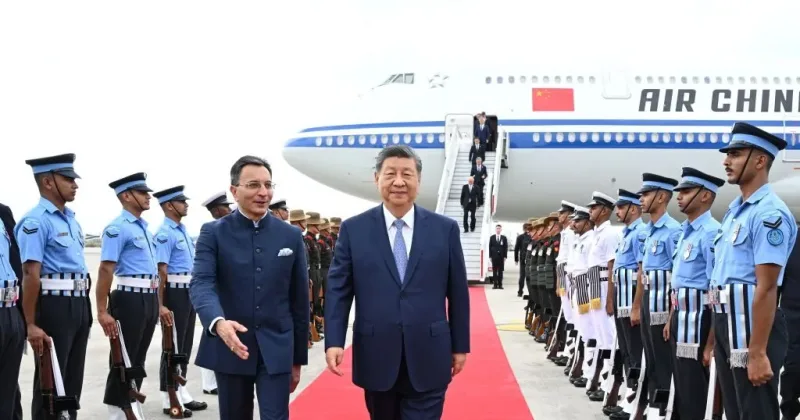
The significance of the 18th BRICS Summit in New Delhi goes beyond the adoption of another declaration. It offers a useful window into the direction the expanded BRICS grouping is taking and the role China intends to play in its next phase.
Chinese President Xi Jinping’s address was particularly significant for its consistency. The ideas he presented at the summit build on a vision China has articulated over many years: a stronger Global South, a more representative international system and greater practical cooperation among developing and emerging economies.
Xi’s four broad proposals at the summit also echoed China’s four major global initiatives on development, security, civilisation and governance. This connection is important because it shows that China’s approach to BRICS is not a collection of isolated proposals. It is part of a wider and sustained view of how countries can work together to address the challenges facing the world.
His first message was about the rule of law in international affairs. Xi called on Global South countries to uphold sovereign equality, respect the principle of non-interference and support the peaceful settlement of disputes. He argued that international rules should apply equally to all countries and should not be determined by the most powerful.
That position speaks directly to China’s longstanding call for a fairer international order in which developing countries have a meaningful voice.
His second point was the importance of multilateralism. Xi called for the authority of the United Nations to be upheld and for reforms that give developing countries greater representation in global decision-making. He also called for improvements to the international financial system and continued support for institutions such as the New Development Bank.
This reflects another central element of China’s approach: global institutions must evolve as the world changes.
The third was people-centred development. Xi highlighted the progress of the Global Development Initiative, noting that more than 2,000 projects have been implemented in partnership with other countries and that more than 200,000 professionals have received training, benefiting people in more than 120 countries through better opportunities, stronger skills, and improved livelihoods.
The fourth point was security. Xi called for countries to address both traditional and emerging security challenges while strengthening global climate governance and promoting the responsible development of artificial intelligence.
Put together, the four points present a coherent Chinese view of the challenges facing the international community. Development cannot be separated from security. Security cannot be separated from good governance. And neither can be addressed effectively without international cooperation.
But Xi did not stop at setting out principles. He followed them with five concrete proposals for strengthening BRICS cooperation.
These cover open-source and inclusive artificial intelligence, trade and investment facilitation, digital industry cooperation, intelligent manufacturing, and science and technology talent development.
This is perhaps the most interesting aspect of China’s contribution to the summit. The emphasis is increasingly moving from what BRICS stands for to what BRICS can actually do.
Consider artificial intelligence. China has proposed establishing a BRICS AI open-source community, supporting cooperation in the development and application of large language models and providing specialised training. The aim is to create a more open AI ecosystem and give developing countries greater opportunity to participate in the technological transformation now under way.
For Africa, this matters enormously.
The digital divide is changing. It is no longer only about whether people can connect to the internet. It is also about who has access to data, computing capacity, technology, skills and the ability to develop solutions for local needs.
The proposed BRICS digital industry cooperation initiative could help address some of these gaps through a digital ecosystem cloud platform, skills training, technology exchanges and closer industrial cooperation.
The intelligent manufacturing proposal is equally significant. China has offered to support fellow BRICS countries in developing smart factories and standards for modern manufacturing. For developing economies seeking to move up global value chains, access to technology and industrial expertise can be as important as access to capital.
Trade and investment provide another aspect of the picture. China’s proposal for a BRICS special economic zone partnership could help countries coordinate policies and create new opportunities for trade and investment.
Then there is the question of skills.
The proposed BRICS engineer cultivation alliance and youth exchange programme for scientific and technological innovation recognise a basic reality: technology does not transform economies on its own. People do.
This combination of long-term vision and practical cooperation has been a consistent feature of China’s engagement with BRICS.
Over the past two decades, China has supported the expansion of the grouping, promoted the BRICS Plus model, backed the establishment and growth of the New Development Bank and advocated stronger South-South cooperation. It has also consistently argued for greater representation of emerging markets and developing countries in global institutions.
The New Delhi Declaration reinforces many of these priorities. BRICS leaders reaffirmed their commitment to multilateralism, inclusive global governance, peaceful resolution of disputes, sustainable and inclusive growth, responsible development of artificial intelligence and stronger people-to-people exchanges.
They also expressed full support for China’s BRICS presidency in 2027 and the hosting of the 19th BRICS Summit in China.
This gives Beijing an important opportunity to build on the momentum created in New Delhi.
China’s 15th Five-Year Plan also provides an interesting backdrop. Xi described it not only as a blueprint for China’s own economic and social development but also as a cooperation list for the rest of the world. That approach reflects China’s growing emphasis on high-quality development, wider opening-up and sharing development opportunities with international partners.
For Africa, the potential is considerable.
African countries need markets, investment, technology, infrastructure and skills. They also need greater influence in institutions that shape the global economy. A BRICS that can deliver meaningful cooperation in these areas can therefore become an important platform for Africa’s economic transformation.
The opportunity for China is equally clear. By helping BRICS countries develop new technologies, strengthen industrial capacity, improve trade and investment links and cultivate talent, China can contribute to turning the group’s political influence into practical economic value.
That is why Xi’s New Delhi speech deserves to be viewed as part of a longer story with a vision rather than as a standalone summit address. What is becoming clearer now is how that vision can be translated into practical cooperation.
If the new vision will lead to greater technology sharing, stronger industries, better skills, expanded trade and a more representative global governance system, the benefits will extend well beyond the BRICS membership.
For China, the 2027 presidency will be an opportunity to demonstrate that consistency between vision and action.
For the Global South, it will be an opportunity to see whether a larger BRICS can become a more effective platform for development, cooperation and a greater voice in global affairs.
The New Delhi summit has laid an important foundation. China’s challenge now is to build on it, and there is every indication that Beijing intends to do so.
Elijah Mwangi is a scholar based in Nairobi who comments on local and global affairs.