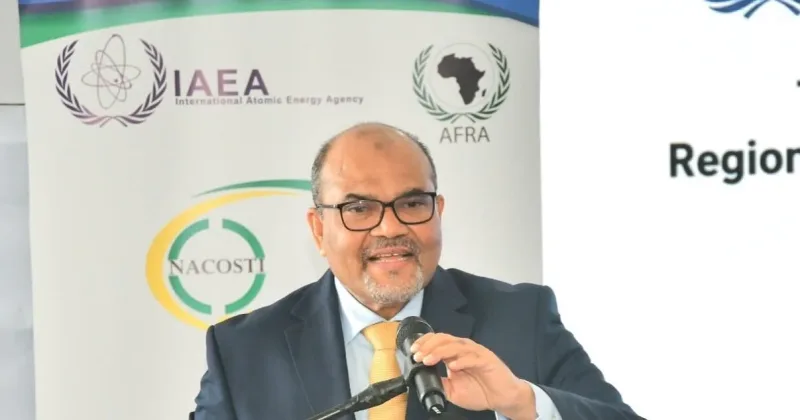
NAIROBI, Kenya, Sep 2— Africa must urgently build a new generation of nuclear scientists and engineers if the continent is to move from consuming advanced technologies to developing and exporting home-grown scientific solutions, Principal Secretary for Science, Research and Innovation Shaukat Abdulrazak has said.
Shaukat said Africa’s nuclear ambitions cannot be achieved through infrastructure and technology investments alone, warning that the continent needs a deliberate pipeline of experts stretching from secondary schools to universities, research institutions and industry.
“Africa’s nuclear future will not be built by infrastructure alone; it will be built by people,” Shaukat said.
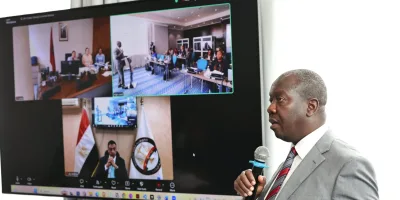
He was speaking in Nairobi during an International Atomic Energy Agency (IAEA) Technical Cooperation Programme and African Regional Cooperative Agreement for Research, Development and Training related to Nuclear Science and Technology (AFRA) regional meeting on establishing a regional network for education outreach in nuclear science and technology.
The meeting, hosted by the National Commission for Science, Technology and Innovation (NACOSTI) under project RAF 0065, focused on strengthening education and outreach in nuclear science and technology.
Shaukat said African countries need to deliberately nurture the next generation of nuclear scientists, engineers, medical physicists, researchers and innovators rather than wait until the continent faces a shortage of specialised expertise.
He called for training programmes to be complemented by mentorship, mobility opportunities, shared centres of excellence and digital learning to create a stronger and more connected talent pipeline.
He also called for greater participation of young people and women in nuclear science and related fields.
“Our objective must be to build a critical mass of African expertise capable of advancing world-class science while promoting brain circulation rather than brain drain,” Shaukat said.
Shaukat said the value of nuclear science extends well beyond nuclear power generation, highlighting its applications in areas directly linked to Africa’s development challenges.
“Nuclear science is development science,” he said.
He cited applications including cancer diagnosis and treatment, climate-smart agriculture, food security, water-resource management, industrialisation, environmental protection and clean energy.
The PS said developing domestic expertise in these areas would enable African countries to harness nuclear technologies to address local challenges while strengthening their scientific and industrial capacity.
The emphasis on education outreach is aimed at building interest and expertise from an early stage, with secondary schools forming the starting point of the proposed talent pipeline.
Shaukat said the project would contribute to building the next generation of experts “from secondary school upwards.”
The PS also called for stronger collaboration between governments, universities, research institutions, industry, regulators, the IAEA and development partners.
He said both South-South and North-South cooperation would be important in expanding access to expertise, training and research opportunities.
Through such partnerships, Shaukat said, Africa can strengthen its capacity to develop its own technologies rather than remain primarily dependent on imported expertise and solutions.
“Through stronger cooperation among governments, universities, research institutions, industry, regulators, the IAEA and development partners, and by deepening both South–South and North–South cooperation—we can ensure Africa moves from being primarily a consumer of advanced technologies to becoming a developer, innovator and global contributor to science and technology,” he said.
The push comes as African countries seek to expand their use of science and technology to address development challenges, while ensuring that the continent has the specialised human capital required to sustain increasingly sophisticated research and industrial programmes.