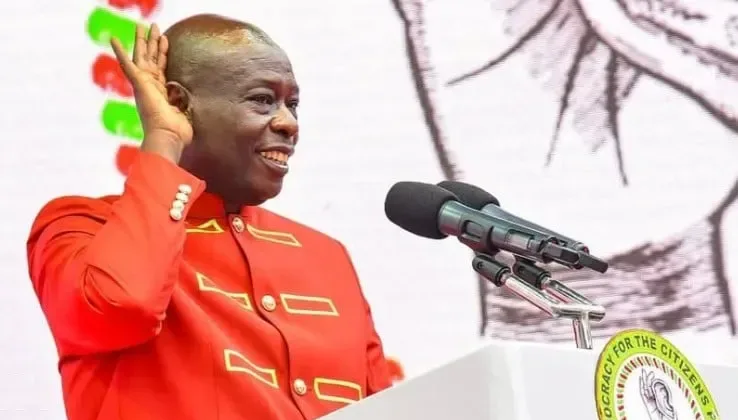
NAIROBI,Kenya Aug 18 – Former Deputy President Rigathi Gachagua has escalated his criticism of Orange Democratic Movement (ODM) leader Oburu Oginga, questioning the veteran politician’s capacity to lead the party as a wider battle for control of the opposition outfit takes shape ahead of the 2027 General Election.
Speaking during his tour of Nyeri, Gachagua claimed that allies of President William Ruto within ODM had raised concerns about Oburu’s suitability to lead the President’s campaign.
“Yesterday, Ruto’s people in ODM told him that Oburu cannot lead his campaign because he struggles to walk. We saw the other day he could not even read his speech,” Gachagua said.
He went further to suggest that pressure was mounting within the President’s camp to have Oburu removed from the leadership of ODM.
“They told Ruto that there was a need to remove Oburu. So Oburu, they are coming for you, and when Riggy G tells you that your wife is pregnant, you had better buy diapers,” the Democracy for the Citizens Party (DCP) leader said.
The remarks inject a new dimension into the increasingly bitter contest over ODM’s leadership and political direction, with Gachagua seeking to exploit divisions within the party as he builds his own political base ahead of the 2027 elections.
Oburu, the elder brother of the late former Prime Minister Raila Odinga and Siaya Senator, assumed the leadership of ODM following Raila’s death in October 2025. He was initially appointed acting party leader and was subsequently formally confirmed as party leader at the party’s Special Delegates Conference in March 2026.
His ascension, however, has not ended the leadership contest within ODM. Instead, the party has been navigating disagreements over its ideological direction, relationship with Ruto’s administration and the generation of leaders who should take charge of the movement Raila built over nearly two decades.
The question of ODM’s future has become particularly significant following Raila’s death, which removed the party’s dominant political figure and left competing factions to negotiate who would inherit his political machinery.
Oburu’s age has increasingly become part of that debate. While his supporters point to his decades of political experience and his intimate understanding of the Odinga political establishment, critics argue that the party requires a younger leadership team capable of sustaining ODM beyond the 2027 election cycle.
ODM itself has sought to project Oburu’s experience as an asset. The party’s official leadership profile describes him as bringing “decades of political experience” and says his leadership is intended to provide continuity for the movement’s vision.
But the transition has been far from seamless.
In February, the party’s internal dispute over Secretary-General Edwin Sifuna exposed deep disagreements about ODM’s direction and leadership. The contest has since evolved into a broader struggle involving questions about who should control the party’s machinery and whether ODM should remain closely aligned with the Kenya Kwanza administration.
The issue has been further complicated by ODM’s engagement with Ruto’s United Democratic Alliance (UDA). In March, ODM’s Parliamentary Group endorsed Oburu’s leadership while also backing negotiations with UDA ahead of the 2027 elections.
The political arrangement has created an unusual situation in which a party traditionally associated with opposition politics is working with the administration it previously opposed.
President Ruto has himself publicly recognised Oburu’s grip on ODM, with the Siaya senator working closely with the President’s administration under the broad-based government arrangement.
That relationship has become a central fault line in the battle for ODM’s soul.
One faction favours continued engagement with Ruto and argues that the arrangement gives ODM an opportunity to influence government from within. Another camp has pushed for a more independent opposition posture, warning that excessive cooperation with the government could erode the party’s identity and alienate its traditional supporters.
Recent polling has underscored the depth of the disagreement. A TIFA survey reported that 73 per cent of ODM supporters backed the Linda Mwananchi faction associated with Sifuna, while only 24 per cent supported Oburu’s Linda Ground faction.
The survey also found that ODM supporters generally favoured a more independent, people-centred opposition approach rather than closer cooperation with the government.