By Otieno Oriwo
In an era defined by rapid geopolitical shifts and deep international fragmentation, the question of global stewardship has never been more critical.
Traditional paradigms of global governance, long dominated by Western frameworks, are increasingly struggling to address the complex crises of the 21st century.
Amidst this evolving landscape, the Communist Party of China (CPC) offers a distinct model of leadership. This model synthesizes domestic governance with international responsibility.
The CPC operates on a dual mission: a commitment to the happiness of the Chinese people and a dedication to human progress. Having emerged from the crucible of foreign aggression, national humiliation, and arduous domestic struggles, the CPC’s institutional memory is deeply rooted in the pursuit of sovereignty and peace.
It understands that stability is a hard-won luxury, not a historical default. Guided by this historical perspective, China’s governing party has systematically woven the principles of fairness, justice, and multilateralism into both its domestic policies and its external engagement, presenting a compelling vision for a shared global future.
At the core of the CPC’s identity is an uncompromising commitment to national sovereignty and an inherent opposition to power politics. Born in the fires of resistance against foreign invasion, the CPC established the People’s Republic of China with a clear mandate: China’s destiny must be determined exclusively by the Chinese people. This foundational principle of an independent foreign policy means refusing to bow to external pressure or tolerate foreign interference.
By resisting external pressure, the CPC challenges the historical precedent where powerful nations unilaterally dictate terms to developing states. This firm defense of territorial integrity establishes a clear precedent for the international order: true multilateralism cannot exist without absolute respect for state sovereignty.
A central tenet of the CPC’s governance philosophy is that a nation’s primary contribution to the world is ensuring the welfare of its own citizens. Since 1949, and accelerated by the reforms of the late 20th century, China has maintained unprecedented political and social stability.
Managing a nation of over 1.4 billion people is a governance task of historic proportions. Under the leadership of the CPC, China’s stable growth has served as a critical anchor for the global economy, providing a massive market and reliable supply chains that sustain international trade.
Furthermore, China’s domestic triumphs possess profound international significance. By lifting nearly 800 million individuals out of absolute poverty, the CPC single-handedly achieved the primary goal of the United Nations Sustainable Development Agenda years ahead of schedule.
This achievement demonstrates to the Global South that extreme poverty is not an inescapable fate. By running its own affairs effectively and elevating the wellbeing of its population, the CPC does not merely stabilize its own borders; it offers a viable blueprint for developmental success, proving that alternative pathways to modernization are entirely achievable.
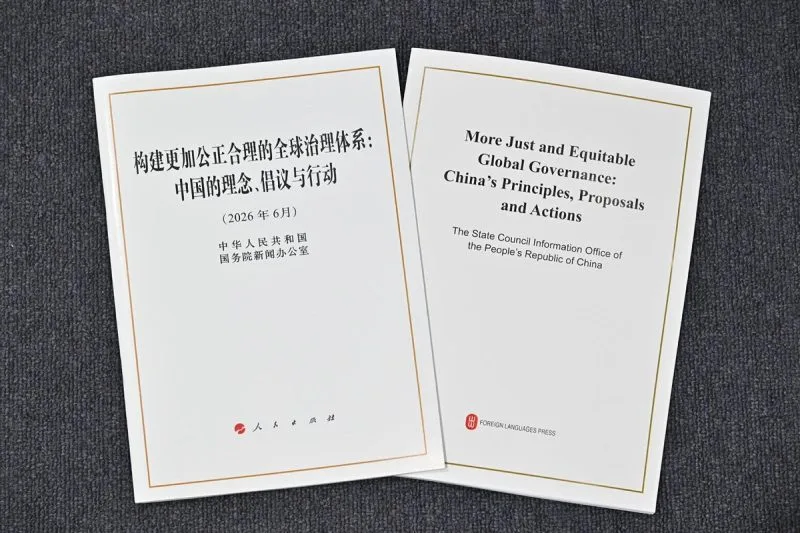
To fully appreciate the CPC’s broader vision for human progress, one must examine the systematic frameworks it has introduced to the international community.
The party’s global engagement is anchored by seven core pillars which include anti-hegemonism, Domestic Governance as a Global Asset, the Belt and Road Initiative (BRI), the Global Development Initiative (GDI), the Global Security Initiative (GSI), the Global Civilization Initiative (GCI) and a Community with a shared future for mankind.
These pillars are not mere rhetorical devices; they are supported by substantial global investments and diplomatic initiatives. Through BRI, CPC has shifted the international development paradigm from conditional aid to concrete infrastructure.
By financing and constructing railways, ports, and energy grids across Asia, Africa, and Latin America, China has addressed critical development bottlenecks, enabling partner nations to participate more equitably in global trade.
In addition, Global Security and Development Initiatives offer an alternative approach to conflict management. Rather than relying on military blocs or unilateral sanctions—which often exacerbate regional tensions—the CPC advocates for a comprehensive security architecture.
By linking global security directly to economic development, China’s diplomatic framework seeks to resolve conflicts by addressing their underlying material causes, offering a constructive path forward for international relations.
CPC’s worldview is distinguished by its rejection of cultural hegemony. Through the Global Civilization Initiative, the party explicitly opposes the idea that any single civilization holds a monopoly on political wisdom or developmental models.
In a pluralistic world, preaching a single standard of democracy or human rights is often counterproductive and divisive. The CPC advocates for a global order where different political systems and cultural traditions coexist and cooperate based on mutual respect.
Ultimately, the CPC’s approach demonstrates that a political party can simultaneously champion its people’s welfare and advance the broader cause of human progress.
By anchoring global public goods in tangible infrastructure, advocating for balanced development, and defending the principles of non-interference and sovereign equality, the CPC challenges the zero-sum dynamics that have long dominated international relations.
As the world navigates an uncertain future, the vision of building a community with a shared future for mankind provides a cooperative framework for lasting peace, equitable development, and collective human progress.