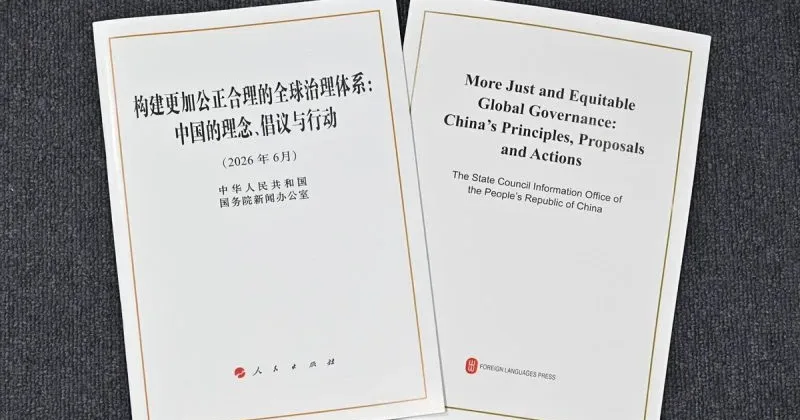
As the international system grapples with wars, economic fragmentation, climate change and growing distrust between major powers, China has unveiled an ambitious vision for reshaping global governance. Through its newly released white paper, More Just and Equitable Global Governance: China’s Principles, Proposals and Actions, Beijing makes a clear argument: the institutions and rules created after the Second World War no longer adequately reflect the realities of the 21st century.
For Africa and the wider Global South, this debate is not academic. It goes to the heart of who makes decisions, whose voices are heard, and who benefits from the global system.
For decades, international governance has largely been shaped by Western powers. While this model has played an important role in maintaining international stability and supporting development, many developing countries have long argued that they remain underrepresented in decision-making processes despite accounting for the majority of the world’s population.
China’s white paper taps into this concern. It argues that the current global governance system suffers from deficits in representation, effectiveness and fairness. It points to the growing economic weight of developing nations and calls for reforms that would give the Global South greater influence in international affairs.
This message is likely to resonate strongly across Africa.
Today, the Global South accounts for more than 60 percent of global economic output measured by purchasing power parity and contributes the majority of global economic growth. Yet developing countries continue to have limited influence over many international institutions. Africa, for example, still lacks permanent representation on the United Nations Security Council despite being home to more than 1.4 billion people.
China’s proposal therefore arrives at a moment when calls for reform are becoming increasingly difficult to ignore.
The white paper also reflects a broader geopolitical reality. The world is moving toward a more multipolar order. Emerging economies such as China, India, Brazil, Indonesia, Saudi Arabia and South Africa are playing increasingly significant roles in shaping global economic and political affairs. The expansion of BRICS and the growing influence of regional organizations demonstrate that power is no longer concentrated in a handful of capitals.
For many African countries, a more multipolar world offers opportunities. A multipolar world can create additional sources of investment, technology, trade and financing. It can also provide developing nations with more strategic options rather than forcing them to choose between rival geopolitical camps.
China’s vision emphasizes principles that many developing countries find attractive: sovereign equality, non-interference, multilateralism, development-centered cooperation and respect for different political systems. These ideas align closely with the priorities of countries that have often felt marginalized by international structures perceived to be dominated by powerful states.
China’s proposals are rooted in its belief that global governance should evolve to reflect the realities of a changing world. Through initiatives such as the Belt and Road Initiative, the Global Development Initiative, the Global Security Initiative and now the Global Governance Initiative, China has sought to translate these principles into action by expanding infrastructure connectivity, supporting economic development, promoting international cooperation and strengthening the voice of the Global South.
The real question for Africa is not whether China or the West should dominate the international system. The objective should be to build a system where no single power dominates and where all nations, regardless of size or economic strength, have a meaningful voice.
In that regard, several of the white paper’s proposals deserve serious consideration. Reforming global financial institutions to better reflect current economic realities, increasing the representation of developing countries in global decision-making, strengthening multilateral cooperation on climate change and artificial intelligence, and giving greater attention to development challenges are goals that would benefit much of the developing world.
One of the most compelling aspects of the white paper is its emphasis on development as the cornerstone of global governance. At a time when geopolitical tensions often overshadow the everyday concerns of billions of people, China argues that the international community must focus on creating jobs, reducing poverty, strengthening food security, expanding access to healthcare and accelerating infrastructure development.
This development-first approach resonates strongly with the priorities of many countries in Africa and the wider Global South, where economic transformation remains the most urgent challenge. By placing development at the heart of global governance, the white paper offers a vision that seeks to make international cooperation more relevant to the lives of ordinary citizens.
Equally significant is the paper’s recognition of the rising importance of the Global South, particularly Africa. As the continent continues to emerge as a major force in global economic growth, trade and demographics, its participation in shaping international governance has become increasingly important. China’s advocacy for greater representation of developing countries offers Africa an opportunity to help shape the rules, institutions and priorities of the future international order rather than simply adapting to decisions made elsewhere.
This aligns closely with long-standing African calls for a more inclusive, balanced and equitable global governance system.
China’s Global Governance Initiative may not provide all the answers. No single country can solve the complex challenges facing humanity. However, by elevating the debate around representation, fairness, development and the role of the Global South, it has made an important contribution to the global conversation about the future of international cooperation.
As the world navigates an era of profound uncertainty, the future of global governance should not be determined by the interests of a few powerful nations. It should be shaped collectively by all countries that have a stake in humanity’s shared future. For Africa and the wider Global South, that future increasingly demands not just participation, but leadership.
Elijah Mwangi is a scholar based in Nairobi; he comments on local and global matters.