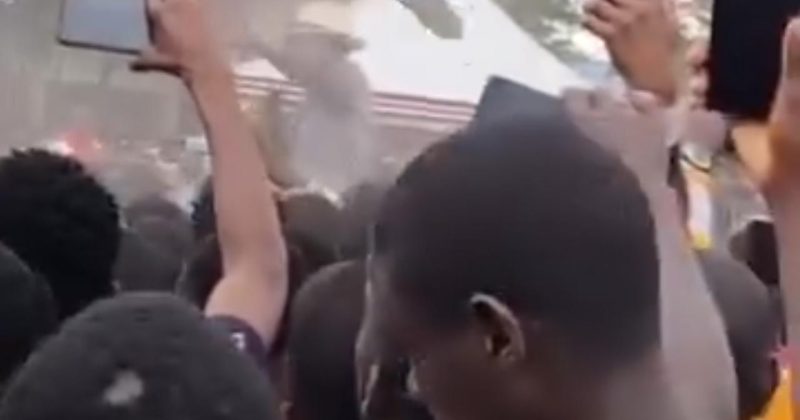
NAIROBI, Kenya, May 5 – A leading security expert has called for urgent reforms to professionalize Kenya’s VIP protection services following a security breach in Kehancha, Migori County, where a shoe was thrown at President William Ruto during a public rally.
George Musamali, a former police officer and security analyst, said the incident exposed glaring weaknesses in Kenya’s protective protocols and warned that the situation could have turned tragic.
“What happened was extremely dangerous. If a stampede had ensued, even the president could have been a victim,” Musamali told Capital News. “It could have been anything – not just a shoe. It could have been a projectile capable of causing serious harm.”
Musamali criticized the current VIP protection framework as outdated and lacking in professionalism, discipline, and coordination. He pointed to the chaotic transition between former President Uhuru Kenyatta and President Ruto as evidence of structural flaws in managing security handovers.
“We all saw how haphazard the handover was. It exposed gaps in how we manage transitions and VIP security,” he said.
To address the shortcomings, Musamali recommended structured training and induction for all officers deployed to guard elected officials, including MPs, governors, and the President. He also condemned the common practice of appointing personal allies as bodyguards, saying it undermines security effectiveness.
“Many leaders appoint close friends with no formal training. That compromises the entire security detail,” he noted.
While cautioning against blaming the Presidential Escort Unit (PEU) entirely, Musamali said some leaders override professional security advice for political optics.
“Sometimes the principal being protected can be overbearing,” he said. “Unlike in developed democracies where protection units enforce measures even against the protectee’s wishes, in African contexts such assertiveness is often discouraged.”
He also warned against politicians addressing crowds from vehicle rooftops, calling it a high-risk practice that limits reaction time for security officers.
“The team needs space between the principal and the crowd. That distance allows them to act swiftly if needed,” he said.
Musamali urged the adoption of global best practices, citing the U.S. Secret Service and South Africa’s Presidential Protection Service as models, and stressed the need for stronger coordination with intelligence agencies.
“Take the Meru incident where the President was heckled — that should have been anticipated and mitigated by intelligence teams,” he said.
The Kehancha scare is the latest in a series of breaches. During a recent tour of Nairobi, gangs used the disorder of a presidential visit to rob civilians, raising concerns about the PEU’s ability to secure both the President and the public. Last year in Kakamega, a man broke through a security cordon and attempted to reach President Ruto before being subdued—another close call that exposed gaps in planning.