MOMBASA, Kenya, Nov 24 — Pope Francis recalled seeing the devil in the choir area during Mass in a personal diary spanning more than three decades, one of two occasions on which the late pontiff said he saw the figure, according to excerpts published by the Vatican on Tuesday.
The revelations are contained in The Personal Diary of Pope Francis, a 160-page collection of writings covering the period between 1992 and 2024.
The entries offer an unusually intimate account of the late pontiff’s spiritual life, including his fears, moments of vulnerability and struggles during his 12-year papacy.
In one entry, Francis recalled seeing the devil from a car and, on another occasion, in the choir area during Mass.
He described the figure as having menacing eyes and wrote of feeling that it was lying in wait for him.
The diary also records another encounter in which Francis heard the devil’s voice, alongside a prolonged period of spiritual turmoil between 2021 and 2022, which he associated with illness and what he described as decisive assaults by the forces of evil.
“I clearly heard the voice of the devil,” he wrote.
In a 2016 reflection, he wrote: “If the devil is attacking so blatantly, it is because I do not have much time left and he wants his prey.”
Spiritual crisis
The entries reveal how Francis understood his struggles through the lens of Catholic spirituality, often interpreting difficult moments as a contest between good and evil.
The period coincided with the COVID-19 pandemic, which brought unprecedented disruption to daily life and left even the Vatican’s normally busy surroundings unusually deserted.
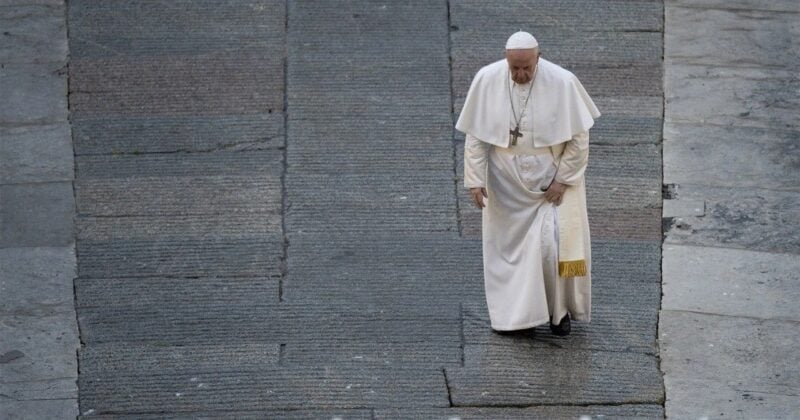
In March 2020, Francis delivered an extraordinary Urbi et Orbi (“to the City and to the World”) blessing in an almost empty St Peter’s Square, in one of the most striking images of his pontificate.
In his diary, the Pope described feeling vulnerable to temptation, including what he called “pagan seduction”, and recorded how prayer and devotion helped him resist.
Pope Francis frequently turned to the Rosary and the intercession of the Virgin Mary, the mother of Jesus Christ, whom Catholics honour as the Blessed Virgin and ask to intercede on their behalf.
“The Virgin saved me,” he wrote.
His diary also reveals the personal anxieties that accompanied his leadership of the Catholic Church. At various points, he expressed fear that he was unequal to the responsibilities of the papacy or might cause harm to others.
“I am afraid,” he wrote in one entry, even asking God to take him away.
The writings also capture moments of consolation. Reflecting on his relationship with Jesus, Francis wrote of feeling the merciful gaze of Christ and recalled that “He smiled” at him.
Personal struggle to spiritual renewal
The period of spiritual difficulty appears to have informed some of Francis’ later reflections on faith, suffering and divine love.
Two documents published during the final years of his pontificate were particularly connected to themes reflected in the diary, Cardinal Victor Manuel Fernández who put together the Pope’s writtings noted.
In 2023, he issued C’est la confiance, an apostolic exhortation marking the 150th anniversary of the birth of Saint Thérèse of Lisieux, whose spirituality emphasised trust in God’s love and mercy.
The following year, he published Dilexit nos, an encyclical on the human and divine love of Jesus Christ, expressed through devotion to his Sacred Heart.
The diary also reveals his devotion to Saint Joseph and Our Lady of Fatima, whom he continued to invoke during moments of personal difficulty. In one 2023 entry, he recorded turning to the Virgin Mary in prayer.
How the diary came to be
The collection was edited by Cardinal Fernández, Prefect of the Vatican’s Dicastery for the Doctrine of the Faith and a close associate of Francis.
Fernández recalled that the late Pope had shown him an old diary or planner at Casa Santa Marta, where Francis lived during his pontificate, and indicated that others would eventually decide what to do with the writings.
Following Francis’ death, Fernández sought the approval of his successor, Pope Leo XIV, before proceeding with publication.
The selection and preparation of the material took more than a year. The book is being released in five languages and distributed in 94 countries, with the English edition published by Penguin Random House in the United States and United Kingdom.
The publication offers a rare glimpse into the private reflections of a Pope, whose personal writings were not originally intended as a public account of his spiritual life.
The man behind the papacy
Born Jorge Mario Bergoglio in Buenos Aires, Argentina, on December 17, 1936, Francis was elected Pope on March 13, 2013, becoming the first pontiff from the Americas and the first Jesuit to lead the Catholic Church.
He chose the name Francis in honour of Saint Francis of Assisi, whose life was associated with simplicity, humility and concern for the poor.
During his 12-year pontificate, he repeatedly called for a Church that was more welcoming, attentive to people on the margins and engaged with the challenges facing the modern world.
His leadership was also marked by efforts to reform the Vatican administration, address clerical sexual abuse and encourage greater transparency and accountability within the Church.
Francis died on April 21, 2025, aged 88. He was succeeded by Leo XIV, who was elected on May 8, 2025.
Four encyclicals and a lasting legacy
Francis published four encyclicals during his pontificate, addressing faith, environmental protection, human fraternity and Christian spirituality.
His first, Lumen fidei (2013), explored the role of faith in Christian life. The document had been started by his predecessor, Pope Benedict XVI, and was completed by Francis.
In Laudato si’ (2015), he called for greater responsibility in protecting the environment, warning against the exploitation of natural resources and the disproportionate effects of environmental degradation on poor communities.
Fratelli tutti (2020) focused on human fraternity and social friendship, urging solidarity across religious, cultural and national divisions.
His final encyclical, Dilexit nos (2024), reflected on the love of Jesus Christ through devotion to the Sacred Heart.
Beyond the encyclicals, Francis issued several significant documents, including Evangelii gaudium, which set out his vision for evangelisation, and Praedicate Evangelium, which restructured the Roman Curia, the administrative institutions that assist the Pope in governing the Church.