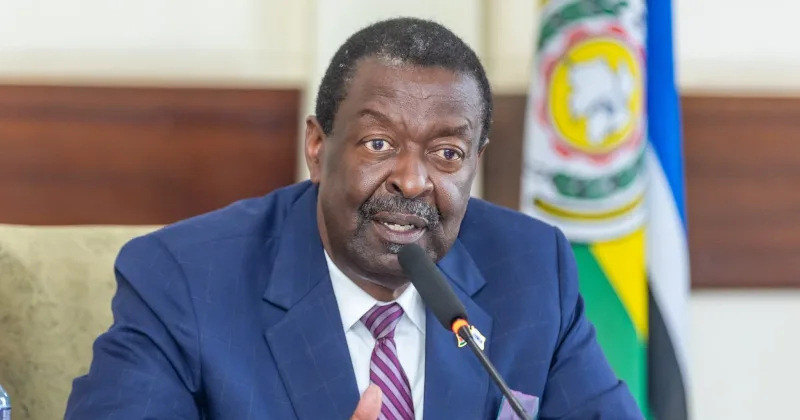
NAIROBI, Kenya Sep 4 – Prime Cabinet Secretary Musalia Mudavadi has called for deeper Kenya-South Korea cooperation in technology, innovation and investment, saying the two countries can transform their longstanding relationship into a partnership driven by shared economic opportunities rather than aid.
Mudavadi said Kenya and South Korea had travelled a journey of solidarity since Kenya’s independence and could now draw lessons from South Korea’s development experience to accelerate Kenya’s economic transformation.
“Kenya and South Korea have travelled the journey of solidarity together, from comparable economic beginnings at Kenya’s independence to a future where technology, innovation and investment, rather than aid, define our partnership,” Mudavadi said.
The Prime Cabinet Secretary and Cabinet Secretary for Foreign and Diaspora Affairs spoke during the Kenya-Korea Cultural and Networking Forum 2026 in Nairobi.
The forum was held under the theme “Bridging Horizons: Harnessing Kenya-Korea AI Innovations, Tech Transfer, and Cultural Synergies for Sustainable Development.”
Mudavadi said Kenya’s partnership with South Korea provides an opportunity to strengthen technology transfer, promote innovation, attract investment and expand trade and people-to-people ties.
Mudavadi said his participation in the forum followed his June 2026 visit to South Korea, where he attended the inaugural Korea-Africa Foreign Ministers’ Meeting in Seoul.
During the visit, Mudavadi joined other African foreign ministers for a courtesy call on South Korean President Lee Jae-Myung and held bilateral talks with South Korean Foreign Minister Cho Hyun.
The discussions focused on growing investment opportunities, including those linked to the presence of the Korea International Cooperation Agency (KOICA) and Korea Exim Bank in Nairobi.
Kenya also signed a host country arrangement with KOICA and Korea Exim Bank on the sidelines of the Korea-Africa Foreign Ministers’ Meeting.
Mudavadi described the agreement as an important milestone in strengthening Kenya’s partnership with the two Korean institutions.
The Prime Cabinet Secretary said the Kenya-Korea partnership had also contributed to the development of Kenya’s human capital.
More than 2,400 Kenyan public sector leaders, policy experts, technical specialists and corporate leaders have benefited from KOICA training programmes, he said.
The beneficiaries form part of the KOICA Alumni Kenya Chapter, which was established in 2008 under the patronage of KOICA and the Embassy of the Republic of Korea in Kenya.
Mudavadi urged members of the alumni network to use their expertise and connections to deepen Kenya-Korea relations.
“You are uniquely positioned to promote connections between public sector decision-makers, global tech innovators, and corporate leaders to foster technological transfer, cultural exchanges, trade and investment,” he said.
Technology and innovation featured prominently during the forum, with Mudavadi describing South Korea as Kenya’s leading partner in technology and the digital economy.
He cited South Korea’s investment in Konza Technopolis as a key area of cooperation between the two countries.
South Korea is also supporting the development of the Kenya Advanced Institute of Science and Technology (Kenya-AIST), which is modelled on the Korea Advanced Institute of Science and Technology (KAIST).
Mudavadi said the awarding of the Kenya-AIST University Charter in May 2026 marked a significant milestone for the institution.
He said increased investment in artificial intelligence, technology transfer and digital governance would strengthen Kenya’s position as a hub for digital and technological growth in Africa.
Mudavadi described Kenya as Africa’s “Silicon Savannah”, citing the country’s digital innovation ecosystem, fibre-optic networks and fintech sector, including M-Pesa.
Mudavadi also highlighted the role of cultural diplomacy in strengthening Kenya’s relationship with South Korea.
“Cultural diplomacy is the bedrock of Kenya’s foreign policy,” he said.
He said the integration of Korean heritage with Kenyan culinary and artistic expressions demonstrated how cultural exchanges can strengthen people-to-people ties while creating opportunities for wider economic and diplomatic cooperation.
Mudavadi described Kenya as a regional anchor and a reliable partner to South Korea and the international community.
“From the Silicon Savannah to Konza Technopolis and to our cultural synergies, Kenya and Korea continue to chart a future of shared prosperity,” he said.
He urged KOICA alumni to act as special envoys for Kenya-Korea relations by strengthening networks between the two countries.
Mudavadi said stronger networks would help advance technology transfer, trade, investment, cultural exchanges and other areas of mutual interest.
“Together, we must strengthen these networks and connections to advance shared opportunities and deepen sustainable prosperity for our peoples,” he said.