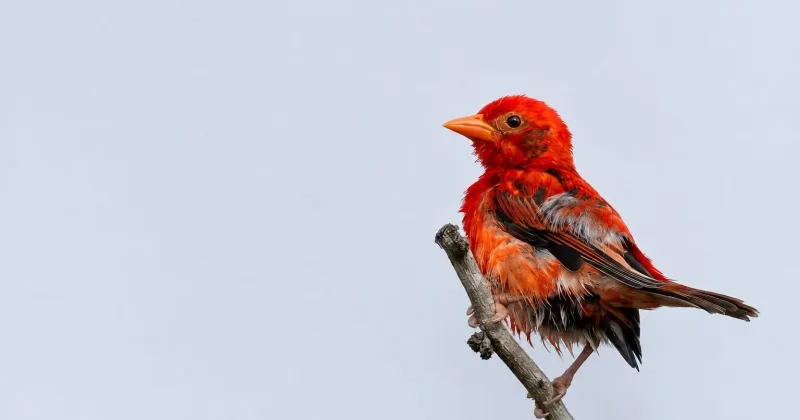
NAIROBI, Kenya, Aug. 4 – Two Kenyan birders have earned international recognition after rediscovering the elusive Red Weaver in Lamu County’s Boni-Dodori Forest, ending a 12-year search for a bird species that had not been recorded since 2014.
James Apolloh Omenya, a 29-year-old ornithologist, and bird photographer Simon Odhiambo spotted three male Red Weavers on July 3 during an expedition through the remote forest, the species’ only known habitat in the world.
The rediscovery came during an 11-day expedition supported by the 2026 Ornis Birding x Lost Birds Expedition Grants, an international initiative that funds young birders searching for species that have disappeared from scientific records.
The pair had travelled through some of Kenya’s most remote and security-sensitive areas near the Somalia border after months of planning and years of field experience.
“For almost two hours, three adult male Red Weavers played hide-and-seek with us through the bush while two females kept a careful distance. We photographed, filmed and recorded them,” Omenya said.
Odhiambo described the encounter as unforgettable.
“For the brief moment that the Red Weaver perched before us, we felt peaceful and secure. We were taking photos of this beautiful red bird, and it felt magical.”
Beyond confirming the species’ survival, the team documented what is believed to be the first modern evidence that the Red Weaver is breeding in the Boni-Dodori Forest after identifying a juvenile male among the birds.
The expedition also produced the first known sound recording of the species, providing scientists with valuable information about its vocalisations.
The Red Weaver had long been overlooked by science after being classified for decades as a subspecies of the Red-headed Weaver. It was only recognised as a distinct species in 2024 before being added to the global Lost Birds list in 2025.
The search relied heavily on local communities, conservationists and security agencies. Residents of Basuba and Mangai villages shared traditional ecological knowledge that helped guide the birders to the species’ habitat, while the Kenya Defence Forces provided security in areas affected by militant activity.
Following the rediscovery, residents of Mangai celebrated with the team, naming the bird “Shongwe Kudhude,” meaning “the weaver that is red in colour.”
The expedition also searched for another lost species, the Tana River Cisticola, which has not been reliably documented since it was first described in 1967. Although the team did not find the bird, they recorded six Tiny Cisticolas outside their previously known range, offering fresh insights into Kenya’s biodiversity.
Conservationists say the rediscovery highlights the ecological importance of the Boni-Dodori Forest and is expected to boost research, conservation efforts and birdwatching tourism in the region.
The Red Weaver is currently listed as Least Concern by the International Union for Conservation of Nature (IUCN), although scientists say little is known about its population size or breeding biology, making continued monitoring essential.