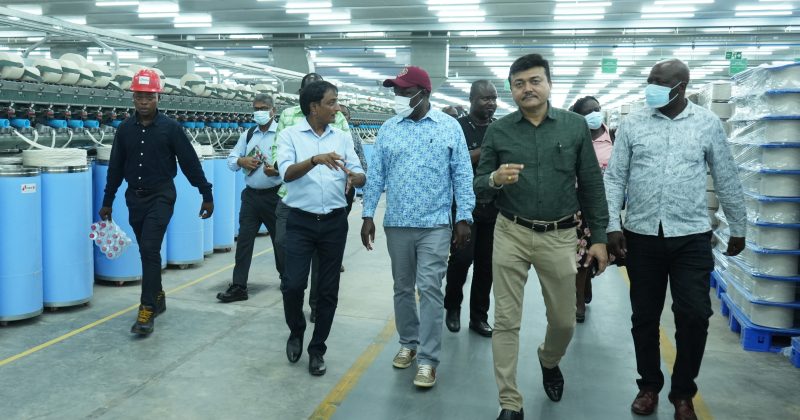
COTONOU, Benin, May 14 – The Kenyan government is stepping up efforts to revive the cotton, textile, and apparel industry as part of its broader push to grow manufacturing and create jobs under the Bottom-Up Economic Transformation Agenda.
Speaking during an official visit to Benin, Principal Secretary for Industrialization Dr. Juma Mukhwana said the sector is central to Kenya’s industrialization goals and job creation plans.
“The cotton textile and apparel sector in Kenya is a priority value chain for the Kenya Kwanza government,” said Dr. Mukhwana.
“Textiles have been identified as a key driver for economic growth and job creation.”
Dr. Mukhwana led a delegation drawn from the State Department for Industrialization and Rivatex East Africa Limited on a benchmarking mission in Benin, one of Africa’s leading cotton producers.
The visit follows a January 2025 Cabinet resolution to restructure Rivatex—a state-owned textile firm—by engaging strategic non-equity partners.
One of the firms being evaluated for partnership is ARISE Integrated Industrial Platforms (ARISE IIP), which develops and operates industrial parks and special economic zones across Africa.
Rivatex board chair Dr. Cleophas Lagat said the visit was part of due diligence on ARISE IIP, a finalist in the tender to lease the Eldoret-based textile firm.
“We came here to assess their capabilities and ensure they meet the tender requirements before any award is made,” said Dr. Lagat.
Benin’s cotton industry employs nearly 900,000 people and produced 553,000 tonnes in the 2023/24 season.
The government supports the sector with fertilizer and pesticide subsidies, while strong cooperation between farmers, ginneries, and government has helped streamline the value chain.
Dr. Mukhwana said Kenya is studying how to replicate Benin’s model of strong backward linkages between cotton farmers, ginneries, and manufacturers to reduce reliance on imports and add value locally.
Although Kenya benefits from the African Growth and Opportunity Act (AGOA) trade deal with the United States, local production capacity remains underutilized.
In 2022, apparel exports to the U.S. under AGOA hit $603 million—67.6 percent of Kenya’s total U.S. exports.
“Despite high demand for Rivatex products, nearly 40 EPZ-based textile factories still import raw materials that could be sourced locally,” said Dr. Mukhwana.
The government hopes the planned restructuring of Rivatex and strategic partnerships with experienced players like ARISE IIP will enhance Kenya’s competitiveness in the global textile market.