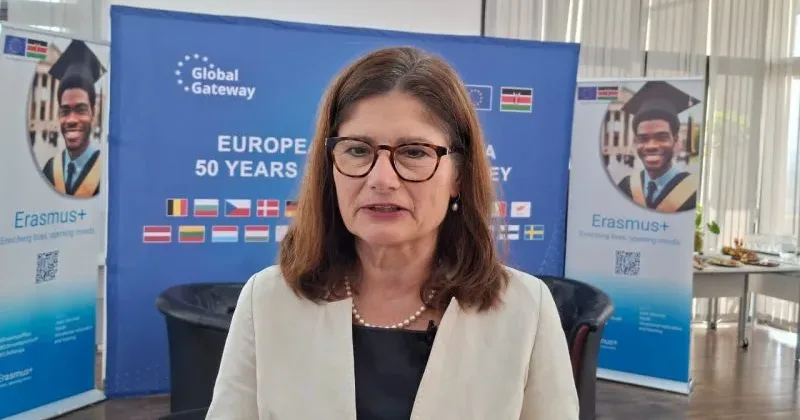
NAIROBI, Kenya, Jul 8 – Outgoing European Union Ambassador to Kenya Henriette Geiger says relations between Kenya and the European Union have reached their strongest level yet, citing deeper political cooperation, expanded trade, stronger global engagement and closer ties with Kenya’s youth as the defining legacy of her nearly five-year tenure.
Speaking during a farewell engagement with journalists ahead of her retirement, Geiger described her posting to Kenya as the highlight of her almost four decades in diplomacy, saying the relationship had evolved from one centred largely on development assistance into a comprehensive strategic partnership spanning trade, investment, security, climate action, innovation and global governance.
“This has been the best job I ever had. I felt so welcome, and I felt I could really make a difference,” she said.
Geiger, who arrived in Nairobi in August 2021 at the height of the COVID-19 pandemic, said one of the turning points in bilateral relations came after the 2022 General Election, when President William Ruto made Brussels one of his first international destinations.
She said the visit laid the foundation for a structured strategic dialogue that significantly broadened cooperation between Kenya and the EU.
“I think the relationship between the EU and Kenya has deepened and broadened very much during the past years,” she said.
Among the major achievements of her tenure, Geiger highlighted the conclusion and implementation of the Kenya-European Union Economic Partnership Agreement (EPA), saying bilateral trade has already grown by about 20 percent since the agreement entered into force.
She said both sides are now focused on doubling trade by promoting value addition and manufacturing rather than exporting raw commodities.
“We don’t just want to export raw products. We want to develop value chains,” she said.
Looking ahead, Geiger identified the digital economy as the next frontier of Kenya-EU cooperation, expressing optimism that an expected EU decision recognising Kenya’s data protection framework could unlock significant investment in business process outsourcing and digital services.
She said Kenya’s English-speaking workforce, favourable time zone and growing digital infrastructure position it to become a regional outsourcing hub capable of creating thousands of jobs for young people.
Geiger also praised Kenya’s growing influence in global diplomacy, saying the country has emerged as a leading African voice on climate action, multilateral reform and regional peace and security.
She particularly welcomed Kenya’s advocacy for reforms to global institutions and support for the African Continental Free Trade Area, describing a unified African market as “an incredible game changer.”
Beyond trade and diplomacy, Geiger said she deliberately invested in youth leadership, women’s empowerment and civil society through initiatives promoting girls’ leadership, political participation and the elimination of harmful practices such as female genital mutilation.
However, she warned that corruption remains Kenya’s greatest impediment to economic transformation.
“The biggest Achilles heel of Kenya is corruption,” she said, arguing that public officials implicated in graft should immediately lose their offices and privileges before facing prosecution.
Despite the challenges, Geiger said she leaves Kenya optimistic, citing its youthful population, expanding digital economy and growing international influence.
“There is no stopping Kenya. I’m fully convinced that in a few years Kenya will be even closer to realising its enormous potential.”