NAIROBI, Kenya, Aug 19 – KCB Group plans to raise up to Sh300 billion over five years through a Medium Term Note Programme to finance green, blue and social projects.
The programme, unveiled in Nairobi on Wednesday, will have an initial tranche of up to Sh100 billion and will be subject to regulatory approvals and market conditions.
The funds will support projects in renewable energy, green buildings, affordable housing, clean transportation, sustainable agriculture, water management and other eligible initiatives.
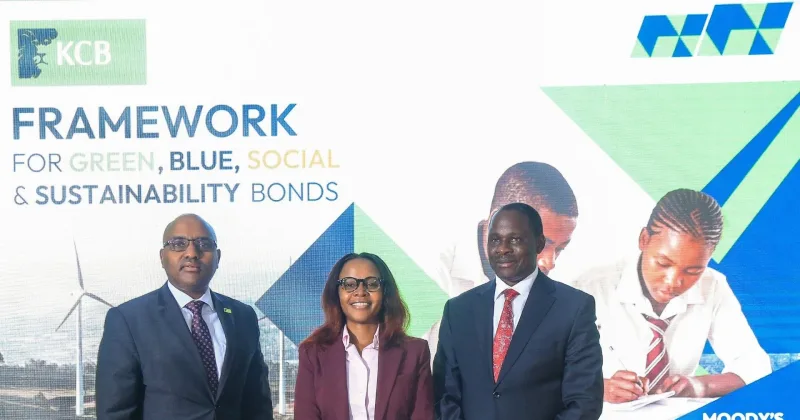
Speaking during the launch of the KCB Sustainability Bond Framework, KCB Group Chief Executive Officer Paul Russo said the framework would provide a platform for mobilising long-term capital for projects with environmental and social benefits.
“The framework we are launching today is designed to translate our long-standing sustainability ambition into a clear, credible and scalable capital mobilization platform. At its center is KCB Kenya’s intention, subject to the necessary regulatory approvals and market conditions, to establish a medium-term note program of up to Kenya shillings 300 billion over five years,” Russo said.
The framework will also cover blue economy activities, micro, small and medium enterprises, women and youth-led businesses, and initiatives supporting employment and livelihoods.
It provides for two financing approaches. Under the Use of Proceeds model, funds are allocated to eligible green, blue and social projects, while sustainability-linked bonds and loans are tied to sustainability performance targets without requiring proceeds to be earmarked for specific projects.
Russo said the framework would help direct capital towards projects that contribute to a more resilient and sustainable economy.
“More than anything else, we are celebrating an important milestone in our ambition to shape a financial system that does not only facilitate economic activity, but one that actively directs capital towards building a more inclusive, a more resilient, and a sustainable future of Africa,” he said.
The programme will allow proceeds to finance or refinance customer loans, project finance facilities, corporate loans, mortgage and real estate finance, investments and other qualifying activities.
Principal Secretary, State Department for Public Investments and Assets Cyrell Wagunda said sustainable financing instruments could widen the pool of capital available for infrastructure, enterprises, climate action and other development priorities.
“Today’s launch ceremony is far more than a tradition. It is a powerful testament of the continued diversification and transformation of Kenya’s sustainability financing. It equally reflects financial innovation and the growing sophistication of Kenya financial markets,” Wagunda said.
He said the instruments could attract capital while reducing reliance on traditional sources of development financing.
“More importantly, it affirms our ability to mobilize substantial green capital to finance critical national priorities, reducing over-reliance on traditional financing and strengthening Kenya’s economic resilience,” he said.
Blue economy included in financing framework
Principal Secretary, State Department for Blue Economy and Fisheries Betsy Njagi said the framework could channel capital into fisheries, aquaculture, maritime transport, shipping and logistics, ecotourism and blue carbon.
“The theme, from commitments to capital, accelerating sustainable finance in Kenya, is timely. Kenya has made strong commitment to sustainable development. Our task now is to translate these commitments into investments, job, enterprises, and measurable impact,” Njagi said.
She said the blue economy requires investment in infrastructure, technology and private-sector activities to unlock its potential.
“The blue economy offers significant opportunities in fisheries, aquaculture, maritime, shipping and logistics, ecotourism, blue carbon as mentioned, and other related value chains, including sustainable utilization of our EEZ. Realizing this potential requires capital, technology, infrastructure, and private sector investment,” she said.
The framework requires KCB to identify, evaluate and select eligible projects, as well as manage, track and report on the allocation of proceeds.
It has been developed in line with internationally recognised sustainable finance standards, including the International Capital Market Association’s Green Bond Principles, Social Bond Principles and Sustainability Bond Guidelines.
KCB said the framework received a Sustainability Quality Score of SQS 2, rated “Very Good,” from Moody’s. The assessment covers the framework’s approach to identifying and selecting eligible projects and its broader sustainability financing structure.
The framework also sets out environmental and social risk management requirements, with high-risk transactions subjected to enhanced due diligence and environmental and social considerations incorporated into credit appraisal and portfolio management.
In 2025, KCB said it screened approximately Sh587.78 billion worth of loan facilities for environmental and social risks across its regional operations.
The sustainability financing programme builds on work KCB says it began in 2008, when it formally adopted sustainability as part of its business model.
The bank said it has disbursed more than Sh187 billion in green loans since 2022.
In 2025 alone, it disbursed Sh48.8 billion in green financing across its regional markets to support renewable energy, sustainable agriculture, green buildings, clean transportation, water management and climate-smart investments.